
Search News
Industry Portal
Hot Articles
What to check before choosing an adaptive lighting control supplier
Time
Click Count
Meta Title: What to Check Before Choosing an Adaptive Lighting Control Supplier
Choosing an adaptive lighting control supplier is rarely a simple product comparison. The real decision sits deeper: will the system work with your building infrastructure, respond accurately in live conditions, stay manageable after handover, and still make sense when the site expands two or three years later? Many lighting projects look strong on paper and then become difficult in commissioning, unstable in operation, or expensive to maintain. For technical evaluators, the safest path is to check the supplier’s technical depth, protocol openness, software stability, sensor behavior, service model, and long-term upgrade logic before procurement starts.
In practice, the supplier matters as much as the hardware. Adaptive lighting is not just LED fixtures plus a few sensors. It is a control environment made up of devices, gateways, drivers, software, logic rules, field commissioning, and support response. If one part is weak, the whole “smart” layer becomes fragile.
A short answer first: the best supplier is usually the one that can prove interoperability, explain control logic clearly, support real commissioning conditions, and keep the system maintainable without locking you into a closed ecosystem.
Start with compatibility, not feature lists
A common mistake is to begin with functions such as daylight harvesting, occupancy sensing, scene scheduling, or tunable white. Those features matter, but they should not be the first filter. First ask whether the supplier’s system can fit your actual environment.
That means checking protocol support in concrete terms. Does the platform support the standards your project already uses or is likely to use, such as DALI, Zigbee, BACnet, Modbus, or other building management interfaces? “Supports integration” is too vague to accept in a technical review. Ask what is native, what requires a gateway, and what becomes custom engineering.
This matters even more in retrofit projects. In a new building, you may still have room to shape the architecture. In a hospital wing upgrade, logistics center relighting, campus renovation, or municipal smart streetlighting deployment, you are usually fitting into existing electrical layouts, network policies, and operations workflows. A supplier that only performs well in clean, greenfield projects may create unnecessary friction later.
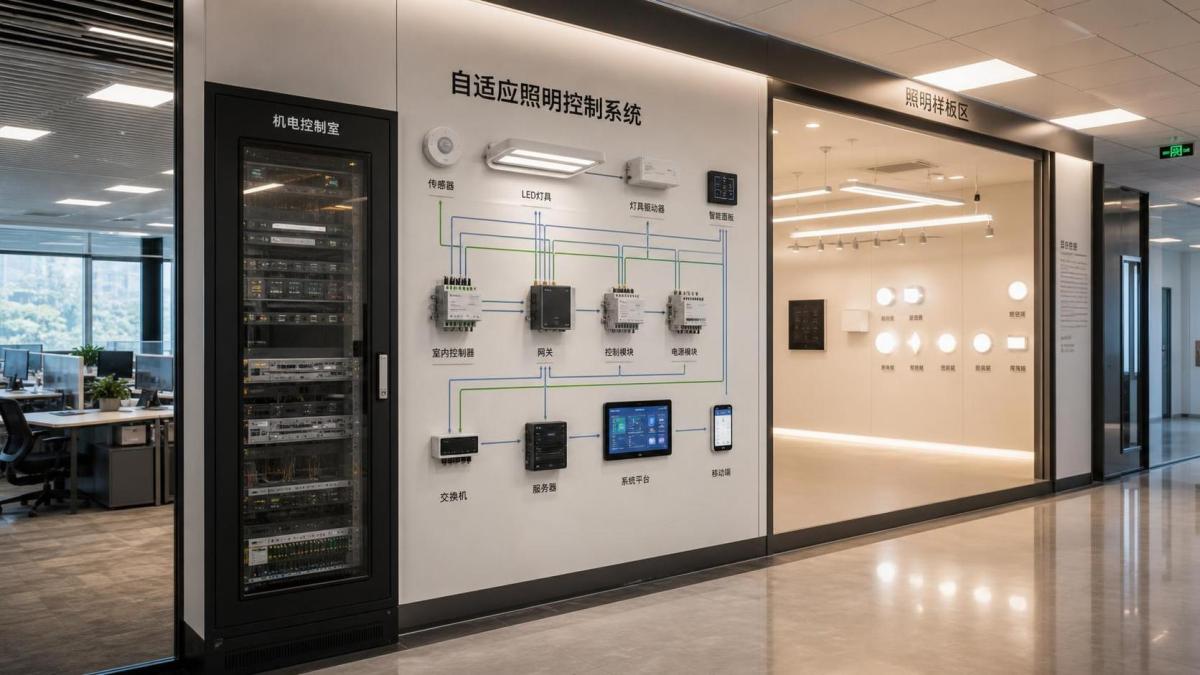
If the supplier cannot provide a clean system architecture diagram early, treat that as a warning sign.
What to verify from an adaptive lighting control supplier before shortlisting
Technical evaluators usually benefit from a simple shortlist test. Before you go into pricing or commercial terms, confirm whether the supplier can answer these points with evidence rather than slides:
- Supported control protocols and whether they are native or gateway-dependent
- Fixture, driver, sensor, and controller compatibility across brands
- Commissioning workflow: local, cloud-based, or hybrid
- Data ownership, export options, and cybersecurity practices
- Failure behavior when network, gateway, or cloud access is interrupted
- Firmware update method and rollback process
- Availability of local technical support during design and commissioning
That last point gets underestimated. Plenty of systems look capable until the first commissioning conflict appears: delayed sensor response, unstable zoning, false occupancy triggers, or daylight sensors overcorrecting because of window reflections. A supplier with weak field support can turn a technically valid design into a site problem.
Sensor quality is where many projects quietly fail
Adaptive lighting depends on sensing, so sensor quality should be reviewed as seriously as the luminaires themselves. Occupancy detection range, mounting sensitivity, daylight measurement logic, and calibration stability all affect whether the system feels intelligent or annoying.
On paper, two suppliers may both claim occupancy and daylight control. In operation, one may deliver smooth transitions and stable illuminance, while the other causes flicker-like dimming behavior, lights switching off too aggressively, or poor response in edge zones such as corridors, stair cores, loading bays, and high-rack aisles.
Ask how sensors are tested and calibrated. Ask what conditions affect performance: ceiling height, partition changes, skylights, reflective flooring, mixed daylight exposure, or irregular occupancy patterns. If the application includes warehouses, industrial workshops, parking structures, schools, or healthcare areas, response logic needs to be matched to the use case. A system tuned for offices does not automatically work well in an industrial environment.
It is also worth asking whether the supplier offers sensor placement guidance before installation. Good suppliers do not treat sensors as accessories. They treat them as part of the control design.
Software reliability matters more than a polished dashboard
Many evaluators get shown a clean interface and assume the software layer is mature. That is not enough. The real questions are operational.
How easy is it to commission hundreds or thousands of nodes? Can zones, groups, scenes, and schedules be modified without disrupting live operations? Is there a clear audit trail? Can fault data be exported? What permissions exist for facility teams, integrators, and external service partners?
The software should also match the reality of building operations. Some platforms are fine for demonstration spaces but become inefficient in multi-site portfolios. Others are strong for central monitoring but weak in local override logic. A technical evaluator should test whether the system supports both engineering needs and maintenance workflows.
If cloud dependency is high, ask what happens during connectivity loss. A capable adaptive lighting control supplier should explain which functions continue locally and which require cloud access. This is not just an IT question; it directly affects occupant experience and operational continuity.
Do not treat “open” and “scalable” as self-explanatory
These are two of the most overused words in lighting control discussions.
When a supplier says the platform is open, ask what that means in procurement terms. Can you source replacement devices from more than one channel? Can a third-party integrator work on the system without proprietary restrictions? Can you migrate data and settings if the service model changes? If every meaningful adjustment requires the original vendor, the system may be less open than advertised.
Scalability has the same issue. A system that works across one office floor may become difficult when extended across campuses, streetlighting networks, logistics parks, or mixed-use estates. Check addressing limits, gateway capacity, network segmentation, and license structure. Growth costs are often hidden in software tiers, added controllers, or custom integration work.
A reliable supplier should be able to explain where the platform scales cleanly and where additional planning is needed.
Look beyond energy savings claims
Energy reduction is usually part of the business case, but supplier selection should not rest on broad savings percentages unless they are tied to a verified use case. Occupancy patterns, baseline lighting design, daylight availability, runtime schedules, and local control strategy all influence results. Without project-specific assumptions, savings claims are only directional.
The better question is whether the supplier can help build a realistic performance model. That includes control sequences, fallback modes, commissioning assumptions, and measurement logic. In commercial and smart LED lighting projects, especially those connected to broader smart building programs, it helps if the supplier understands not just luminaires but the operational context around them.
This is one reason industry intelligence platforms such as SHSS are useful as a reference layer. Their coverage of smart lighting within a wider smart hardware and urban operations context can help evaluators compare suppliers more critically, especially when integration, lifecycle cost, and infrastructure fit matter more than marketing language.
Compliance, cybersecurity, and handover discipline
Lighting controls now sit closer to IT and building data environments than many procurement teams expect. Even if the system does not process sensitive personal data directly, it may still connect to enterprise networks, occupancy-based analytics, or centralized facility platforms.
Ask the supplier about cybersecurity documentation, access control, firmware governance, password policy, remote support method, and update responsibility after handover. If the system includes cloud services, confirm server region options, retention settings, and customer admin rights. Requirements vary by project and jurisdiction, so final verification should follow your internal IT and compliance rules.
Then look at documentation quality. Poor handover packages create years of avoidable maintenance cost. You want clear as-built control drawings, device lists, addressing records, logic descriptions, backup files, and recovery procedures. If the supplier is vague here, assume the maintenance burden will shift to your team.
Check the supplier’s commissioning model before you check price
This is where many decisions go off track. A lower equipment price can disappear quickly if commissioning is slow, support is remote-only, or the system needs repeated adjustment after occupancy.
Ask who owns commissioning: the manufacturer, an authorized partner, the electrical contractor, or a third-party integrator. Ask how issues are escalated. Ask whether functional testing is included and how tuning is handled after the building is occupied. Adaptive systems usually need refinement once real behavior starts.
For technical evaluators, that post-installation tuning period is often the difference between a successful project and a system users keep overriding manually.
When a supplier may be the wrong fit
Sometimes the system is not bad; it is simply wrong for the project.
If the building has limited technical support on site, a highly customized platform may create long-term friction. If the owner wants future flexibility across multiple brands, a tightly closed ecosystem may be a poor fit. If the project is small and operational needs are simple, a very advanced adaptive platform may add complexity without enough return.
Likewise, if the supplier is strong in office controls but has weak experience in industrial, municipal, education, or healthcare applications, take that gap seriously. Control logic is not one-size-fits-all.
A practical way to make the final decision
When you get down to two or three candidates, stop comparing brochure features and build a weighted review around operational risk. Most teams benefit from scoring five areas: interoperability, sensing performance, software maintainability, commissioning support, and lifecycle flexibility.
Then request proof. Not generic case studies, but project references that resemble your environment. Ask for sample documentation. Ask for a demo of fault handling, not just normal operation. Ask how the system behaves when a gateway fails or a zone needs reconfiguration after occupancy changes.
The best adaptive lighting control supplier is usually not the one with the longest feature list. It is the one that makes fewer assumptions, gives clearer technical answers, and leaves you with a system your operations team can actually live with.
FAQ
Should I prioritize protocol support or software usability?
Start with protocol support. If the system cannot fit your infrastructure and integration requirements, better software will not fix the structural problem.
Is a closed ecosystem always a bad choice?
Not always. It can work well when you want single-vendor accountability and have no need for broad future integration. It becomes risky when long-term flexibility is a priority.
How important is local commissioning support?
Very important for anything beyond a small, simple installation. Adaptive lighting often needs tuning in real site conditions, and remote support alone may not be enough.
Can I rely on vendor energy-saving claims?
Only as a starting point. Savings need to be tested against actual operating hours, occupancy patterns, daylight conditions, and control strategy.
Image Placeholder List
Suggested placement: After the shortlist verification section
Suggested image: A decision checklist or system architecture review visual for adaptive lighting control evaluation
Alt text: Technical checklist for selecting an adaptive lighting control supplier
Internal Link Anchor Text Suggestions
- smart lighting control protocol comparison: protocol guide or standards overview page
- DALI vs Zigbee for commercial lighting: technical comparison article
- how to evaluate smart building integration risk: integration planning page
- commercial LED lighting lifecycle cost factors: cost analysis article
- commissioning checklist for connected lighting systems: implementation guide
External Authoritative Source Suggestions
- Industry association guidance on lighting control standards and interoperability
- Government or public-sector building energy efficiency guidance pages
- Official technical documentation from major control protocol organizations or lighting component manufacturers
Recommended News