
Search News
Industry Portal
Hot Articles
How full spectrum LED grow lights affect indoor plant growth
Time
Click Count
How Full Spectrum LED Grow Lights Affect Indoor Plant Growth
Full spectrum LED grow lights can make a meaningful difference for indoor plants when natural daylight is weak, seasonal, blocked by windows, or simply unavailable where plants are placed. They can support leaf development, root growth, compact form, and, for suitable species, flowering or fruiting. Yet the light itself is only one part of the result. A high-quality fixture placed too far away, run for the wrong number of hours, or used with poor watering habits will not deliver the improvement many buyers expect.
For most houseplant owners, the practical value of a full spectrum grow light is consistency. It gives plants a more reliable source of usable light than a dim corner or a north-facing window, especially through shorter winter days. The goal is not to recreate outdoor sunlight perfectly. It is to provide enough useful light, at an appropriate distance and for a stable daily period, to match what a plant needs in its indoor environment.
What “full spectrum” changes for a plant
Plants do not respond to brightness in the same way people do. A room can look well lit while offering too little usable light for a plant to maintain healthy growth. Plant leaves use light energy for photosynthesis, and they also read light signals that influence leaf shape, stem length, flowering behavior, and daily rhythms.
Full spectrum LED grow lights are designed to provide a broader range of wavelengths than a single-color lamp. In practical consumer products, this often creates a light appearance closer to white daylight than the intensely purple glow associated with older red-and-blue grow lamps. The broader output can include wavelengths that help support photosynthesis alongside wavelengths involved in plant form and developmental signals.
This does not mean every full spectrum lamp performs equally. “Full spectrum” is a product description, not a guarantee that a light has sufficient intensity, useful coverage, reliable heat management, or appropriate output for every plant. A small clip-on light may be useful for one pothos or a few seedlings, while a shelf of herbs or a fruiting pepper plant requires substantially more usable light across a wider area.
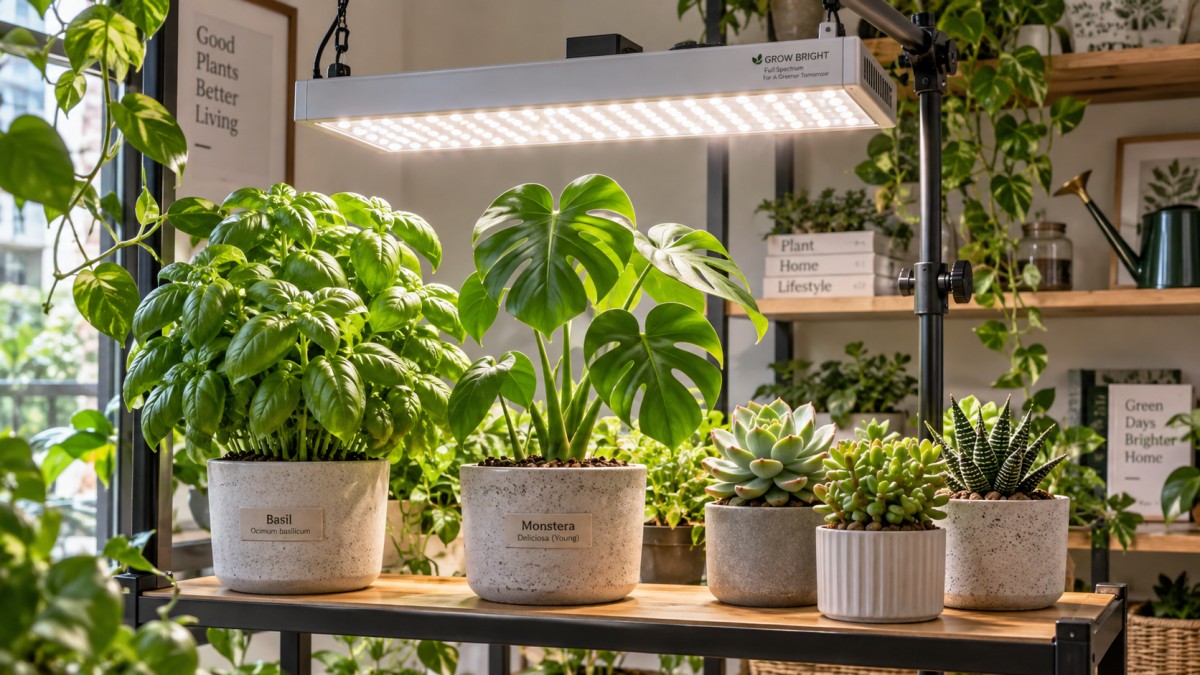
Growth improvements depend on the plant’s starting condition
When a light-starved plant receives an appropriate amount of supplemental light, the first visible change is often steadier new growth. Leaves may emerge more regularly, stems may become less stretched, and new foliage can develop with better size or color for that species. Plants that had been leaning strongly toward a window may also grow more evenly when the light source is positioned above them.
The response varies by plant type. Many foliage houseplants can remain healthy under moderate supplemental lighting, though their growth may stay slow. Herbs, succulents, cacti, seedlings, and flowering or fruiting plants generally demand stronger light. A light that keeps a peace lily alive may be far too weak to produce a compact basil plant or encourage blooms on a light-hungry flowering plant.
There is also a timing issue. A plant that has spent months in poor light may need time before it looks noticeably better. Existing stretched stems will not become shorter. Damaged leaves will not repair themselves. The benefit appears in the quality and pattern of new growth, provided watering, temperature, soil, and nutrition are also reasonably well managed.
Intensity and distance matter more than a broad-spectrum label
Indoor plant lighting often fails because the fixture is treated like ordinary room lighting. Ceiling lights are usually too far from the leaves, and decorative lamps can appear bright without delivering enough energy at plant level. Light intensity falls quickly as the fixture is moved away, so placement has a direct effect on growth.
Manufacturers may list wattage, lumens, color temperature, or a claimed coverage area. Those details can be useful, but they should not be read in isolation. Electrical wattage describes power consumption, not the amount of plant-useful light reaching the canopy. Lumens are weighted for human vision and can be misleading when comparing grow lights. A claimed coverage area is only meaningful when it states the hanging height and the plant type being considered.
For a consumer purchase, clearer signs of a usable product include a stated recommended hanging distance, a realistic coverage footprint, adjustable height or intensity, and information about how the fixture manages heat. A lamp should be close enough to serve the foliage but far enough to avoid heat stress or excessive intensity. The manufacturer’s guidance is a reasonable starting point; plant response should determine the final adjustment.
- Stretching stems, wide gaps between leaves, and growth leaning toward a window often suggest insufficient light.
- Pale new growth can indicate low light, but it can also result from nutrient, root, or watering problems.
- Bleached patches, crisp leaf areas facing the fixture, or leaves curling upward may indicate that the light is too intense or too close.
- Even, compact new growth is usually a better sign than rapid but thin, elongated growth.
Daily duration should match the plant, not run endlessly
More hours of artificial light do not automatically produce better plants. Plants need a predictable dark period for normal biological processes, and a lamp left on around the clock can create stress rather than solve a low-light problem.
A timer is one of the most useful accessories in an indoor growing setup because it removes inconsistency. Many common houseplants do well with a regular daily lighting window in the general range used for indoor cultivation, while high-light herbs, seedlings, and flowering plants may need a longer exposure. The appropriate duration depends on the intensity at leaf level: a weak lamp may need more time than a strong fixture, but extending the schedule cannot fully compensate for a severely underpowered light.
Begin with a moderate, repeatable schedule and observe new growth for several weeks. If the plant remains leggy or its growth stalls despite stable care, increase light intensity, reduce the distance to the canopy within safe limits, or extend the photoperiod gradually. Sudden major changes can be hard on plants already adapted to low indoor light.
Choosing a grow light by use case
The most sensible purchase begins with the plant and the growing area, rather than with the most powerful lamp available.
For a compact plant corner, controllability is often more valuable than raw output. Dimming, height adjustment, and a timer make it easier to adapt the light as plants grow or as seasonal daylight changes. For shelves and propagation racks, uniformity matters: plants at the outer edge should not receive dramatically less light than those directly beneath the fixture.
Common assumptions that lead to disappointing results
A full spectrum bulb can replace any window. It can supplement or, in the right setup, replace natural light for certain plants, but the fixture must provide adequate intensity and coverage. A small bulb in a distant floor lamp is unlikely to serve a large, high-light plant.
White light means it is suitable for growing. White light may be more comfortable in a living space, but visual appearance alone says little about output at the leaves. A suitable spectrum still needs enough intensity for the intended plant.
A stronger lamp is always better. Excess light can stress plants, particularly shade-adapted houseplants. It can also create heat buildup in a small enclosure. Match the fixture to the plant’s needs and keep the installation adjustable.
Grow lights solve every plant problem. Light affects how quickly a plant uses water and nutrients. After improving lighting, a plant may dry out faster and grow more actively, but overwatering, compacted soil, pests, cold drafts, and damaged roots can still limit the result.
Use the light as part of a stable care system
A full spectrum LED grow light is most effective when it creates a stable routine: consistent placement, a reliable timer, sensible distance from foliage, and periodic adjustments as the plant grows. Rotate pots only when needed for even exposure, keep leaves free of dust, and avoid letting one fixture cast strong light on a plant’s top leaves while the rest of the canopy remains shaded.
For indoor gardeners deciding whether a grow light is worthwhile, the answer is usually yes when natural light is clearly insufficient and the plant’s location cannot change. The right fixture will not turn every room into a greenhouse, but it can give plants the dependable light conditions that ordinary indoor spaces often lack. Choose for the plant’s actual light demand, watch the new growth rather than the marketing language, and make small adjustments before assuming the light is not working.
- Last One:No more articles
- Next Article:How to evaluate an industrial automation tools manufacturer’s cybersecuritySep 18, 2026
Recommended News