
Search News
Industry Portal
Hot Articles
How to choose cut-resistant apparel for sheet metal work
Time
Click Count
Sharp sheet metal edges can cause serious lacerations during cutting, handling, and assembly, making protective clothing a critical part of workplace risk control. Choosing cut resistant apparel for metalwork requires more than checking a fabric label: safety managers and quality control teams must consider the task, exposed body areas, fit, durability, and relevant cut-resistance standards. This guide explains how to assess these factors and select practical protection that supports both worker safety and production efficiency.
Start with the edge, not the garment
A flat sheet waiting to be loaded into a laser cutter presents a different exposure from a stamped bracket with burrs or a bin of narrow offcuts. Before comparing sleeves and aprons, follow the material through the job: unloading, cutting, deburring, stacking, assembly, inspection, and scrap removal. The most serious contact may occur between operations, when a worker turns a part or reaches into a container.
Note where the edge travels relative to the body and how much force could be involved. A worker carrying a large panel may hold it against the torso; another removing small blanks from a press may expose the wrist and forearm. Awkward posture, oily surfaces, limited visibility, and the need to handle several pieces at once can all make a slip harder to control.
Ask operators which movements make them adjust their grip or pull a sleeve back into place. Near misses and damaged clothing can reveal contact points that a walk-through misses. Record the material type and edge condition too: a cleanly cut edge, a sharp burr, and a jagged scrap edge do not behave identically against fabric.
Protective apparel belongs at the end of that assessment, not the beginning. Where practical, use handling aids, edge protection, deburring, guarded equipment, and better storage to reduce exposure. No garment makes it safe to catch a falling sheet or reach into an unguarded machine.
Match coverage to the way people handle metal
Gloves receive the most attention in sheet metal work, but cuts often occur where glove coverage ends. Sleeves are useful when forearms pass over sheet edges or reach into racks. An apron or protective jacket may be more appropriate when large panels are carried close to the body. For scrap handling or frequent contact with low bins, assess whether thighs and legs also need protection.
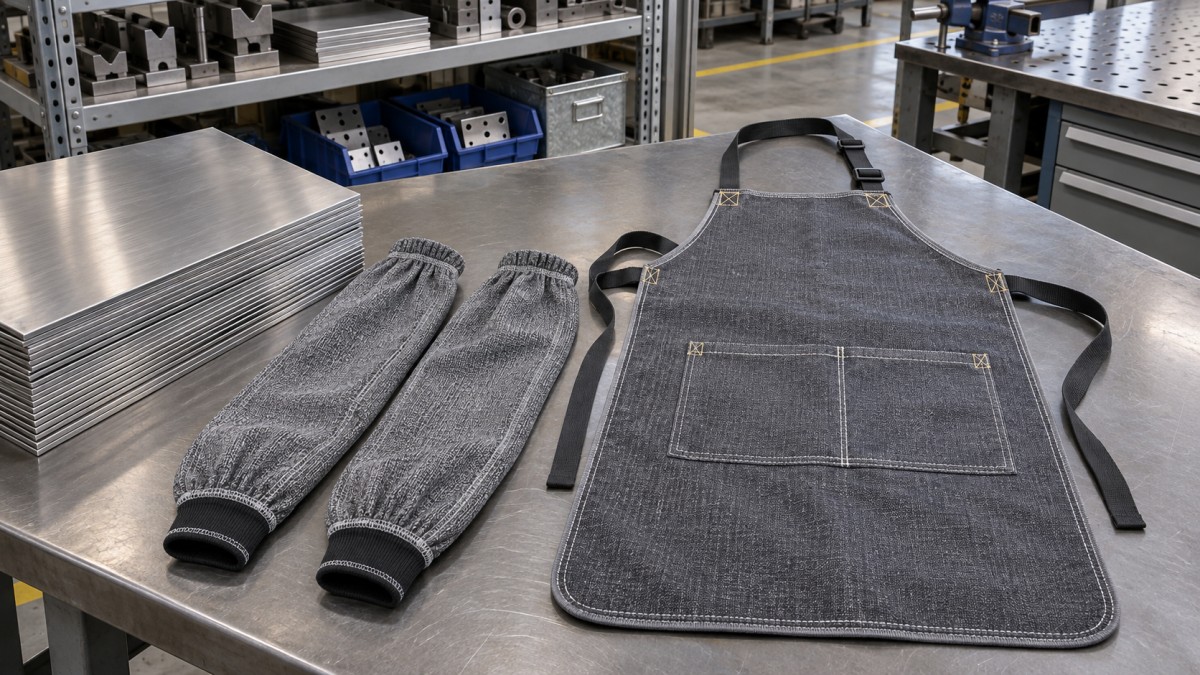
Coverage must remain in place during the actual movement. Have the wearer reach, lift, bend, and turn while wearing the intended gloves and clothing. Check the wrist overlap: a sleeve that looks long enough with the arm straight may expose skin when the worker reaches forward. Thumb openings or other retention features can help in some tasks, but they must fit properly and must not create a snagging hazard.
More fabric is not always better. Loose sleeves, hanging straps, and poorly secured aprons can catch on equipment or stock. Around rotating machinery, clothing selection must follow the machine-specific hazard assessment and operating instructions; a cut-resistant garment is not a substitute for guarding. If secure coverage cannot be achieved safely, change the handling method rather than relying on the worker to compensate.
Also check interfaces with safety footwear, protective eyewear, hearing protection, and any required respiratory protection. A garment that restricts movement or interferes with another control is unlikely to remain correctly worn throughout a shift.
Read cut-resistance claims with care
A cut rating is useful for screening materials, but it is not a prediction of whether a particular sheet edge will cut through a garment. Laboratory methods use defined blades and test conditions; actual exposures vary in edge geometry, force, direction, and contact with seams. Cut resistant apparel for metalwork should therefore be selected from documented task risk as well as test results.
In North America, suppliers may report ANSI/ISEA 105 cut levels using the ASTM F2992/F2992M test method. In the European market, EN 388 is commonly used for protective gloves against mechanical risks and includes cut-test reporting, with the EN ISO 13997 method used for the relevant letter-rated result. These are glove-related standards; do not assume that a sleeve, apron, or jacket is certified to a particular standard simply because its fabric carries a familiar cut-level claim.
The ANSI A1–A9 scale and the EN ISO 13997 A–F scale are not interchangeable labels. Ask which method was used, what was tested, and whether the result applies to the finished item or only to a fabric sample. Compare products using the same method wherever possible, and check the applicable edition and documentation for the market in which the PPE will be used.
A higher reported cut level may be justified where contact is more forceful or the consequences of a cut are greater. It can also mean a heavier or less flexible material, depending on construction. There is no universal level that makes every sheet metal task safe. Set a minimum through the site assessment, then check whether the garment provides usable coverage for the specific operation.
Cut resistance is not puncture, heat, or flame resistance
A sharp burr can concentrate force differently from a slicing edge. A cut-test result alone does not establish protection against puncture, abrasion, sparks, molten metal, or hot parts. Where grinding, welding, or thermal cutting occurs nearby, verify the garment’s suitability for those hazards separately. Some fibers or blends may melt, ignite, or lose performance under heat; a cut-resistant claim does not resolve that question.
The same caution applies to oils, cleaning agents, and coolants. Consult the manufacturer about chemical compatibility and care. If chemical splash is a credible exposure, assess it separately rather than assuming a metal-handling sleeve provides chemical protection.
Look beyond the fiber name
High-performance polyethylene, aramid, glass fiber, steel fiber, and blends can all appear in cut-resistant textiles. The fiber name alone does not tell you how the finished garment will perform. Yarn construction, fabric weight, layering, coatings, and garment design affect protection, comfort, and service life.
Examine the whole item, including stitching, closures, cuffs, and areas of frequent bending. A durable fabric panel offers limited value if an exposed seam opens or a cuff repeatedly rolls down. For an apron, check whether it stays in position when the wearer bends over a pallet. For a jacket, check whether sleeves remain seated when arms are raised. These details are easy to miss in a catalog comparison.
Comfort deserves a practical assessment, not a separate scorecard. A sleeve that traps heat, irritates skin, or restricts elbow movement may be pushed down during demanding work. Conversely, a very light garment should not be accepted merely because workers prefer it if it falls below the protection established for the task. The right decision balances both requirements rather than treating either as optional.
Run a controlled trial before specifying a site-wide purchase
A short, supervised workplace trial can reveal problems that specifications cannot. Select representative operations and several wearers with different sizes and roles. Use garments that already meet the site’s documented minimum requirements; a trial is not a reason to expose workers to known hazards or to test protection by deliberately cutting worn clothing.
Observe normal movements across the shift, including material changes and cleanup. Collect specific feedback: Does the sleeve migrate? Can the wearer handle a panel without changing grip? Does an apron interfere with reaching into a bin? Are cuffs or seams wearing against a particular workstation? Include supervisors and workers in reviewing the answers, not just the purchasing team.
For quality control, define acceptance criteria before comparing samples. Document the required coverage, sizes, test method and minimum result, garment construction, labeling, and care instructions. Ask suppliers for current technical documentation and clarify whether stated performance applies before or after laundering. Where certification is claimed, verify its scope and validity through the documentation supplied for the intended market.
Treat substitutions as changes, even when the replacement has the same advertised cut level. A different knit, cuff, or closure can alter fit and wear. Review the replacement against the original requirements and repeat the relevant workplace checks before approving it.
Plan for inspection, cleaning, and replacement
Cut-resistant clothing is consumable protection. Inspect it before use for cuts, holes, thinning, damaged seams, stretched cuffs, and contamination. Pay attention to the locations identified during the task assessment: forearms that rub against sheet edges, apron fronts that contact panels, and closures exposed to repeated strain.
Follow the manufacturer’s cleaning and drying instructions. Unapproved laundering, excessive heat, or unsuitable chemicals may affect materials or construction. If the supplier specifies a washing limit or an inspection criterion, include it in the site procedure. A garment that looks clean is not necessarily serviceable, and one visible cut may be enough to require removal from use.
Make replacement straightforward: provide access to the correct sizes, tell workers whom to notify, and keep damaged items out of circulation. Record recurring damage by task and location. If sleeves repeatedly fail at the same point, investigate the edge, handling method, workstation, and garment design rather than simply issuing more sleeves.
SHSS’s focus on protective equipment alongside industrial tools reflects a useful purchasing principle: evaluate PPE in the context of the work system. Before approval, put the proposed garment on the people who will use it, at the workstation where the exposure occurs, with the other required equipment in place. If coverage shifts or the task still requires uncontrolled contact with a sharp edge, revisit the process before placing the order.
Recommended News