
Search News
Industry Portal
Hot Articles
How DALI lighting specifications prevent incompatibility in retrofit projects
Time
Click Count
Retrofit Compatibility Is Decided Before Devices Reach the Site
Lighting retrofits often run into trouble after the luminaires, sensors, and controllers have already been ordered. The fixtures may power up, the DALI bus may appear healthy, and individual devices may even respond during a bench check. Yet groups fail to behave as intended, sensors cannot trigger the required scenes, emergency functions are isolated, or a replacement driver cannot be commissioned with the existing tool.
A well-written lighting specification DALI framework reduces those failures by treating interoperability as a defined project requirement rather than an assumed property of anything labelled “DALI.” For project managers, that distinction matters most in occupied buildings, phased renovations, and sites with a mixture of legacy controls and new LED equipment. The cost of an incompatible component is rarely limited to the component itself; it can include ceiling rework, access equipment, recommissioning, delayed handover, and operational disruption.
DALI can provide a strong basis for a retrofit, but only when the specification states which functions must work together, which device types are acceptable, and how that behavior will be proven before installation.
“DALI-Compatible” Does Not Define the Required System Behavior
DALI is a digital lighting-control protocol, but the label alone does not establish that every device will deliver the same function within a mixed installation. A conventional dimmable LED driver, a tunable-white driver, an occupancy sensor, a push-button coupler, and an application controller may all use DALI connections while supporting different commands, device types, configuration assumptions, or commissioning workflows.
This is where retrofit specifications often become too broad. A statement such as “provide DALI-compatible luminaires and controls” may be enough for a simple replacement project with local switching and dimming. It is not enough where the intended outcome includes automated daylight response, scene recall, tunable white control, central monitoring, emergency-light testing, or integration with a building-management platform.
The specification should begin with the operational result required in each area. For example:
- Open offices may require occupancy detection, daylight harvesting, user override, and separately controlled perimeter zones.
- Corridors may need preset light levels, timed response, and a clear treatment of emergency lighting.
- Teaching, meeting, or presentation spaces may require scene control that simultaneously manages luminaires, blinds, and local wall stations.
- Industrial or logistics areas may need robust local behavior even if a supervisory network connection is unavailable.
Once those outcomes are clear, the project team can specify the DALI functions and interfaces needed to achieve them. That sequence prevents a common procurement mistake: selecting low-cost components with a DALI interface, then discovering that the desired control strategy depends on features they do not support.
Define Device Roles, Not Just Product Categories
Retrofit projects commonly retain part of an existing lighting system. Existing luminaires may stay in place, some circuits may be rewired, and only selected areas may receive new sensors or controllers. In that environment, a schedule listing “drivers,” “sensors,” and “DALI control modules” leaves too much to interpretation.
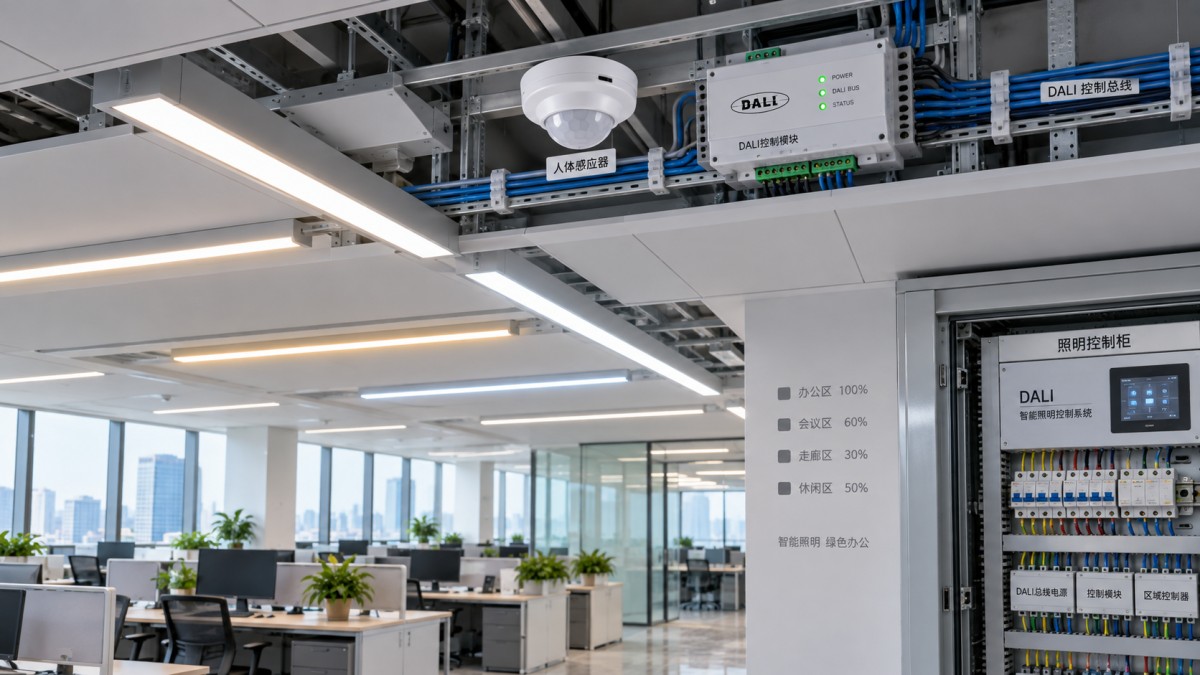
A practical specification identifies the role each device will play on the control system. It should distinguish at least between control gear, input devices, application controllers, and any gateway or supervisory interface. It should also say whether control intelligence sits in a central controller, in sensors, in luminaires, or across several devices.
This decision affects replacement flexibility later. If every sensor contains its own control logic, replacing a failed sensor may require restoration of settings and scenes. If the controller holds the configuration, the replacement process may be simpler, but the controller becomes a more critical point of dependency. Neither architecture is automatically better. The right choice depends on building operations, maintenance capability, and whether the project must be delivered in stages.
The device schedule should also state the required capabilities rather than relying on manufacturer-specific terminology. Useful requirements may include:
- Individual addressing and grouping capability.
- Required dimming range and behavior at low output.
- Support for the intended colour-control function where tunable or colour lighting is in scope.
- Input-device functions, including occupancy, daylight, manual control, or scene selection.
- Emergency-lighting monitoring or test functions where applicable.
- Required behavior after loss and restoration of power.
- Ability to be commissioned, replaced, and documented with the project’s chosen toolchain.
The purpose is not to prescribe every internal product design. It is to ensure that bidders price for a common functional baseline and that substitutions can be assessed against defined behavior.
Survey the Existing Installation Before Freezing the Design
Many compatibility problems originate in assumptions about the legacy installation. A building may have DALI-labelled wiring but no usable DALI topology for the new design. It may contain older control gear with limited functions, wiring shared with non-lighting services, inaccessible junctions, undocumented modifications, or a control panel that was never intended to support expansion.
A retrofit survey should establish more than fixture quantities. It should identify the installed control equipment, the condition and routing of the existing wiring, the location of circuits and panels, available bus capacity, the control zones that can realistically be retained, and any existing gateways or building-management interfaces. A sample audit of representative areas is often more valuable than relying on as-built drawings alone, particularly in older or repeatedly altered facilities.
Project teams should then classify areas by intervention level. A like-for-like luminaire replacement on a stable existing DALI line is a different technical task from converting a switched circuit into sensor-driven, addressable lighting. Treating both as the same “DALI retrofit” produces misleading budgets and schedules.
Where legacy equipment should be isolated
Retaining existing components can be sensible when their function is simple, documented, and compatible with the target control approach. It becomes a risk when an old controller, sensor, or gateway has proprietary configuration dependencies that constrain the new system. In those cases, retaining the physical wiring while replacing the control layer may be more predictable than trying to bridge incompatible generations of equipment.
The specification should identify whether legacy DALI devices are to remain, be tested for continued use, or be removed. Leaving that decision until site installation invites improvised workarounds that undermine the intended control strategy.
Addressing and Commissioning Need a Deliverable, Not an Allowance
DALI systems gain much of their value from addressable control, but commissioning is where that value can be lost. In a retrofit, devices can be installed in the wrong zone, addresses can be assigned inconsistently, sensors can be left with default behavior, and later changes can become difficult because no reliable record exists of what was commissioned.
The lighting specification should require a commissioning plan before installation is complete. That plan should define who assigns addresses, who creates groups and scenes, which commissioning software or interface will be used, how each space will be functionally tested, and what documentation will be handed over.
Commissioning also needs acceptance criteria that are observable on site. “System fully commissioned” is too vague. A stronger requirement describes the expected sequence: which luminaires respond to a sensor, whether manual override takes priority, how long a hold period lasts, how daylight dimming behaves, and what happens after a network or power interruption. This gives the contractor a clear target and gives the project manager a basis for sign-off.
Use Interoperability Testing Before Full Procurement
For a small, uncomplicated installation, product documentation and a competent installer may be sufficient. For larger or higher-risk retrofits, pre-installation testing is usually cheaper than resolving incompatibility across an occupied floor.
The test does not need to recreate the entire building. It should recreate the interfaces most likely to fail: selected luminaires and drivers, the proposed controller, representative sensors, wall controls, gateways, and the commissioning tool. The project team can then verify addressing, dimming, group behavior, scene recall, sensor response, power recovery, and any interface to another building system.
This approach is especially useful when the design combines products from several suppliers. Multi-vendor procurement can improve commercial flexibility and reduce dependency on a single manufacturer, but it shifts more responsibility onto the specification and verification process. The more distributed the responsibility for system behavior, the less prudent it is to rely on declarations of compatibility alone.
Testing should also cover substitutions. A contractor may propose an alternative driver or luminaire because of availability, lead time, or cost. Approval should depend on whether the substitute preserves the stated DALI functions and can be commissioned within the project architecture, not only whether it fits mechanically and produces a similar light output.
Write for Future Replacement, Not Only Initial Handover
A retrofit can meet its handover requirements and still create a maintenance problem if the installed system depends on a discontinued configuration tool, undocumented software access, or a narrowly proprietary controller. DALI specifications should therefore set a reasonable path for replacing common field devices without redesigning the installation.
That does not require a promise of unlimited interchangeability. Lighting performance, physical fit, electrical characteristics, and application-specific functions will always need review. It does require clear records, accessible configuration files, identified device roles, and a defined procedure for adding or replacing equipment.
For project managers, the most useful final question is straightforward: if a driver, sensor, or luminaire must be replaced several years after handover, can the facilities team identify the device, source an equivalent functional component, commission it, and restore the intended behavior without reopening the original design process? A lighting specification that can answer that question has done far more to prevent retrofit incompatibility than a generic requirement for DALI connectivity.
- Last One:No more articles
- Next Article:How full spectrum LED grow lights affect indoor plant growthSep 19, 2026
Recommended News