
Search News
Industry Portal
Hot Articles
What to verify before choosing a vertical farming LED lighting supplier
Time
Click Count
A vertical farming LED lighting supplier should be evaluated as a long-term production-system partner, not as a fixture vendor. The lowest quoted price can be misleading when spectrum data are incomplete, output degrades early, drivers cannot communicate with the farm controller, or replacement units are unavailable during a crop cycle. The relevant question is whether the supplier can document that its luminaires will deliver the required photons, uniformly and reliably, in the farm’s actual growing environment.
Before issuing a purchase order, verify performance claims against independent or reproducible evidence, examine the commercial terms behind the warranty, and test whether the supplier can support the project after shipment. A vertical farming LED lighting supplier that is suitable for a small pilot room is not automatically capable of supporting a multi-layer installation with tight energy, maintenance, and crop-consistency requirements.
Start with the crop recipe, not the fixture catalogue
Lighting specifications only become meaningful when linked to a defined crop and operating method. A supplier should be able to work from basic application inputs: crop species and cultivar, target photoperiod, desired daily light integral (DLI), growing area, rack geometry, mounting height, ambient temperature, humidity, irrigation arrangement, and whether the farm uses dimming or scheduled spectral changes.
Without those inputs, a proposal based only on fixture wattage or a generic “full-spectrum” label does not establish suitability. Plants respond to photon quantity, spectral distribution, timing, and uniformity. A fixture with a high power rating may still be a poor choice if it produces excess light in one band, insufficient photosynthetic photon flux density (PPFD) at canopy level, or unacceptable variation from the centre to the edge of a shelf.
The supplier should explain how its recommended fixture count and mounting layout achieve the required canopy-level result. Ask for a PPFD map for the proposed geometry rather than a single measurement directly below one luminaire. The map should state measurement height, fixture spacing, mounting distance, dimming level, and operating conditions. It should also distinguish between nominal output and the expected output after allowing for the actual installation arrangement.
For multi-tier farms, the physical envelope matters as much as photon output. Fixture depth, connector position, cable bend radius, driver location, clearance above the crop, and accessibility for cleaning can determine whether a theoretically sound lighting plan can be installed and maintained in a real rack system.
Verify photon performance with test conditions that can be inspected
Photosynthetic photon efficacy (PPE), generally expressed in micromoles per joule (µmol/J), is one of the most useful efficiency indicators for horticultural luminaires. It links electrical input to photosynthetically active photon output. But it should not be treated as a standalone buying criterion. A quoted PPE value has limited value unless the supplier identifies the test method, electrical conditions, spectrum, and fixture configuration used to obtain it.
Request the underlying photometric or horticultural test report for the exact model offered, including:
- photosynthetic photon flux (PPF), in µmol/s;
- input power and input voltage used during testing;
- spectral power distribution (SPD);
- photon efficacy;
- test laboratory identity and report date;
- fixture model, optical configuration, dimming setting, and driver version;
- ambient temperature and stabilization conditions where stated.
There is an important commercial distinction between a report for a component LED board and a report for the complete luminaire. The buyer needs data for the supplied product, including optics, driver losses, thermal effects, and the final housing. If a supplier presents high efficacy figures drawn from LED-chip literature or from a different fixture variant, those figures should not be used in energy modelling.
Spectrum also needs a more rigorous review than the common red-blue versus white-light comparison. Broad-spectrum fixtures may support crop inspection and working conditions better than narrow-band products, while targeted red, blue, far-red, or ultraviolet channels can be relevant to specific crop responses. That does not make adjustable-spectrum equipment automatically superior. Extra channels introduce more components, control requirements, calibration questions, and capital cost. The supplier should be able to state what each channel is intended to achieve and provide the photon output of each channel at the proposed operating setting.
Where far-red or UV is included, confirm how those wavelengths are measured, controlled, and represented in the supplied documentation. Standard photosynthetically active radiation metrics do not fully describe every plant-response consideration outside the conventional 400–700 nm range. A crop-specific recommendation should therefore be separated from broad efficacy claims.
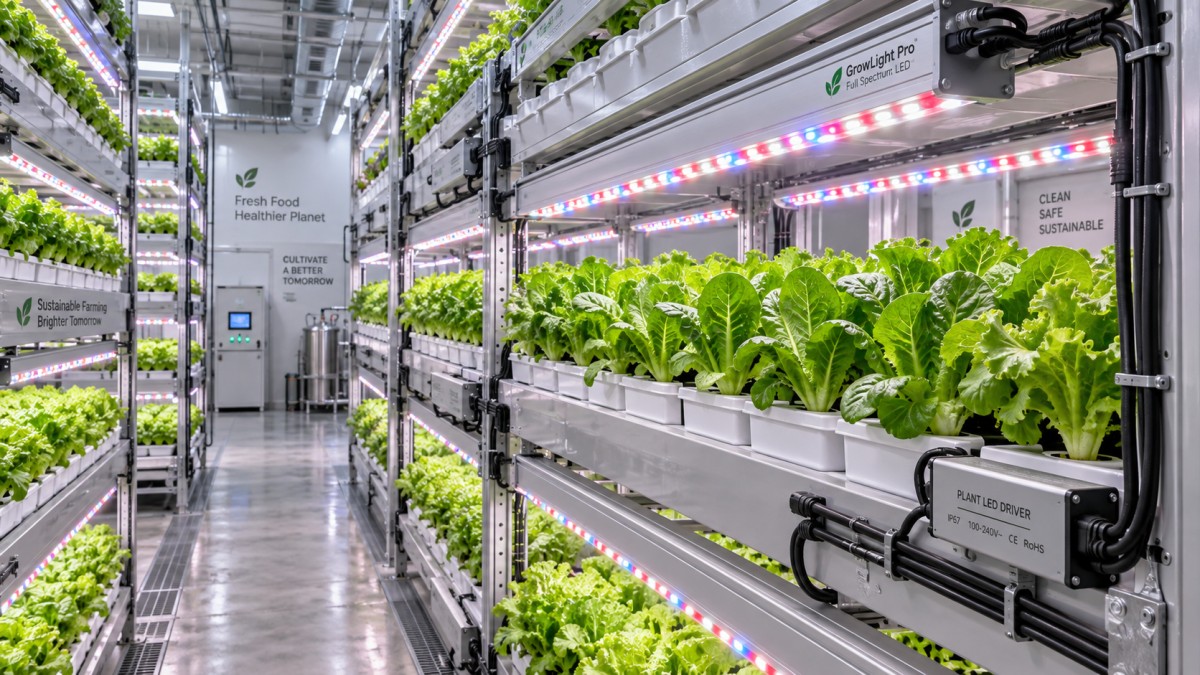
Uniformity is an operational issue, not a presentation detail
Plants at the edge of a tray do not experience the same conditions as plants directly beneath a fixture. Uneven PPFD can create uneven growth, inconsistent harvest timing, variable biomass, and avoidable adjustments to irrigation or nutrition. A supplier’s lighting layout should show the minimum, average, and maximum PPFD values across the usable canopy area, not merely a visually attractive simulation.
The correct uniformity target depends on crop density, shelf dimensions, and production tolerance. What matters during evaluation is whether the supplier defines the calculation area honestly. Including aisle space, structural gaps, or areas outside the actual crop footprint can make an average figure appear better than the crop receives.
Also check whether the proposed layout accounts for end effects. End-of-row fixtures, wall reflections, obstructions, fan locations, and rack posts can all affect delivered light. For large facilities, ask whether the lighting plan can be supplied in a format that the farm designer or electrical contractor can audit, rather than only as a static sales drawing.
Examine thermal design in the conditions the farm will create
LEDs convert much of their electrical input into heat, even though they are more efficient than legacy lighting technologies. In a vertical farm, that heat is released close to the crop and inside a conditioned building. It affects HVAC sizing, dehumidification demand, canopy temperature, driver reliability, and the practical distance between fixture and plants.
Ask where heat is dissipated and whether the fixture relies on passive cooling, active fans, or remote-mounted drivers. Passive designs avoid fan maintenance and may reduce points of failure, but they still require adequate airflow around the heat sink. Fan-cooled products need a clear cleaning and replacement strategy in an environment where dust, humidity, and plant debris can accumulate.
Driver placement deserves separate attention. An integrated driver simplifies installation but exposes electronics to heat and moisture near the canopy. A remotely mounted driver can reduce heat above the crop and may simplify replacement, but it adds cabling, voltage-drop considerations, and enclosure requirements. Neither approach is universally better; the decision depends on rack design, service access, ambient conditions, and local electrical rules.
Do not accept lifetime claims without understanding their basis. Statements such as L90 or L80 describe projected lumen maintenance, but horticultural operations need to know the expected retention of photon output, not only visible-light output. The supplier should identify the stated lifetime metric, the operating temperature, the drive current, and whether the claim applies to LEDs alone or to the assembled luminaire. Drivers, connectors, seals, and power supplies can fail before LED output degradation becomes the limiting issue.
Check environmental protection and cleanability
Vertical farms combine electrical equipment with humidity, condensate risk, water lines, nutrient solutions, cleaning procedures, and confined installation spaces. The required ingress protection rating depends on where the fixture is mounted and how the facility is cleaned. An IP rating should be reviewed alongside the actual cleaning method; it is not a blanket declaration that the product is suitable for high-pressure washdown or chemical exposure.
For products carrying an IP classification, ask which standard was used and whether the rating applies to the complete assembled luminaire, including cable entries and connectors. IEC 60529 is the commonly referenced standard for IP codes, but the installed system can lose its intended protection if connectors, glands, field splices, or junction boxes are unsuitable.
Material selection is equally relevant. Check whether housings, fasteners, lens materials, gaskets, and cable jackets are compatible with the farm’s cleaning agents and humidity level. A fixture that performs well in a dry indoor test environment may deteriorate more quickly if seals are attacked by chemicals or if metallic components corrode under persistent condensation.
Cleanability affects output over time. Fins, exposed fasteners, deep recesses, and complex lens profiles can collect dust and residues. Suppliers should provide cleaning instructions, permitted agents, and any limitation on spraying, wiping, or disassembly. If the fixture must be removed from the rack to clean it safely, that labour requirement should be reflected in the total cost assessment.
Confirm controls, electrical interfaces, and data ownership before integration
Dimming control can materially affect energy consumption, heat load, and the ability to maintain a crop recipe as natural-light contributions or production schedules change. Yet control compatibility is a frequent source of project delay because the lighting supplier, farm-automation vendor, and electrical contractor may each assume that another party will solve the interface.
Establish the required control architecture early. Common options include 0–10 V, DALI, PWM-based systems, proprietary wired protocols, and wireless systems. The presence of a dimming port does not guarantee interoperability. Verify voltage ranges, addressing limits, maximum devices per control line, gateway requirements, failure behaviour, commissioning tools, and whether the supplier’s controls can operate with the selected environmental controller.
A useful question is what happens when communications fail. Some systems hold the last dimming level; others revert to full output, turn off, or require manual reset. The preferred response depends on crop risk, energy constraints, and the farm’s backup-power strategy. This should be documented rather than inferred from a brochure.
For networked luminaires, clarify access rights and software obligations. Determine whether configuration software requires a paid subscription, whether data can be exported, whether cloud connectivity is mandatory, and whether the farm can continue operating if the supplier changes its platform. Proprietary controls are not inherently unsuitable, but their commercial dependency should be visible before installation.
Review certifications as market-access and risk documents
Certifications should match the destination market and the installation environment. A CE mark, for example, is not a universal safety certificate; it is a manufacturer declaration associated with applicable European requirements. In North America, an NRTL listing such as UL or ETL may be requested by authorities having jurisdiction or insurers, depending on the project. For horticultural lighting, UL 8800 is a relevant safety standard in the United States, while other installations may involve additional requirements for luminaires, drivers, wiring methods, electromagnetic compatibility, and local electrical codes.
Ask for the certificate number, issuing body, scope, and exact product model. Confirm that the listed model includes the offered driver, cable, plug, and control configuration. A certificate for a related family does not automatically cover every variation. For export projects, verify plug type, input voltage and frequency range, labeling language, documentation requirements, and any country-specific electrical approvals before production begins.
Photobiological safety may also require review where workers can be exposed to intense or specialized spectra. IEC 62471 is commonly referenced for photobiological safety assessment of lamps and lamp systems. Its relevance and the required documentation depend on the product design and local compliance framework.
Read the warranty as a service commitment, not a headline duration
A five-year warranty can have very different value depending on exclusions, labour coverage, claim thresholds, and the supplier’s ability to provide replacement stock. Obtain the full warranty document before comparing offers. It should specify the covered components, acceptable output depreciation, operating-temperature limits, installation conditions, exclusions for water ingress or power quality, claim process, and remedy offered.
Distinguish between a promise to repair a failed unit and a commitment to supply a replacement quickly enough to protect production. In a dense multi-layer farm, replacing a fixture may require crop movement, access equipment, and production interruption. A low fixture failure rate can still be costly if every replacement requires extended diagnosis or international return shipping.
For projects with long operating horizons, clarify whether the supplier will maintain spare parts, compatible drivers, control modules, and replacement fixtures after a model is discontinued. A written spare-parts schedule or agreed buffer-stock arrangement can be more valuable than an extended warranty with vague fulfillment terms.
Test the supplier’s delivery discipline before committing at scale
Technical documentation cannot compensate for weak manufacturing control. Supplier qualification should cover production capacity, quality inspection, component traceability, packaging design, export documentation, and the ability to manage design changes. This is especially important when the project depends on fixtures being electrically and optically consistent across multiple production batches.
Ask whether critical components such as LEDs, drivers, lenses, and connectors are sourced from approved alternatives, and whether substitutions trigger a new performance review. A component substitution can alter spectrum, efficacy, dimming behaviour, electromagnetic compatibility, or thermal performance. The purchase agreement should state that changes affecting agreed specifications require notification and approval.
Before full deployment, a pilot order or pre-shipment sample can validate installation fit, connector compatibility, dimming response, heat behaviour, and crop-area uniformity. The sample should be representative of production equipment, not a separately optimized demonstration unit. If factory inspection is used, inspection criteria should include model identification, quantity, workmanship, electrical function, dimming function, labeling, packaging, and any agreed output-verification process.
The strongest selection decision is built from evidence that connects crop requirements to fixture performance, fixture performance to installed conditions, and warranty language to practical service capability. Price remains relevant, but it should be compared against usable photon output, energy demand, expected maintenance burden, integration risk, and replacement support. That approach turns a vertical farming LED lighting supplier evaluation from a catalogue comparison into a controlled assessment of production risk.
- Last One:No more articles
- Next Article:How torque control prevents joint failure in industrial fastening systemsSep 29, 2026
Recommended News