
Search News
Industry Portal
Hot Articles
How to choose filters for reusable full-face respirators
Time
Click Count
Choose filters for reusable full-face respirators by identifying the contaminants and their concentrations first, then matching the required particulate filter, gas and vapor cartridge, or combination unit to the specific respirator. Check exposure limits, the respirator’s permitted use, certification, fit and a defensible replacement schedule before approving the selection.
A cartridge chosen for a dusty grinding task may offer no protection against solvent vapor released during cleaning. Similarly, a cartridge marked for organic vapors may not capture welding fume unless it includes an appropriate particulate filter. Those distinctions matter when one facepiece is used across several jobs or when a process changes during a shift.
Start with the exposure, not the cartridge color
List the substances workers may inhale during each task, including preparation, normal operation, cleanup and foreseeable process upsets. Review safety data sheets, process records and exposure monitoring where available. Identify the chemical and its physical form: airborne particles, gas, vapor or a mixture. A material’s name alone may not describe what is in the air after it is heated, sprayed or mechanically worked.
For each contaminant, determine the expected concentration and applicable occupational exposure limit, including any short-term or ceiling limit. Compare those findings with the protection the selected respirator can provide under the applicable program and local rules. Use representative measurements and account for variations in task duration, ventilation and work location; a typical reading from a different operation is not a reliable substitute.
Do not select an air-purifying filter when the atmosphere is unknown, oxygen-deficient, immediately dangerous to life or health, or otherwise outside the respirator’s approved conditions. Leave the area and use the emergency procedures and respiratory protection appropriate to the hazard. An air-purifying respirator does not supply oxygen.
Match the filter type to the airborne hazard
For example, sanding a dry coating may generate particulate, while spraying a solvent-containing coating can produce both airborne droplets and solvent vapor. The latter cannot be addressed by selecting a particulate filter alone. Equally, the solvent cartridge must be suitable for the specific chemicals involved; “paint” is not a sufficiently precise selection category.
Some contaminants require special consideration or are poorly suited to ordinary cartridge selection. Review the cartridge manufacturer’s approval, limitations and chemical-specific guidance rather than assuming that a broad label covers every substance in a mixture. When the exposure cannot be identified or controlled within the equipment’s limits, stop the selection process and reassess the work and respiratory protection method.
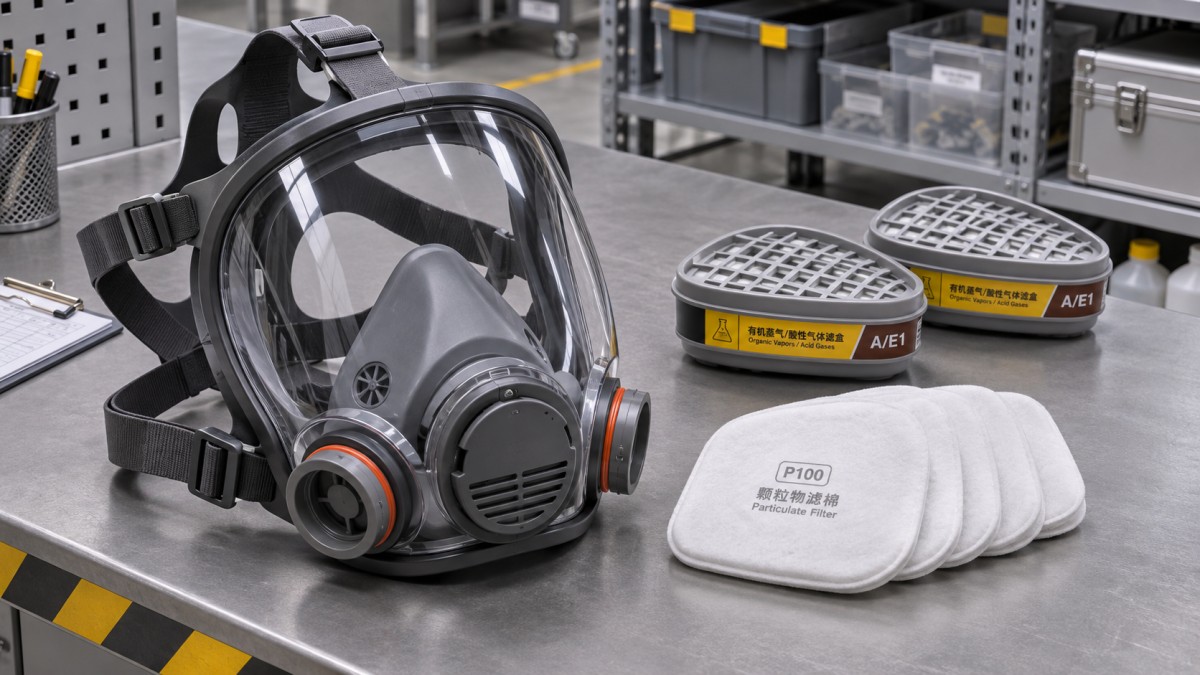
Read particulate classifications in their own context
Particulate filters are classified under different regional systems. In the United States, NIOSH classifications include N, R and P series with efficiency levels such as 95, 99 and 100. The letter relates to oil resistance; it is not a gas or vapor designation. Elsewhere, EN particulate classifications such as P1, P2 and P3 use a different system. Do not treat these markings as interchangeable without checking the applicable approval and selection requirements.
Higher filtration efficiency does not, by itself, establish that the complete respirator is suitable for a job. The facepiece, filter, concentration and permitted use all matter. Follow the manufacturer’s instructions and applicable rules for oil aerosols, filter use and replacement.
Check the cartridge’s chemical coverage
Gas and vapor cartridges use sorbents selected for particular contaminant types. Organic vapor, acid gas, ammonia and other designations are not interchangeable. A combination cartridge may cover several classes, but only as stated in its approval and instructions. Check the actual chemical identity, concentration and any restrictions; do not infer coverage from color alone, especially when comparing products approved under different systems.
For mixtures, assess each relevant component. Cartridge service life can be affected by competing chemicals as well as concentration, humidity, temperature, breathing rate and work pattern. If reliable service-life information is unavailable for the mixture, the answer is not to extend use until someone notices an odor; obtain suitable guidance or select another protective approach.
Verify the complete assembly before ordering
A filter that attaches physically is not automatically approved for the facepiece. Check the exact manufacturer, model and configuration against the approval or certification documentation and instructions. This includes adapters, retainers, prefilters and the number of cartridges required. Avoid mixing components from different manufacturers unless that exact combination is expressly approved.
Record the relevant part numbers rather than purchasing only by a generic description such as “full-face organic vapor cartridge.” Similar-looking parts can have different coverage, connections or use limitations. Confirm shelf life, storage requirements and packaging integrity when stock arrives, and keep the instructions accessible to the people issuing and using the equipment.
The full-facepiece must also be suitable for the wearer and task. A tight-fitting respirator requires the applicable fit-testing process and a user seal check each time it is donned. Facial hair or other interference at the sealing surface can prevent a seal. Corrective eyewear, helmets and other equipment should be assessed for interference; ordinary spectacle temples passing through the face seal can compromise protection.
Set replacement rules before the first shift
Particulate filters and gas or vapor cartridges reach the end of useful service in different ways. A particulate filter may need replacement when it is damaged, contaminated, difficult to breathe through or otherwise due under the manufacturer’s instructions and workplace program. Increased breathing resistance can signal loading, but waiting for severe resistance is not a substitute for inspection and task-specific rules.
Gas and vapor cartridges can allow contaminant breakthrough without an obvious change in breathing resistance. Establish a change schedule based on objective information, such as the manufacturer’s service-life guidance or a suitable calculation using the actual conditions. An end-of-service-life indicator may be used where it is approved and appropriate for the contaminant and conditions. Follow applicable regulatory requirements for the method chosen.
Do not rely on smell, taste or irritation as the normal change-out schedule. Warning properties vary, and a worker may detect a substance only after an unacceptable exposure. If a user detects a contaminant, experiences irritation or suspects a failure, they should leave the contaminated area promptly and follow the workplace response procedure. Investigate the cause before returning.
Write the schedule in terms workers can apply: the cartridge part number, covered task, maximum permitted use period under the established schedule, and the event that triggers earlier replacement. Account for intermittent use and storage between shifts according to manufacturer guidance; unused clock time does not automatically mean a previously opened cartridge retains its original service life.
Test the decision against the actual job
Before issuing the equipment, compare the proposed assembly with the work as performed rather than only with the task description. These checks often expose gaps in an otherwise plausible selection:
- Changing tasks: Does the worker move from dry cutting to solvent cleaning? A particulate-only setup may need to be replaced with an approved combination suitable for the second exposure before that work begins.
- Peak exposure: Are monitoring results representative of mixing, spraying, confined locations and short-duration peaks, not just routine background conditions?
- Fit and movement: Can the wearer maintain a seal while bending, looking down or using other required protective equipment?
- Heat and workload: Can the worker perform the task with the selected equipment, including its breathing resistance and visibility limitations? Discomfort should prompt assessment, not removal of the respirator in the hazard area.
- Stock control: Can the issue point distinguish compatible cartridges from visually similar items, and prevent expired or damaged stock from being used?
Controls such as substitution, enclosure and ventilation should also be considered; a respirator selection does not eliminate the need to reduce exposure at its source. If the assessment shows concentrations beyond the respirator’s permitted range, or the task conditions cannot support a reliable seal, reconsider the work controls and type of respiratory protection rather than simply choosing a different filter.
Keep the selection traceable as conditions change
Maintain a record linking each task to its contaminants, exposure assessment, selected facepiece and filter part numbers, approval checks and change schedule. Include the assumptions used, such as ventilation operating normally or a maximum task duration. This gives supervisors a way to spot when a change in process invalidates the original choice.
Review the decision when chemicals, application methods, production rates, ventilation, measured exposures or equipment models change. A new coating with a different solvent, for instance, may require a different cartridge assessment even if the spraying procedure looks unchanged. Where information is incomplete or the exposure is complex, pause the selection and obtain competent occupational hygiene and manufacturer input before authorizing use.
Recommended News