
Search News
Industry Portal
Hot Articles
Respiratory Protective Equipment EN Standards Explained
Time
Click Count
Why do respiratory protective equipment EN standards matter so much?
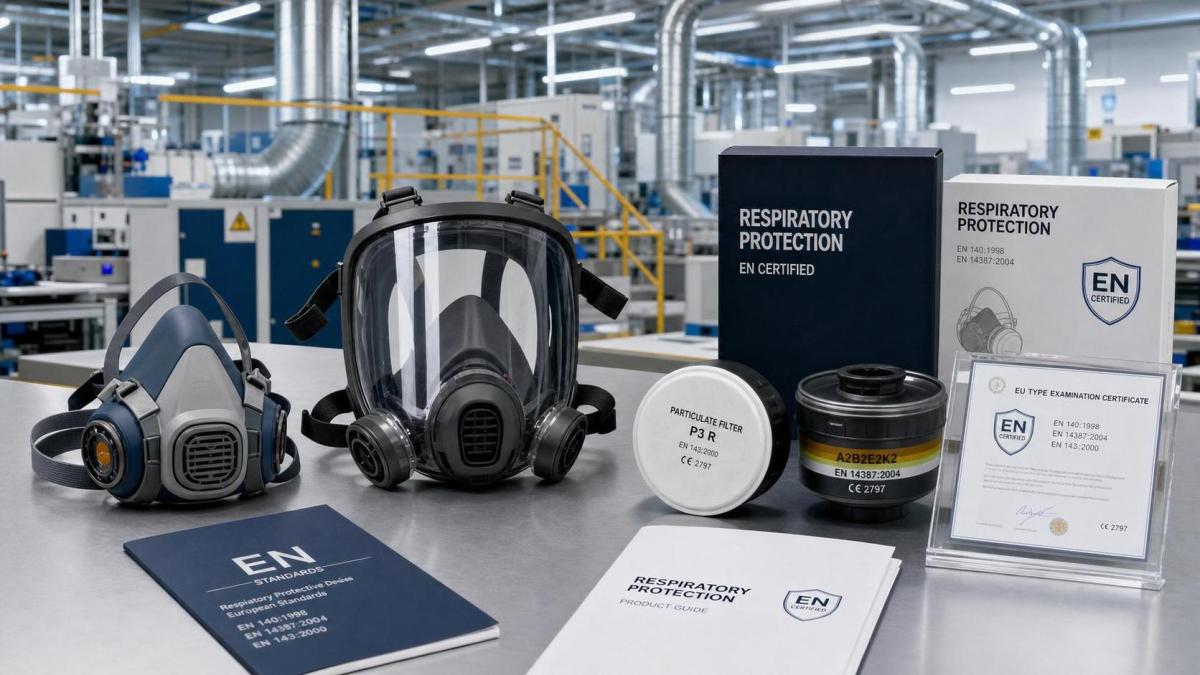
Respiratory hazards rarely look dramatic at first. Dust, fumes, mists, and gases often build risk quietly, then fail suddenly when control is weak.
That is why respiratory protective equipment EN standards matter. They turn a basic mask purchase into a verifiable safety decision.
For sites handling grinding, cutting, coating, welding, demolition, or confined maintenance, the standard behind the respirator matters as much as the respirator itself.
In practice, respiratory protective equipment EN standards define filtration efficiency, inward leakage, breathing resistance, marking, compatibility, and test methods.
They also help separate approved protection from look-alike products that only appear compliant on paper.
Within the SHSS view of industrial safety, PPE is the final physical barrier. When powered tools, fasteners, smart facilities, and urban infrastructure create airborne hazards, that last barrier must be trustworthy.
So the real question is not whether a respirator exists. The useful question is whether it was tested under the correct EN pathway for the actual hazard.
Which EN standards show up most often when checking respirators?
This is where many reviews become confusing. Different respiratory protective equipment EN standards apply to different product types, not to all respirators at once.
A short comparison usually makes the structure easier to follow.
If a supplier only mentions “CE certified respirator” without naming the matching EN standard, the file is still incomplete.
More often than not, the issue is not fake certification. It is incomplete technical matching between hazard and standard.
Is EN 149 enough, or do you need to look beyond FFP ratings?
EN 149 gets most of the attention because FFP1, FFP2, and FFP3 are familiar. Still, FFP rating alone does not finish the evaluation.
EN 149 applies to filtering half masks for particles. It does not cover every gas, vapor, oxygen-deficient space, or powered system decision.
An FFP3 respirator may perform very well for hazardous dust. It is still the wrong answer for solvent vapor exposure.
This is one of the most common misunderstandings in respiratory protective equipment EN standards review.
Another point is the marking detail. NR means non-reusable for a single shift. R indicates reusable performance under the standard conditions.
You may also see “D,” which relates to dolomite clogging resistance. That can matter in heavy dust environments with long wear periods.
A better review method is to ask four linked questions:
- Is the hazard particulate, gaseous, mixed, or unknown?
- Does the task need disposable, reusable, full-face, or powered protection?
- Do wear time, humidity, heat, and exertion change performance expectations?
- Does the technical file show the exact EN route, not just a broad conformity claim?
That is usually where respiratory protective equipment EN standards become practical instead of theoretical.
What should be checked during sourcing, incoming inspection, and document review?
A compliant respirator is not confirmed by appearance. The decision sits across labeling, certificates, technical data, and physical consistency.
When reviewing respiratory protective equipment EN standards in a procurement file, it helps to separate desk checks from floor checks.
Document checks that usually catch early problems
- Exact EN standard reference, including the relevant product family
- EU declaration of conformity aligned with the item code
- Notified body information where required
- User instructions covering limitations, storage, and filter replacement
- Clear lot traceability between carton, unit marking, and paperwork
Physical checks that should not be skipped
- Marking remains legible after normal handling
- Straps, valves, seals, and connectors match the approved design
- No odor, deformation, brittle components, or aging signs
- Packaging carries storage limits and expiry details where relevant
SHSS often treats this as part of a larger hardware quality chain. A trusted fastening system or biometric gate still fails the safety objective if respiratory protection is weak during installation or maintenance.
Where do teams usually get respiratory protective equipment EN standards wrong?
The mistakes are usually simple, but the consequences are not. Most failures happen in interpretation, not in test laboratories.
A related mistake is assuming EN compliance removes the need for workplace assessment. It does not.
Respiratory protective equipment EN standards verify product performance under defined methods. They do not replace exposure evaluation, fit testing, maintenance, or supervision.
How do you turn the standards into a workable site-level decision?
The most effective approach is to build a short decision path and use it every time a task changes.
Start with the airborne hazard profile. Then review task duration, worker movement, compatibility with helmets or eye protection, and replacement frequency.
In heavy industry, the choice may shift during one project. Cutting anchors, spraying coatings, and cleaning residue may each require different respiratory protective equipment EN standards.
A practical workflow often looks like this:
- Define the contaminant and concentration range as accurately as possible.
- Select the respirator type that fits task intensity and face coverage needs.
- Confirm the exact EN standard and filter classification.
- Check certification documents, marking, storage, and traceability.
- Validate use conditions through fit, training, and replacement rules.
That sequence keeps decisions grounded in evidence instead of habit.
In broader smart infrastructure projects, this matters even more. Construction, energy retrofits, industrial maintenance, and secure facility upgrades all combine hardware performance with human protection.
Respiratory protective equipment EN standards are part of that same reliability culture. They support the idea that the final safeguard should be measured, documented, and field-ready.
What is the sensible next step if your current review process feels too shallow?
Begin with one respirator family already in use. Map its claimed protection, matching EN standard, certificate scope, marking, storage controls, and actual task exposure.
That single exercise often reveals the real gap. Sometimes it is document inconsistency. Sometimes it is a hazard mismatch. Sometimes it is weak wear discipline.
The value of understanding respiratory protective equipment EN standards is not academic. It reduces false confidence.
A stronger review process should leave you with a clear matrix: hazard type, respirator type, EN standard, filter class, approval evidence, and replacement trigger.
Once that matrix exists, sourcing, incoming inspection, and worksite supervision become much easier to align.
For organizations following SHSS intelligence across PPE, tools, security, and infrastructure hardware, that alignment is the real goal: durable systems outside, dependable protection at the point of human exposure.
The next move is straightforward. Review one high-risk task, compare the current respirator against the relevant respiratory protective equipment EN standards, and tighten the gaps before the next exposure cycle.
Recommended News