
Search News
Industry Portal
Hot Articles
Which EN standards apply to respiratory protective equipment?
Time
Click Count
The main EN standards for respiratory protective equipment are EN 149 for filtering half masks, EN 140 for reusable half masks and quarter masks, EN 136 for full-face masks, EN 143 for particle filters, and EN 14387 for gas and combined filters. Powered filtering devices typically fall under EN 12941 or EN 12942, while supplied-air and self-contained breathing equipment require different standards.
A procurement specification that simply requests an “EN-approved respirator” leaves important questions unanswered. A dust-filtering mask may meet its product standard yet provide no protection against solvent vapour. When reviewing Personal Protective Equipment EN standards, start with the equipment type, then verify its certification, complete configuration, and suitability for the actual exposure.
Match the standard to the equipment being purchased
Respiratory protection standards do not form a single ladder from basic to advanced protection. They address different product designs and functions. A reusable respirator may therefore involve separate standards for its facepiece and filters, supported by evidence that the complete assembly is an approved combination.
This is a working map, not an exhaustive catalogue. Escape devices, diving equipment, and specialised breathing apparatus can fall under other standards. Check the precise product scope and edition rather than accepting a standard number that merely appears related.
EN 149: interpreting a filtering half mask correctly
EN 149 applies to filtering half masks that protect against particles. The familiar FFP1, FFP2, and FFP3 markings identify performance classes under the standard. The assessment covers more than filter material: it includes requirements concerning inward leakage, breathing resistance, and other device characteristics.
FFP3 does not mean protection against every airborne hazard. It remains a particle-filtering classification. A mask containing an odour-reducing carbon layer should not be treated as certified gas protection unless the relevant protective claim and conformity evidence explicitly support that use.
- NR: indicates a device limited to single-shift use. Contamination, damage, breathing resistance, or the manufacturer's instructions may require earlier replacement.
- R: indicates a reusable device under the specified conditions. It does not permit unlimited reuse or an improvised cleaning method.
- D: indicates compliance with the dolomite dust clogging test requirements. It is not a separate protection class and does not establish chemical suitability.
A valved filtering half mask can comply with EN 149, but that does not automatically make it suitable where controlling the wearer's exhaled emissions is required. Assess wearer protection and source-control requirements separately.
Reusable respirators: the facepiece and filter are separate checks
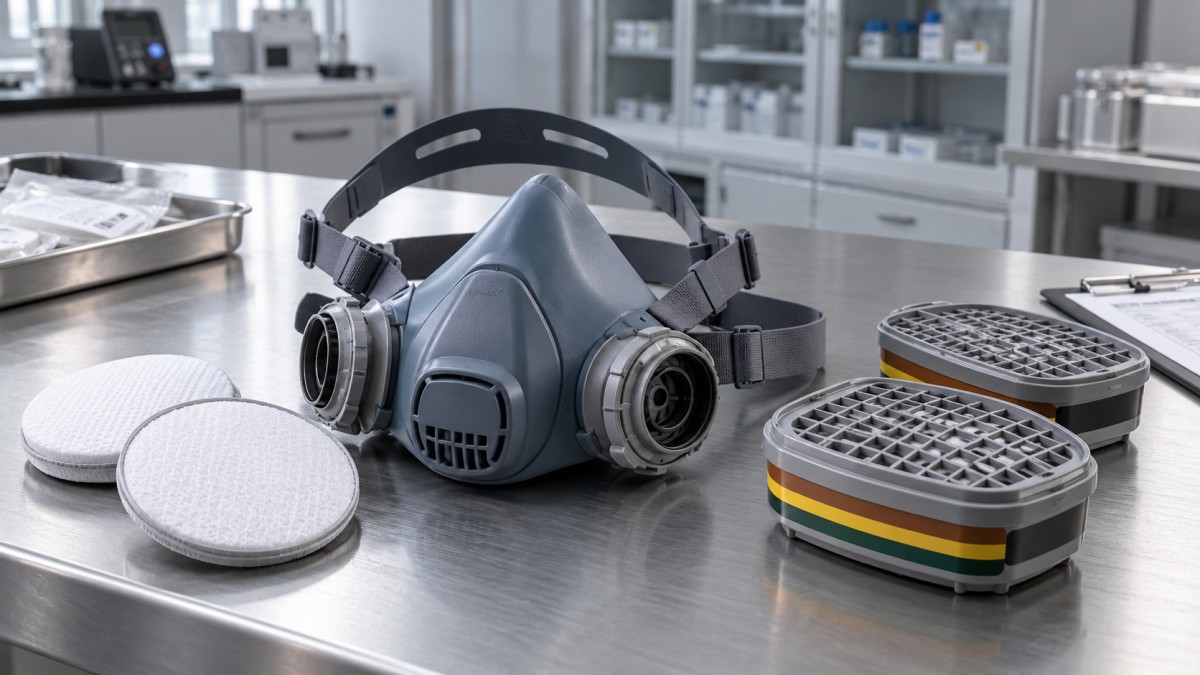
For a reusable half mask, EN 140 identifies the facepiece standard. For a full-face mask, the corresponding standard is EN 136. Neither marking, by itself, establishes whether an installed cartridge protects against silica dust, an organic vapour, ammonia, or a mixed exposure.
The next check is the filter. EN 143 covers particle filters, with P1, P2, and P3 classes. EN 14387 covers gas filters and combined gas/particle filters. A P3 filter and an FFP3 filtering half mask are not interchangeable certification descriptions: one is a component classification, while the other describes a complete filtering half mask.
Compatibility is equally important. A cartridge that physically connects to a mask is not necessarily an approved combination. Confirm the exact facepiece, filter, connector, adapter, and any required accessory against the manufacturer's instructions and certification scope. Unauthorised combinations can compromise sealing, breathing resistance, and demonstrated performance.
Reading gas-filter codes without overinterpreting them
Common EN 14387 designations include A for specified organic gases and vapours with boiling points above 65°C, B for specified inorganic gases and vapours, E for sulfur dioxide and other specified acidic gases, and K for ammonia and specified organic ammonia derivatives. AX addresses certain low-boiling organic compounds and has particular use restrictions.
These letters are not permission to use a filter against every substance in a broad chemical family. Check the exact contaminant against the manufacturer's selection information, including exclusions and concentration limits. In particular, a B filter must not be assumed to protect against carbon monoxide.
For applicable gas-filter types, classes 1, 2, and 3 describe capacity categories, not increasing filtration efficiency in the same sense as particle-filter classes. A combined marking such as A2P3 identifies gas capacity and particle filtration separately. It does not state a universal safe exposure concentration or guaranteed service duration.
Establish a cartridge change schedule using relevant manufacturer data and workplace conditions. Concentration, humidity, temperature, breathing demand, and mixtures affect service life. Smell or taste must not be the routine replacement trigger: warning properties may be inadequate, and exposure can occur before a wearer recognises breakthrough.
Powered and supplied-air equipment need system-level evidence
For powered filtering equipment, EN 12941 generally applies to systems incorporating helmets or hoods, while EN 12942 applies to power-assisted systems incorporating masks. TH and TM classifications belong to their respective standards; they should not be translated directly into FFP classes.
Review the complete approved assembly: blower, battery, filters, breathing tube, and headtop or facepiece. Substituting a different hood or hose can change the configuration's performance and certification status. Minimum airflow checks, alarms, battery endurance, and maintenance requirements also matter during acceptance and use.
A powered filtering respirator still filters ambient air. It does not supply oxygen and is unsuitable for oxygen-deficient atmospheres. Unknown concentrations, immediately dangerous conditions, or tasks requiring emergency entry demand a separate assessment and appropriately selected breathing apparatus.
For supplied-air work, identify the apparatus design before specifying a standard. EN 14594 addresses continuous-flow compressed-air line equipment; other airline designs may require different standards. Where relevant, EN 12021 addresses compressed breathing-gas quality. Certification of the wearable assembly does not establish that a workplace compressor delivers acceptable breathing air.
EN 137 applies to a particular category of open-circuit compressed-air SCBA with a full-face mask. An escape-only device must not be accepted as working or rescue equipment merely because both products carry breathing-apparatus markings.
What demonstrates compliance in the EU?
EN standards provide technical specifications; the legal framework for placing PPE on the EU market is Regulation (EU) 2016/425. Respiratory protective equipment intended to protect against hazardous substances or oxygen-deficient atmospheres falls within Category III, involving EU type-examination and ongoing conformity assessment through an applicable production-control route.
Use the following evidence as a connected record rather than independent paperwork:
- Identify the product precisely. Match model, variant, size, filter designation, and configuration across product markings, packaging, instructions, and purchasing records.
- Obtain the EU Declaration of Conformity. Check the manufacturer, applicable legislation, referenced standards and editions, and conformity-assessment details. Instructions may provide the declaration's internet address.
- Review the EU type-examination certificate. Confirm that its scope covers the supplied model and relevant configurations, not merely a similar product family.
- Check Category III production surveillance. The notified-body identification number following the CE mark relates to the ongoing conformity-assessment stage. It need not identify the body that issued the type-examination certificate.
- Verify questionable evidence independently. Check the notified body's designation and scope through the official EU database and confirm doubtful certificates with the issuing body using independently obtained contact details.
A test report alone is not equivalent to complete conformity assessment. Likewise, CE marking without traceable supporting documents does not resolve whether the delivered product matches the assessed design.
Check the edition, not just the standard number
Standards can be revised, superseded, or subject to transitional arrangements. Check the edition cited on the declaration and certificate against the applicable harmonised-standard references published for the EU PPE Regulation. A newer publication is not automatically the edition conferring presumption of conformity.
Conversely, use of an older edition is not enough, by itself, to decide that a product is unlawful. Establish the applicable references, relevant dates, certificate status, and the manufacturer's demonstration of compliance with essential health and safety requirements. National adoptions such as BS EN or DIN EN identify an adoption of the European standard, not a higher protection class.
Turn the paperwork into a workplace selection decision
Consider a maintenance task involving both airborne dust and cleaning solvent. An EN 149 mask addresses only the particle side of that exposure. A reusable assembly might require an appropriate gas filter combined with particle filtration, but the solvent identity, concentration, exposure duration, and operating conditions must be established before selecting it.
Start with the exposure assessment and required protection factor. Use the assigned protection factors recognised in the jurisdiction where the equipment will be used; do not substitute a laboratory classification or nominal protection factor for workplace guidance. Confirm that the selected equipment remains within its application limits.
Tight-fitting facepieces also require fit testing under the applicable workplace programme. Facial hair in the sealing area, incompatible eyewear, and interference from other PPE can undermine protection despite valid certification. A user seal check at each donning is necessary but does not replace fit testing.
Before release for use, record the approved configuration, fit-test arrangements where applicable, filter replacement rules, inspection criteria, cleaning method, and storage conditions. Hold equipment out of service when its identity, compatibility, or conformity evidence cannot be established. Where the atmosphere is unknown or oxygen deficiency is possible, resolve the hazard assessment before selecting any filtering respirator.
Recommended News