
Search News
Industry Portal
Hot Articles
PPE Application Guide: When to Use Respirators by Hazard Type
Time
Click Count
When hazard type changes, respirator choice should change too
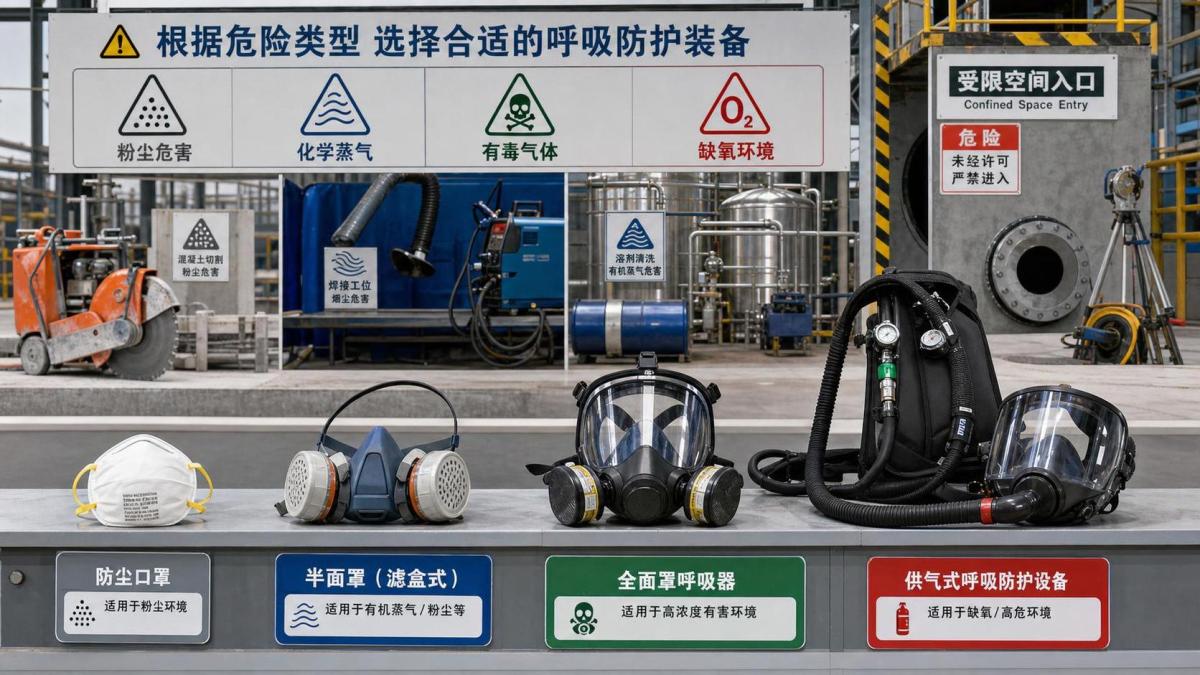
A useful PPE application guide respirators article starts with one practical truth: similar jobs can create very different breathing risks.
Cutting concrete, welding stainless steel, and cleaning a solvent tank may happen on one site, yet each demands a different protection strategy.
That is why respirator selection should follow hazard type, exposure pattern, and task duration, not just what is already stocked.
In construction, manufacturing, utilities, transport, and smart city maintenance, the right respirator protects health and keeps operations stable.
This matters even more in advanced industrial environments, where brushless tools, enclosed equipment rooms, biometric access zones, and retrofit work increase task complexity.
Within that wider safety picture, SHSS treats PPE as the last physical barrier when engineering controls and procedural controls are not enough.
A strong PPE application guide respirators process therefore asks not only what the contaminant is, but how it behaves in the real workspace.
Actual site conditions explain why one respirator is suitable and another is not
The same airborne hazard can appear in several forms.
Dust may be coarse and visible, or fine enough to stay suspended long after cutting stops.
Gas may leak briefly during maintenance, or accumulate quietly in a poorly ventilated chamber.
Fume can be generated intermittently, yet still produce high short-term exposure near the source.
In actual use, the better judgment method is to review four conditions together.
- Whether the hazard is particulate, gas, vapor, or a mixed atmosphere.
- Whether oxygen level or ventilation may change during the task.
- Whether the task is mobile, fixed-position, short-cycle, or extended.
- Whether other PPE, visibility, communication, or heat load affects respirator wearability.
This is where many errors begin.
A mask that works for nuisance dust may fail completely against organic vapor.
A cartridge setup that fits open fabrication areas may be inappropriate in a confined space entry.
Dust-heavy work often looks straightforward, but particle behavior changes the answer
Dust control is one of the most common reasons people search for a PPE application guide respirators reference.
Yet dust is rarely one single category in practice.
Concrete drilling, stone cutting, abrasive cleaning, grain handling, and bulk powder transfer all generate particles differently.
Silica dust is a typical example.
It can be produced by compact handheld power tools, floor saws, or demolition tasks, but exposure intensity depends on suppression and extraction.
Where wet methods and local exhaust ventilation are consistent, a filtering facepiece or elastomeric half mask may be suitable.
Where visibility is poor, dust lingers, or cutting is prolonged, a tighter-sealing system with higher particulate protection becomes more realistic.
The common mistake is to judge by visible dust only.
Fine respirable particles can remain hazardous even when the air appears clear.
Another overlooked point is work rhythm.
Short repetitive tasks across an entire shift may create more meaningful exposure than one dramatic operation.
Where welding fumes call for more than basic particulate thinking
Welding and thermal cutting often sit between dust and gas decisions.
Fumes contain fine metal particulates, but process chemistry matters.
Stainless steel welding may involve chromium and nickel compounds, while painted or coated surfaces add decomposition products.
In open structural work, a particulate-focused respirator may be enough when ventilation is effective.
Inside tanks, frames, utility pits, or mechanical rooms, the decision can shift quickly toward powered air-purifying options or supplied-air systems.
The reason is not only contaminant concentration.
Heat stress, face shield compatibility, and communication limitations can reduce real protection if the chosen unit is difficult to wear correctly.
Gas and vapor exposure requires tighter hazard matching
A PPE application guide respirators discussion becomes more critical when hazards are invisible and odor is unreliable.
Solvent cleaning, coating lines, adhesive use, chemical dosing, and battery room maintenance can all release harmful gases or vapors.
In these cases, filter media alone is not the decision.
Cartridge chemistry, service life, humidity, breakthrough risk, and emergency escape planning all matter.
Organic vapors from coatings differ from acid gases released during cleaning or process upset.
Treating them as interchangeable is a frequent misjudgment.
A more reliable approach is to confirm the contaminant class first, then verify concentration range and exposure duration.
If the atmosphere may become immediately dangerous to life or health, air-purifying respirators should not be the default answer.
This is especially relevant in enclosed service zones supporting smart buildings, data infrastructure, or utility controls, where maintenance may happen away from constant supervision.
Confined spaces change the respirator decision before the task even starts
Confined-space work deserves separate treatment because the hazard can escalate faster than the job appears to suggest.
Sewer access points, pits, tanks, valve chambers, process vessels, and underground service corridors often combine poor ventilation with changing atmospheres.
Here, the first question is not which cartridge to choose.
The first question is whether the atmosphere is known, measured, and stable enough for air-purifying equipment at all.
That distinction is central to any PPE application guide respirators framework.
A confined space can move from routine inspection to rescue conditions within minutes.
For that reason, respirator planning should sit alongside gas detection, entry permits, retrieval systems, and communication procedures.
Where teams ignore that integration, the respirator becomes a false sense of security rather than a last line of defense.
Different environments create different respirator priorities
A side-by-side comparison usually makes the selection logic clearer than general advice.
This comparison also shows why broad procurement categories can hide very different field requirements.
A site may say it needs respirators, but the real need may span disposable filtering units, reusable half masks, full-face protection, and supplied-air systems.
Fit, maintenance, and compatibility often decide whether the chosen protection works
The best PPE application guide respirators plan still fails if the equipment cannot be worn consistently.
Fit testing, seal integrity, cartridge replacement intervals, cleaning routines, and storage conditions all affect field performance.
So does compatibility with helmets, goggles, arc protection, communication gear, and low-light work.
That compatibility issue is more visible in integrated industrial settings.
For example, a maintenance task near smart access systems or lighting controls may require mobility, face visibility, and precise hand work in tight spaces.
A bulky solution may look compliant on paper but interfere with the task enough to encourage unsafe adjustment or removal.
A more realistic selection process checks both protection factor and operational friction.
- Review hazard data before choosing the respirator family.
- Confirm face seal performance with the other required PPE.
- Set cartridge and filter change rules by exposure, not by guesswork.
- Recheck the decision when the process, material, or ventilation changes.
Where respirator decisions are most often misread
Several patterns appear again and again across mixed industrial sites.
One is relying on product specifications while ignoring how long the task lasts each week.
Another is treating two similar maintenance areas as identical, even though one is enclosed and the other is ventilated.
A third is focusing on purchase price while overlooking storage, cleaning, replacement stock, and training time.
There is also a technical blind spot around mixed hazards.
Grinding after solvent cleaning, or welding on coated metal, can shift a task from single-hazard to combination exposure.
When that shift is missed, respirator protection often falls behind the real risk.
A practical next step is to build a site-by-site respirator matrix
The most effective PPE application guide respirators programs rarely depend on memory or general rules.
They map tasks, materials, exposure duration, ventilation status, and emergency conditions into a simple decision matrix.
That matrix should be reviewed when tools, chemicals, workspaces, or shift patterns change.
For multi-industry operations, it helps to separate routine particulate work, mixed fume work, vapor-heavy work, and confined-space entries.
It is also worth checking whether current respirator choices still fit newer workflows built around compact power tools, automated access zones, and tighter service spaces.
When hazard type, site conditions, and wearability are reviewed together, respirator selection becomes more consistent, more compliant, and more useful in real work.
Recommended News