
Search News
Industry Portal
Hot Articles
India BIS Mandates IS 17400:2026 for Respirators
Time
Click Count
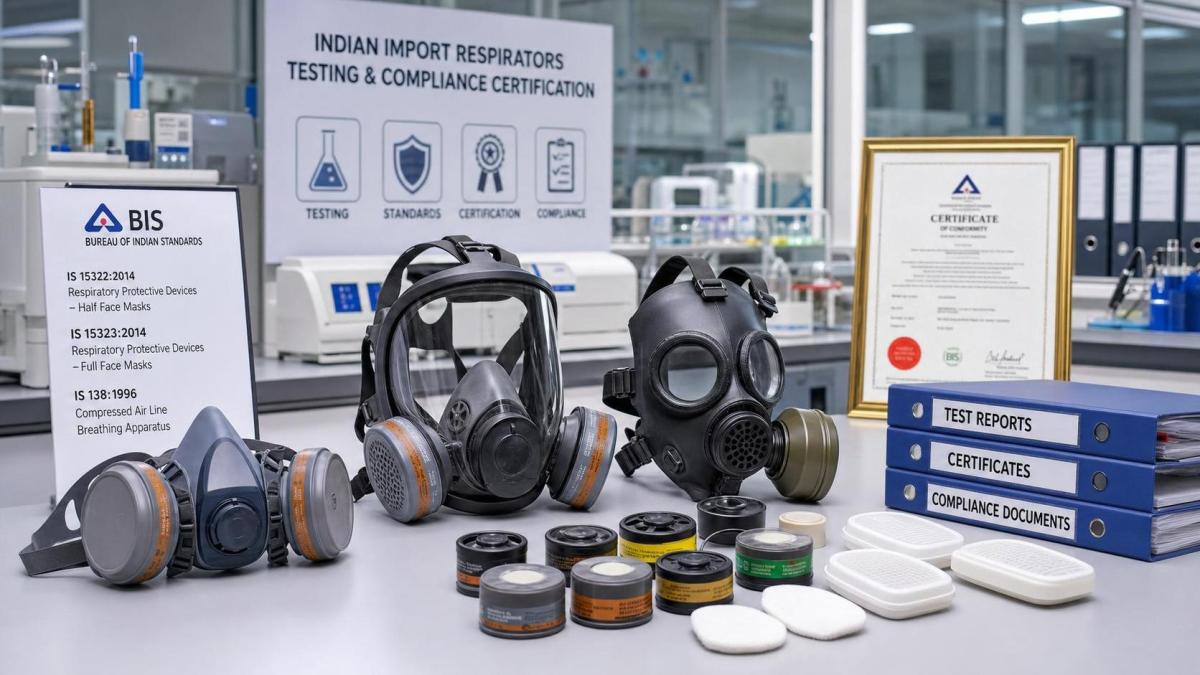
On July 5, 2026, the Bureau of Indian Standards (BIS) updated its mandatory certification list for imported respirators and gas masks. The change matters directly to importers, manufacturers, testing and certification teams, procurement functions, and buyers handling half-face and full-face products, because from October 1, 2026, market access will depend on meeting a new particle filtration requirement under IS 17400:2026 rather than relying on earlier certification continuity.
What the BIS update now requires
According to the provided information, BIS updated the mandatory certification list on July 5, 2026. From October 1, 2026, all imported respirators and gas masks, including half-face and full-face models, must pass the particle filtration efficiency test specified in IS 17400:2026.
The stated test condition is a filtration efficiency of at least 99.97% for 0.3 micrometer particles using both NaCl and DOP media. The test report must be issued by a BIS-recognized laboratory.
The same information also states that products previously certified under IS 17079:2021 will no longer be accepted for renewal.
Where the immediate pressure is likely to appear
Imported product lines face a compliance reset
From an industry perspective, importers of respirators and gas masks may be affected first because the update is tied directly to mandatory certification for imported products. The main impact is likely to fall on product qualification, document readiness, and shipment planning, especially where existing portfolios were built around prior certification status.
Manufacturing and product compliance teams will need to recheck technical readiness
Analysis shows that manufacturers supplying the Indian market may need to focus on whether current products can support testing under the new IS 17400:2026 requirement. The pressure point is not only test performance itself, but also whether product files, laboratory coordination, and certification timing align with the October 1, 2026 implementation date.
Procurement and buyer-side screening may become stricter
For procurement teams and downstream buyers, the update may affect supplier screening and order confirmation. What deserves closer attention is whether suppliers can provide reports from BIS-recognized laboratories and whether any product still relying on IS 17079:2021 renewal assumptions creates delivery or acceptance risk.
Certification and supply-chain service functions may see timing risk
Observably, service providers involved in certification support, documentation, and cross-border supply coordination may need to pay closer attention to transition timing. The key business link here is execution: incomplete files, delayed test reports, or outdated certification expectations could affect customs planning, delivery schedules, or contract communication.
What companies should monitor now
Separate confirmed rules from internal assumptions
The confirmed facts are clear on three points: the BIS list was updated on July 5, 2026; the new requirement takes effect on October 1, 2026; and renewal under IS 17079:2021 will no longer be accepted. Companies should avoid treating earlier certification status as a workable bridge where the new rule has already defined a different path.
Review affected SKUs and product categories early
Businesses handling half-face and full-face respirators or gas masks for import into India should identify which SKUs fall within the stated scope. In practical terms, this is less about broad policy discussion and more about product-by-product confirmation of testing, certification documents, and market entry readiness.
Check laboratory documentation and evidence chain
The requirement for a report issued by a BIS-recognized laboratory makes documentation quality a core operational issue. Companies should pay close attention to whether testing records, report versions, and supplier submissions match the new standard reference and can be used consistently in customer and compliance communication.
Prepare for customer and supplier communication around the transition
Analysis shows that one of the most practical near-term tasks is expectation management across suppliers, distributors, and buyers. The shift away from IS 17079:2021 renewals may affect order timing, product acceptance discussions, and delivery commitments, so companies should prepare a clear internal position on which products are transition-ready and which still require updated evidence.
Why this looks like more than a routine update
As an editorial observation, this development is better understood as an actionable regulatory shift rather than a background standards revision. The reason is straightforward: the update combines a defined effective date, a specified testing method and threshold, a laboratory recognition requirement, and a clear discontinuity for renewal under the earlier standard.
At the same time, it is still more appropriate to understand this as a development that requires continued observation rather than a completed market outcome. The confirmed rule change is already clear, but its operational effect across certification timelines, supplier readiness, and transaction flow will still need to be watched in practice.
How the market should read this development
For the industry, the main significance of this update is that compliance for imported respirators and gas masks in India is being tied to a more explicit current testing basis under IS 17400:2026. That makes the issue immediately relevant for certification planning, procurement review, and shipment execution.
A balanced reading is that this is not merely a short-term notice, but a concrete compliance signal with near-term business consequences. Current conditions suggest it should be treated neither as a broad market forecast nor as a routine administrative change, but as a rule change that needs prompt operational follow-through and continued monitoring.
Basis of this article and what still needs verification
This article is based on the user-provided news title, event date, and event summary concerning the BIS mandatory requirement for respirators and gas masks under IS 17400:2026. The analysis above distinguishes confirmed facts from industry observation and does not add unverified data, company examples, or market figures.
For this type of development, commonly relevant source categories include official notices, company disclosures, industry association updates, authoritative media reporting, and standardization documents. A specific official source link was not provided in the input, so the exact official publication path still needs ongoing verification. Follow-up attention should remain on any further official wording, implementation clarification, and documentation expectations connected to the October 1, 2026 effective date.
Recommended News