
Search News
Industry Portal
Hot Articles
102 New National Standards Take Effect on June 1, 2026, Including Mandatory DALI-2 Interoperability for Smart Lighting Exports
Time
Click Count
Effective June 1, 2026, 102 newly approved national standards will enter into force in China, significantly impacting manufacturers and exporters of intelligent lighting products—particularly those supplying smart streetlights and commercial LED luminaires to international markets. The change stems from a State Administration for Market Regulation (SAMR) announcement mandating formal compliance with interoperability, electromagnetic compatibility, data encryption, and real-time edge command response requirements under GB/T 42892–2026.
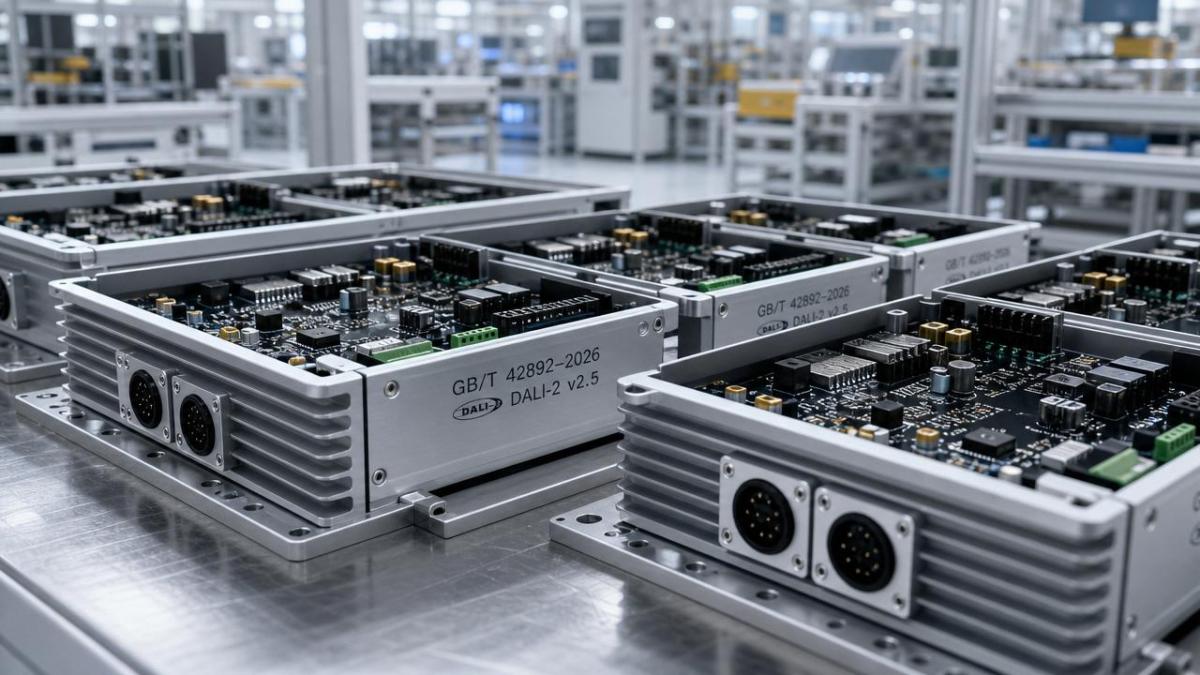
New Standards Officially Enforce Technical Compliance
Per the SAMR’s official notice, 102 national standards—including GB/T 42892–2026, Interoperability Requirements for Intelligent Lighting Control Systems—become mandatory on June 1, 2026. This standard explicitly designates DALI-2 protocol compatibility as a compulsory testing requirement for export-oriented smart streetlights and commercial LED luminaires. Compliance is assessed across three tiers: electromagnetic compatibility (EMC), data encryption integrity, and edge-command response latency.
Impact Across the Lighting Value Chain
Export-Oriented Manufacturers
Companies shipping smart lighting products abroad must now validate DALI-2 interoperability prior to customs clearance or market entry. Non-compliant units risk rejection at destination ports or failure to meet tender specifications in EU, ASEAN, and Middle Eastern infrastructure projects where DALI-2 is increasingly referenced in procurement documents.
Component Suppliers & Subsystem Integrators
Suppliers of drivers, controllers, and wireless gateways face intensified scrutiny on firmware-level DALI-2 stack certification and timing behavior under load. Integration testing cycles will extend to cover edge-response benchmarks (e.g., ≤100 ms latency under concurrent multi-node commands), affecting time-to-market for new SKUs.
Contract Manufacturers & ODMs
ODMs serving global brands must align production test benches with GB/T 42892–2026’s measurement methodology—including EMC immunity during DALI-2 message bursts and AES-128 encryption key exchange validation. Pre-certification audits may now include live edge-command stress tests.
Logistics & Certification Service Providers
Third-party testing labs and conformity assessment bodies are expected to scale DALI-2 interoperability verification capacity. Supply chain actors relying on pre-shipment inspections must confirm that service providers hold updated accreditation scopes covering all three compliance tiers of GB/T 42892–2026.
Key Compliance Actions for Enterprises
Update Export Product Certification Strategy
Reassess existing CE, CB Scheme, or IECEE certifications: DALI-2 interoperability was previously voluntary in most schemes; under GB/T 42892–2026, it becomes a mandatory national baseline for Chinese-origin exports classified as smart streetlights or commercial LED luminaires.
Revise Technical Specifications & Tender Responses
Technical bids for overseas public tenders must now explicitly reference DALI-2 v2.5+ conformance, measured per GB/T 42892–2026 Annex B. Latency claims require documented test reports—not just datasheet assertions—and must specify environmental operating conditions (e.g., ambient temperature, bus length, node count).
Strengthen Supplier Qualification for Critical Subassemblies
Drivers, microcontrollers, and communication modules must be sourced from vendors providing traceable DALI-2 stack validation reports—including EMC resilience during DALI frame transmission and encrypted parameter write cycles. Self-declared conformity is no longer sufficient.
Adjust Production Scheduling & Documentation Workflow
Integrate GB/T 42892–2026 test protocols into final QA checkpoints. Maintain version-controlled records of firmware builds, encryption key management logs, and latency benchmarking results for each production lot—required for post-market surveillance and audit readiness.
Industry Perspective: A Strategic Shift Toward Protocol Governance
Analysis shows this is not merely a technical update but a structural move toward embedding interoperability as a foundational trade requirement—not just a feature. Observably, China’s alignment of export-grade smart lighting with DALI-2 reflects growing convergence between domestic standardization and international smart city procurement frameworks. What deserves closer attention is the implied shift in liability: manufacturers now bear responsibility for end-to-end interoperability—not only device functionality, but predictable network-level behavior under electromagnetic stress and encrypted command loads. This raises the bar for firmware validation rigor and supply chain transparency, particularly for OEMs managing distributed development teams.
Toward Robust, Interoperable Smart Infrastructure
This regulatory milestone signals a maturing phase for intelligent lighting—where reliability, security, and cross-vendor integration are no longer differentiators but prerequisites. While implementation challenges remain, especially for SMEs navigating multi-tier testing requirements, the long-term effect supports more resilient urban lighting ecosystems and strengthens China’s position in high-value, standards-driven export segments.
Source Transparency & Verification Guidance
This article synthesizes information provided in the original briefing: title, event date (June 1, 2026), and summary description. Specific official source links were not provided in the input and should be verified continuously. Stakeholders are advised to monitor updates from the Standardization Administration of China (SAC), SAMR’s official announcements, and accredited certification bodies for implementation guidance, interpretation notes, and phased enforcement clarifications—particularly regarding transitional arrangements for legacy stock and small-batch producers.
Recommended News