
Search News
Industry Portal
Hot Articles
GAOS Security Rules Reach Smart Industrial Tools
Time
Click Count
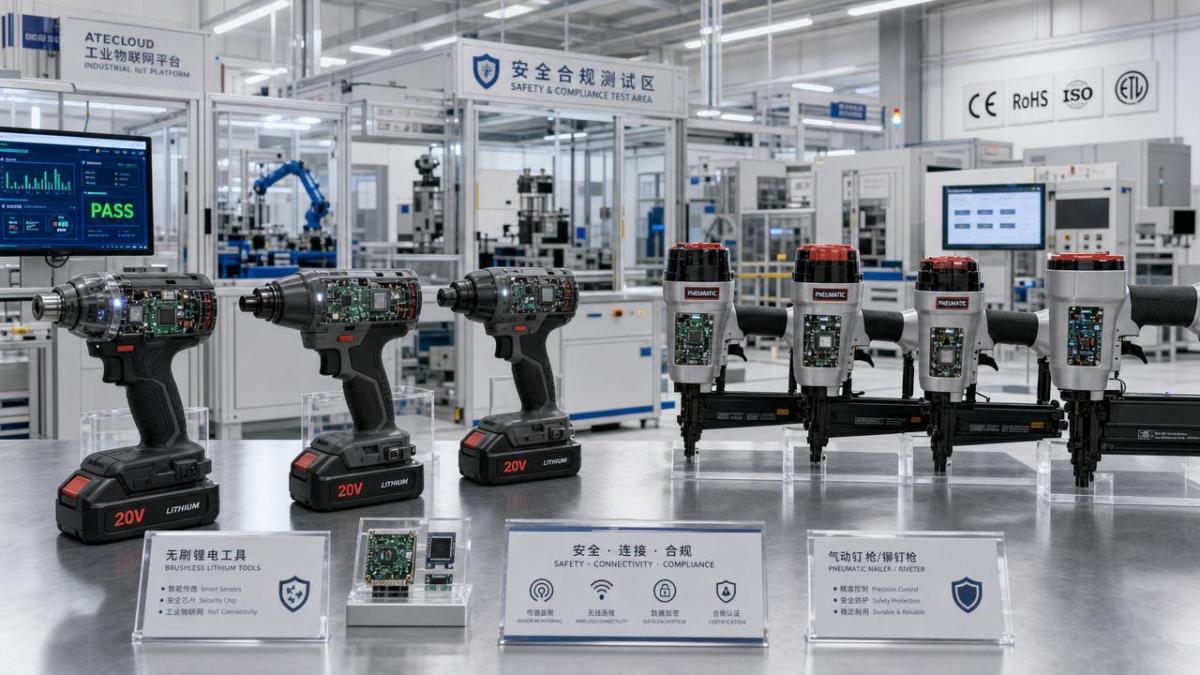
On June 4, 2026, Infrastructure AI introduced the security framework for the Galaxy AI Operating System (GAOS), setting a new requirement for industrial IoT endpoints, including Brushless Li-ion Tools and Pneumatic Nailers/Riveters, to support a dual-blockchain security backbone and zero-knowledge compliance proof. The development deserves close attention from tool manufacturers, importers, compliance teams, distributors, and industrial buyers because TÜV Rheinland has already said it will include this framework in a Q3 2026 pilot for conformity assessment under the updated CE Machinery Directive (2006/42/EC), creating a direct link between security architecture and market access.
What Has Been Confirmed So Far
The confirmed facts are limited but commercially significant. Infrastructure AI released the GAOS security framework on June 4, 2026. Under that framework, all endpoint devices connected to the industrial Internet of Things are required to support a dual-blockchain security backbone and zero-knowledge compliance proof.
The scope explicitly includes Brushless Li-ion Tools and Pneumatic Nailers/Riveters. TÜV Rheinland has also announced that the framework will be incorporated into a pilot for conformity assessment under the updated CE Machinery Directive (2006/42/EC) in the third quarter of 2026. According to the information provided, devices that do not adapt to the framework will not be able to obtain the updated CE mark.
Where the Pressure May Appear First
Product design and manufacturing teams face a technical compliance issue
From an industry perspective, manufacturers of connected industrial tools may be affected first because the stated requirement is embedded at the device level. The immediate pressure is likely to fall on product architecture, embedded security design, firmware planning, and conformity preparation for any industrial IoT-enabled tool line within the named categories.
What deserves closer attention is whether existing connected models can be adapted within current development cycles, or whether compliance will require redesign at the module level. The announcement does not answer that point, so for now it remains an operational question rather than a confirmed outcome.
Export, distribution, and market-entry roles may see documentation risk
Distributors, exporters, and channel partners may also be affected because the information provided ties framework adaptation to eligibility for the updated CE mark in the pilot context announced by TÜV Rheinland. That means the issue is not only technical; it may also influence product documentation, customer declarations, shipment readiness, and communication with EU-facing buyers.
Analysis shows that businesses involved in cross-border sales should pay attention to whether customers begin asking for earlier proof of security architecture readiness, especially for products marketed as industrial IoT-capable.
Industrial buyers and procurement teams may reassess approved products
Procurement teams at end-user companies may be affected if connected tools in approved or planned purchasing lists are expected to align with future CE-related conformity pathways. For buyers, the practical concern is less about blockchain terminology itself and more about whether a selected device can remain certifiable and support deployment plans without later compliance disruption.
Observably, this can turn a cybersecurity framework announcement into a sourcing and qualification issue, especially where purchasing decisions depend on certification continuity.
What Companies Should Watch Next
Separate the announced requirement from full implementation detail
The current information confirms the framework requirement and the TÜV Rheinland pilot linkage, but it does not provide the full implementation method, test workflow, or supporting technical documentation in the input provided. Companies should therefore distinguish between what is already stated and what still needs verification through subsequent official wording or conformity guidance.
Review which product lines are actually within scope
Firms should closely review which connected endpoint products fall under the industrial IoT definition used in their own portfolio. This is especially relevant for suppliers handling Brushless Li-ion Tools and Pneumatic Nailers/Riveters, because the named categories are explicitly referenced in the event summary.
Prepare supplier and customer communication early
Analysis shows that supplier qualification files, technical communication, and customer-facing compliance statements may become more sensitive even before wider implementation details are available. Companies may need to prepare internal talking points on adaptation status, certification planning, and whether specific models are intended for markets influenced by the updated CE pathway.
Track timing around the Q3 2026 pilot
The Q3 2026 conformity assessment pilot announced by TÜV Rheinland is a practical milestone. What deserves closer attention is not only the framework release itself, but also how the pilot translates the requirement into review criteria, evidence expectations, and acceptance thresholds for connected devices.
Why This Looks Like More Than a One-Day Headline
Analysis shows that this development is more appropriately understood as an early regulatory-commercial signal rather than a fully settled market rule across all scenarios. The reason is clear: the input confirms a framework release and a CE-related pilot linkage, but it does not yet provide the full downstream rulebook for implementation, testing, or transition treatment.
At the same time, it is not a minor or purely theoretical update. Because the information explicitly links non-adaptation with inability to obtain the updated CE mark, the issue already moves beyond general cybersecurity discussion and into certification planning. That makes it a development the industry should continue to monitor closely rather than treat as routine vendor messaging.
How This News Is Best Understood Now
At this stage, the most balanced reading is that the GAOS security framework has introduced a concrete compliance signal for connected industrial tools, especially for Brushless Li-ion Tools and Pneumatic Nailers/Riveters that may be assessed under the updated CE pathway referenced in the input. It is not yet enough to infer every technical or commercial consequence, but it is enough to justify immediate review by manufacturers, exporters, distributors, and buyers involved in industrial IoT-enabled equipment.
In that sense, the news is best understood as a near-term compliance watchpoint with possible longer-term implications, rather than as a completed market transition.
Basis of This Article
This article is based on the user-provided news title, event date, and event summary. Relevant source types for developments like this typically include official company announcements, notified body statements, industry association updates, authoritative media coverage, and standards or conformity-related documents.
No specific official source link was provided in the input, so the underlying wording and subsequent implementation details still require ongoing verification. Continued attention should focus on any follow-up statements from Infrastructure AI, TÜV Rheinland, and materials related to the Q3 2026 pilot under the updated CE Machinery Directive (2006/42/EC).
Recommended News