
Search News
Industry Portal
Hot Articles
20V Brushless Impact Wrenches: Torque, Runtime, and Fastener Fit
Time
Click Count
Torque claims attract attention, but they do not settle the question of whether 20V brushless impact wrenches truly fit a fastening task. In practice, output must be read alongside runtime, socket compatibility, trigger control, and the behavior of real fasteners under load.
That is why this tool category matters across construction, equipment assembly, facility maintenance, transport service, and industrial installation. A compact cordless platform can improve mobility and cycle time, yet only when its power delivery matches joint design, duty cycle, and fastening risk.
From the broader SHSS perspective, brushless tools sit close to the physical foundations of safe operations. The same ecosystem that values high-strength hardware, controlled access, smart infrastructure, and PPE also depends on fastening accuracy, because poor torque application can compromise reliability long before failure becomes visible.
Why 20V Brushless Platforms Draw Serious Attention
20V brushless impact wrenches occupy a useful middle ground. They are lighter and more portable than larger cordless systems, but often stronger and more durable than entry-level brushed tools.
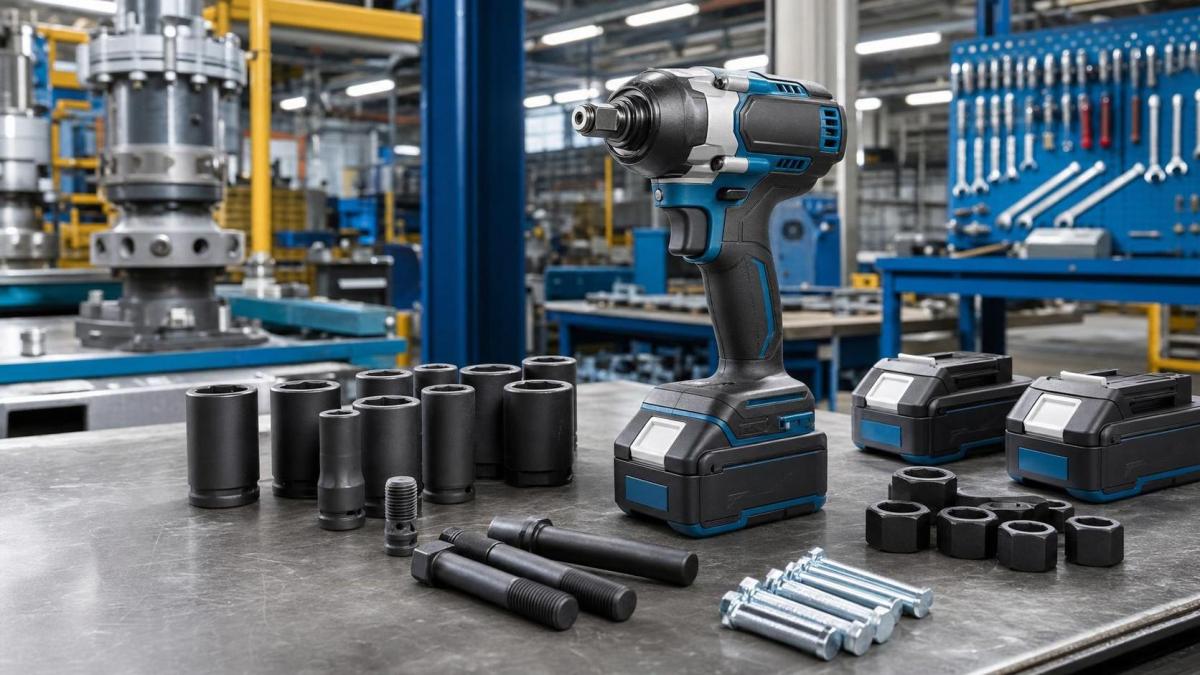
This matters where crews move between anchors, steel framing, service panels, ducts, racks, machine bases, and fleet components. The same shift toward AIoT-enabled infrastructure also raises expectations for tool efficiency, battery logistics, and repeatable installation quality.
Brushless motors strengthen the case. They reduce wear points, improve energy conversion, and support smarter electronic control. For technical evaluation, that usually translates into better thermal behavior, steadier output under load, and more usable runtime per charge.
Torque Numbers Need Context
The first mistake in comparing 20V brushless impact wrenches is reading peak torque as a complete performance summary. Peak breakaway torque, fastening torque, and sustained working torque are not interchangeable.
Breakaway torque describes removal force on seized or previously tightened fasteners. Fastening torque reflects tightening capability. Sustained performance shows what the tool can repeatedly deliver without overheating or draining the battery too quickly.
A high published figure may still disappoint on repetitive assembly if hammer mechanism efficiency is weak or voltage sag appears early. More useful comparisons look at actual bolt sizes, fastening cycle times, and torque retention during continuous use.
For many industrial and site tasks, controllable mid-range output is more valuable than extreme headline torque. Overpowered tightening increases the chance of thread damage, washer deformation, coating failure, or uneven clamp load.
What to compare behind the torque label
- Rated fastening torque versus nut-busting torque
- Performance with specific bolt diameters and grades
- Speed loss under continuous load
- Thermal throttling during repetitive cycles
- Mode control for low, medium, and high output
Runtime Is a System Issue, Not Just a Battery Issue
Runtime is often discussed as battery amp-hour capacity, but the real picture is broader. Motor efficiency, impact mechanism friction, electronics tuning, ambient temperature, and fastener resistance all shape how long 20V brushless impact wrenches remain productive.
A 5.0Ah pack may outperform a 6.0Ah pack in practical cycles if the platform manages current better. That is especially relevant in elevated work, mobile service, or large installation zones where battery changes interrupt workflow.
Runtime should also be measured by completed joints, not only trigger minutes. Fifty stubborn structural fasteners can consume more energy than several hundred lighter M8 or M10 assembly points.
For evaluation, charging speed and battery commonality across the tool fleet matter almost as much as single-tool endurance. A platform with shared packs across drills, grinders, lighting, and inspection tools may reduce downtime more effectively than a higher-torque isolated system.
Fastener Fit Decides Whether the Tool Is Appropriate
Fastener fit is where many tool comparisons become genuinely useful. 20V brushless impact wrenches are not evaluated in isolation; they are evaluated against nut sizes, bolt grades, substrate conditions, access constraints, and required clamp force.
Socket retention style, anvil size, and head profile all influence suitability. A compact 3/8-inch unit may excel in equipment maintenance or tight mechanical spaces. A 1/2-inch model usually covers broader construction and service work.
The fastener itself also changes the decision. High-strength structural hardware, corrosion-resistant assemblies, and vibration-prone joints often require more than raw impact energy. They require predictable final torque procedures and, in many cases, follow-up verification with a calibrated torque tool.
This is especially important in SHSS-aligned sectors, where fastening integrity supports wider systems such as lighting poles, equipment guards, enclosure doors, support brackets, access hardware, and industrial frames. The bolt may be small, but the consequence chain is not.
Typical fit by task range
- Light mechanical assembly: compact housings, panels, brackets, service access covers
- General construction: anchors, channel supports, steel connections, equipment mounting
- Fleet and facility maintenance: lug-related tasks, suspension fittings, machinery adjustments
- Smart infrastructure installation: poles, control boxes, sensor mounts, cabinet hardware
Control, Ergonomics, and Repeatability Matter More Than Spec Sheets Suggest
Once torque and runtime are acceptable, control features often separate a workable tool from a costly mismatch. Variable-speed triggers, multi-mode settings, auto-stop functions, and reverse assist can improve fastening consistency and reduce damage.
Compactness is not only about comfort. In ceiling voids, plant rooms, scaffold zones, and maintenance bays, head length and balance directly affect access time and user fatigue. A lighter tool may complete more accurate work over a shift than a stronger but bulkier alternative.
Vibration behavior also deserves attention. Repeated high-impact work can degrade precision when operators compensate for tool movement. Better handle geometry and smoother electronic modulation can help maintain alignment on coated or partially seated fasteners.
Reliability should be viewed in service terms. Housing durability, contamination resistance, battery contact design, and ease of maintenance become important where dust, metal debris, moisture, and repeated transport are normal operating conditions.
A Practical Evaluation Framework
A sound review of 20V brushless impact wrenches starts with the joint, not the brand. Define the largest and most frequent fasteners, the expected tightening range, and whether removal of corroded hardware is part of the duty profile.
Then compare the platform against workflow realities. Battery turnover, charger placement, overhead work, confined access, socket range, and the need for final torque verification all influence the right choice.
The following checkpoints usually give a clearer picture than marketing claims alone.
- Match torque band to actual fastener grades and diameters
- Test runtime by completed fastening cycles
- Check tool size against clearance limits
- Review mode control for sensitive or repeated joints
- Confirm battery compatibility across the wider cordless system
- Separate removal capability from installation accuracy
- Verify whether final torque tools remain necessary
Where the Category Is Headed
The direction of travel is clear. 20V brushless impact wrenches are becoming more intelligent, not only more powerful. Better motor control, smarter battery communication, and stronger integration with connected jobsite systems will shape the next evaluation cycle.
That trend aligns with the SHSS view of modern hardware: physical tools are no longer isolated devices. They are part of a larger chain that includes fastening reliability, asset uptime, worker safety, and infrastructure resilience.
When reviewing 20V brushless impact wrenches, the most useful next step is to build a scenario-based matrix. Map torque demand, battery duty, fastener type, clearance limits, and verification requirements. That process usually reveals whether a compact cordless wrench is a productivity gain, a control risk, or the right balance of both.
Recommended News