
Search News
Industry Portal
Hot Articles
Industrial Brushless Tools Cordless: Runtime, Torque, and Battery Trade-Offs
Time
Click Count
Industrial Brushless Tools Cordless: Runtime, Torque, and Battery Trade-Offs
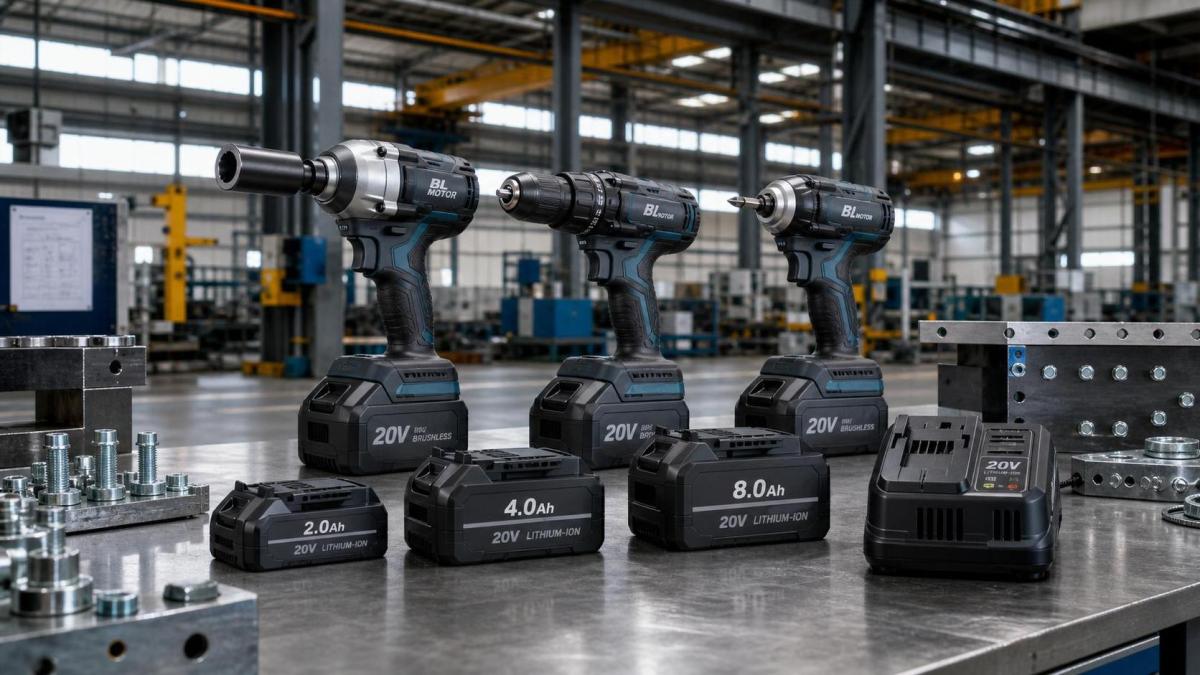
Choosing industrial brushless tools cordless platforms is no longer just about peak power.
The harder question is how torque, runtime, battery mass, and thermal behavior interact under real duty cycles.
That trade-off matters in steel erection, MRO work, line assembly, heavy fastening, and field maintenance.
A cordless brushless platform that looks strong on paper can still underperform when repetitive load, heat buildup, or battery swaps interrupt work.
This is why industrial brushless tools cordless evaluation should focus on system behavior, not just isolated motor claims.
In practice, the best choice is usually the one that maintains usable torque longest, with acceptable weight and predictable operating cost.
Why Cordless Brushless Performance Is a System Decision
Industrial brushless tools cordless systems combine motor, controller, battery pack, firmware, cooling path, and mechanical drive train.
If one part is undersized, the whole tool feels weaker than its advertised rating.
Brushless DC motors improve efficiency and reduce wear compared with brushed designs.
Still, efficiency gains do not remove the physics of current draw, heat generation, and battery voltage sag.
That means tool selection should start with the task profile.
- Short, high-torque bursts need strong peak current delivery and drive train durability.
- Continuous drilling or grinding needs heat control and stable sustained output.
- Overhead or mobile work needs lower mass and fewer battery changes.
- Mixed-use fleets need charger compatibility and manageable lifecycle cost.
From a decision standpoint, cordless brushless tools win when the platform matches these load patterns without forcing workarounds.
Runtime: More Than Amp-Hours
Runtime is often oversimplified.
A larger Ah rating helps, but usable runtime depends on watt-hours, discharge rate, tool efficiency, and thermal throttling.
A 5.0Ah pack at higher voltage can outperform a larger low-voltage pack in demanding applications.
More importantly, some packs maintain voltage under load better than others.
That directly affects drilling speed, fastening consistency, and cycle time.
Key Runtime Questions
- What is the real watt-hour capacity of the battery pack?
- How much output drops near mid-charge and low-charge states?
- Does the tool reduce power after repeated heavy cycles?
- How fast can batteries recharge back to productive use?
In actual operations, runtime should be measured in completed holes, driven fasteners, or minutes at a defined load.
That approach is far more useful than headline battery size.
For industrial brushless tools cordless buying decisions, this is usually where marketing claims separate from production reality.
Torque Delivery: Peak Numbers Versus Sustained Work
Torque is the most visible spec, but not always the most honest one.
Peak torque may describe a short spike, not usable sustained fastening performance.
For technical evaluation, torque curve quality matters more.
A stable curve gives smoother starts, fewer stalls, and less operator compensation.
This becomes critical in structural fastening, repetitive anchoring, and precision assembly.
Where Torque Claims Need Scrutiny
- Breakaway torque may not equal fastening torque.
- High impact energy can increase vibration and reduce control.
- Aggressive tuning can raise heat and battery stress.
- Gear train strength limits real-world durability.
A better evaluation method compares torque retention across repeated cycles at fixed material thickness and fastener size.
If output drops sharply after a few minutes, the platform may be unsuitable for heavy industrial brushless tools cordless use.
Battery Weight, Ergonomics, and Productivity
Bigger batteries extend runtime, but they also change balance, wrist load, and user fatigue.
That trade-off is often underestimated during procurement.
A heavy pack may be acceptable on floor-level fastening.
It can be a poor choice for overhead installation, ladder work, or long inspection routes.
The most effective cordless brushless setup often uses two battery tiers.
- Compact packs for mobility, access, and operator comfort.
- High-capacity packs for sustained drilling, cutting, or anchoring.
This mixed strategy supports productivity without forcing every task onto the heaviest configuration.
For industrial brushless tools cordless fleets, battery modularity can be as valuable as motor performance.
Thermal Control and Duty Cycle Stability
Heat is the hidden limiter in cordless brushless tools.
When motor windings, controllers, or battery cells run hot, systems protect themselves by reducing output.
That protection is necessary, but it changes jobsite performance.
More clearly now, thermal design has become a serious differentiator between premium and mid-tier platforms.
Look at airflow paths, controller tuning, pack ventilation, and recovery speed after high load.
In dusty, hot, or enclosed environments, these factors often matter more than maximum catalog torque.
Lifecycle Cost and Platform Value
Purchase price alone does not define value.
Industrial brushless tools cordless investments should be evaluated across batteries, chargers, downtime, maintenance, and replacement intervals.
A cheaper platform can become expensive when batteries age quickly or tool families lack cross-compatibility.
This also affects inventory complexity and field support.
Cost Drivers Worth Comparing
- Battery cycle life under high-rate industrial use.
- Availability of shared chargers across the platform.
- Service turnaround and spare part access.
- Firmware features such as overload protection and mode control.
- Compatibility with future tool expansion.
In many fleets, long-term economics favor the platform with stronger battery management and broader ecosystem depth.
That is especially true when uptime is more valuable than unit purchase savings.
A Practical Selection Framework
A structured comparison usually produces better decisions than spec-sheet reading alone.
- Define the top three applications by load, cycle frequency, and access constraints.
- Test industrial brushless tools cordless candidates using the same fasteners, materials, and ambient conditions.
- Record completed work per charge, temperature rise, and operator feedback.
- Compare battery weight against productivity gains, not in isolation.
- Estimate annual battery replacement, charger count, and downtime exposure.
- Select the platform that delivers stable output across the full shift.
This process reduces the risk of buying for peak numbers while missing operational fit.
It also creates a clearer business case for standardizing one cordless brushless family across teams.
Final Decision Takeaway
The strongest industrial brushless tools cordless option is rarely the one with the highest headline torque.
The better choice is the platform that balances sustained torque, useful runtime, manageable weight, and thermal stability.
When those factors align, productivity rises and battery-related disruption falls.
That also improves safety, because operators are less likely to compensate for weak output or unstable handling.
For evaluation teams, the most reliable path is to test industrial brushless tools cordless systems as complete working platforms.
Focus on completed work, thermal consistency, battery strategy, and lifetime cost.
That is the basis for a selection decision that holds up in real industrial use, not just in a product brochure.
Recommended News