
Search News
Industry Portal
Hot Articles
Sensored BLDC Motor Technology: When Position Feedback Improves Control
Time
Click Count
Sensored BLDC motor technology matters when motion quality is judged by what happens before full speed is reached. In many evaluation cycles, the real question is not peak power alone, but whether a motor can start cleanly, hold torque at low speed, and respond predictably when load changes without warning.
That is why position feedback keeps returning to the center of design discussions. By telling the controller exactly where the rotor is, sensored BLDC motor technology improves commutation timing, reduces instability, and supports tighter control in equipment where precision and uptime carry direct operational value.
Across the SHSS landscape, that value is easy to recognize. Industrial brushless tools, access systems, automated lighting mechanisms, and ruggedized hardware platforms all depend on motion systems that behave consistently under pressure, not only efficiently in ideal laboratory conditions.
Why Position Feedback Changes the Conversation
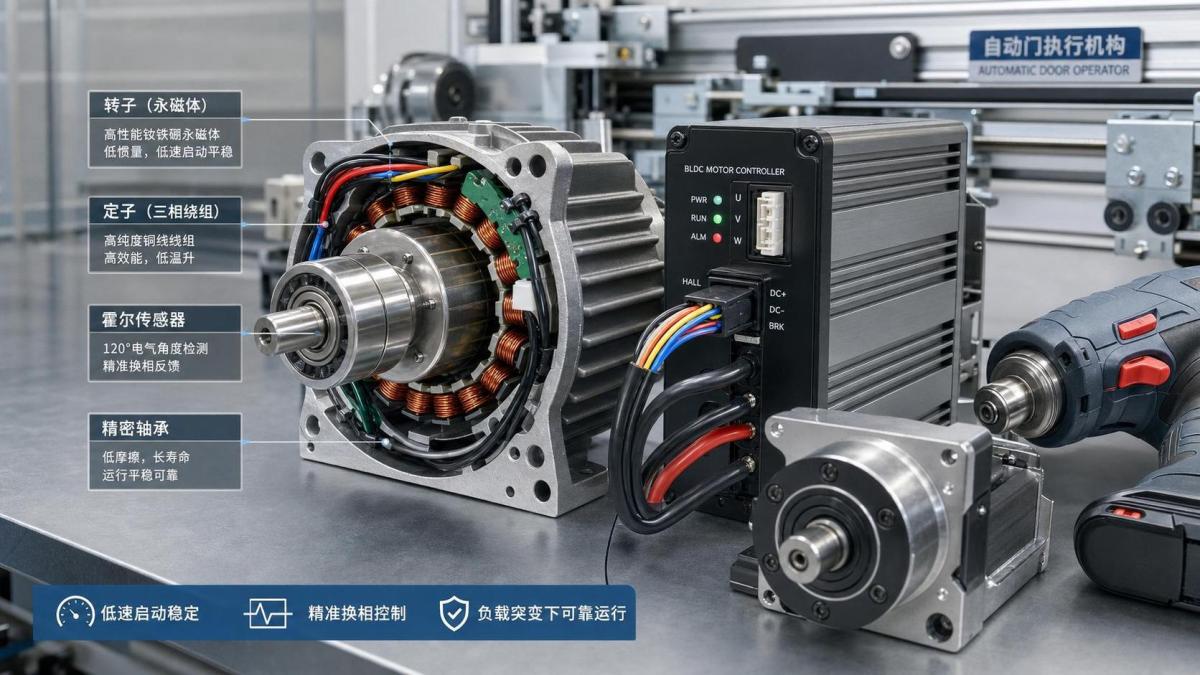
A brushless DC motor still needs to know rotor position to energize the correct stator phases. In a sensorless design, that estimate is inferred from back EMF. In a sensored design, it is measured directly.
This distinction sounds narrow, but it changes control behavior in important ways. Back EMF becomes weak at startup and low speed. Direct feedback does not disappear there, so the controller can act with more confidence.
Most implementations use Hall sensors, although encoders and resolvers appear in higher precision systems. The principle is the same: commutation is no longer based mainly on estimation during the most demanding operating range.
For technical evaluation, this is often the dividing line between acceptable motion and dependable motion. A motor that looks efficient at steady speed may still feel rough, hesitate, or draw excess current during transient events.
What Sensored BLDC Motor Technology Solves in Practice
The strongest case for sensored BLDC motor technology appears in conditions where control error has visible mechanical or system-level consequences. Startup, low-speed holding, reversal, and rapid load shifts are the common pressure points.
In handheld industrial tools, a poor start can mean kick, chatter, or lost fastening accuracy. In access control, it can mean delayed actuation or inconsistent locking movement. In smart automation, it often means position drift or unstable speed regulation.
The benefit is not simply smoother motion. Better rotor awareness can reduce current spikes, lower thermal stress, and shorten the time needed to reach commanded torque. That can extend service life in tightly packaged systems.
It also improves repeatability. For equipment connected to safety, security, or productivity targets, repeatability matters more than a headline efficiency claim taken from one operating point.
Typical performance gains
- More reliable zero-speed and near-zero-speed startup
- Stronger low-speed torque control under fluctuating load
- Cleaner directional changes and braking response
- Lower risk of stall, miscommutation, and acoustic harshness
- Better controller tuning margin for demanding duty cycles
Where the Technology Fits Across SHSS Sectors
Within SHSS coverage areas, sensored BLDC motor technology aligns best with systems where physical performance supports security, durability, or task accuracy. It is not limited to one product family.
Brushless fastening tools are the most direct example. A compact tool delivering high torque from a light housing depends on controlled current delivery, stable startup, and responsive speed correction when bit engagement changes suddenly.
Security systems present another strong use case. Motorized latches, gates, shutters, and protected access modules often operate under intermittent loads. They must respond quickly, quietly, and repeatedly, sometimes after long idle periods.
Commercial lighting may seem less obvious, yet actuated optics, ventilation subsystems, and smart building mechanisms can benefit when low-speed motion must remain stable over long service intervals.
Even in heavy-duty hardware environments, motion control quality affects the integrity of the broader assembly. If a motor-driven fastening or positioning unit overshoots, stalls, or oscillates, downstream mechanical reliability can suffer.
Tradeoffs That Deserve a Closer Look
Sensored BLDC motor technology is not automatically the right answer. It adds components, wiring, and integration work. That can affect cost, packaging space, and environmental robustness.
Hall sensors are common because they are practical and affordable, but they still introduce failure points. High heat, contamination, connector fatigue, and electromagnetic noise all deserve attention during evaluation.
The controller also matters. A weak control algorithm can waste the value of good position feedback. In other words, sensing improves the information available, but system performance still depends on firmware quality and power stage design.
There is also a business tradeoff. In applications dominated by long periods of stable, medium-to-high speed operation, a mature sensorless architecture may deliver enough value with fewer parts and lower complexity.
Questions worth asking during comparison
- Is low-speed torque critical to the task, or only peak speed?
- How often does the load change abruptly in normal use?
- What happens operationally if startup is inconsistent?
- Can the sensing hardware survive heat, vibration, and dust?
- Does the controller support diagnostics and fault handling?
How to Evaluate a Real System, Not Just a Motor Spec
The most useful evaluations treat sensored BLDC motor technology as one layer of a complete electromechanical system. Datasheet claims are only a starting point.
Begin with the load profile. A motor that performs well with a lab dynamometer may react differently when coupled to an impact mechanism, latch assembly, belt drive, or gear train with backlash.
Then examine the speed band where the product spends its time. If the duty cycle is concentrated around startup, crawl speed, or repeated stop-start motion, feedback quality becomes more valuable.
Thermal behavior should be measured across the controller, winding, and sensor package. Some designs look stable in short tests, then lose margin after enclosure temperature rises.
Noise and vibration should be reviewed alongside electrical metrics. In security hardware and compact tools, harsh acoustic signatures often reveal control weaknesses before outright failure appears.
A practical evaluation sequence
A disciplined comparison usually includes these checkpoints.
- Map the duty cycle, including idle time, startup frequency, and overload events
- Measure low-speed current draw and torque stability
- Test rapid load changes, reversals, and stall recovery
- Review sensor integrity under heat, shock, and contamination
- Compare control behavior after aging, not only when new
Why the Topic Remains Timely
The broader industrial context is pushing motor decisions closer to system-level risk decisions. Tools are becoming lighter and more powerful. Security hardware is becoming more automated. Smart infrastructure expects continuous uptime with tighter energy discipline.
That combination makes control quality more visible. When power density rises, the penalty for unstable commutation rises with it. When systems connect to access, safety, or city operations, motion reliability becomes part of the service promise.
From the SHSS perspective, this is where sensored BLDC motor technology fits naturally. It supports the larger pursuit of durable, precise, and trustworthy physical systems, whether the endpoint is a high-torque tool, a controlled actuator, or a protected facility mechanism.
A Useful Next Step for Decision Making
A good next step is to define the application by failure consequence rather than by motor type preference. If missed starts, weak low-speed control, or poor transient response create operational cost, sensored BLDC motor technology deserves serious weight.
Build the comparison around measured behavior in the real load envelope. Review controller quality, sensing durability, and service environment together. That approach usually reveals whether position feedback is an unnecessary layer or a justified control advantage.
In many advanced hardware and security systems, the answer becomes clear only when motion, reliability, and system risk are judged as one problem. That is the point where sensored BLDC motor technology stops being a feature and becomes a design decision.
Recommended News