
Search News
Industry Portal
Hot Articles
Brushless Drill Wholesale Price: What Changes Cost Across Order Sizes
Time
Click Count
Why does brushless drill wholesale price change so much by order size?
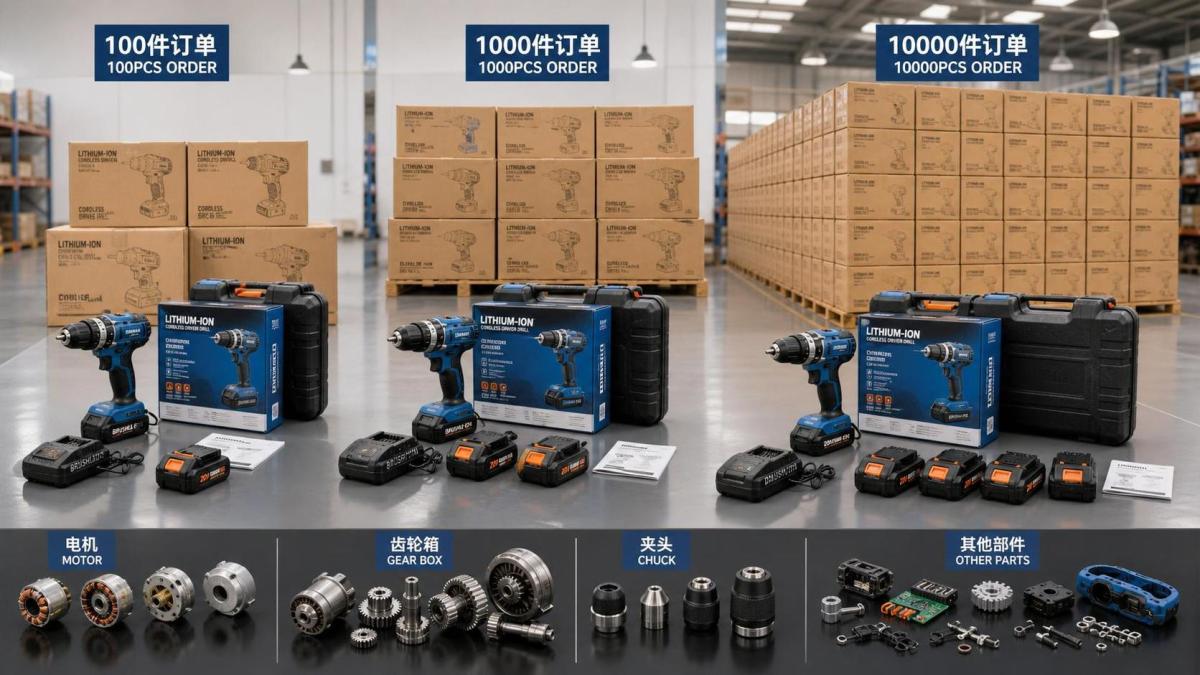
Brushless drill wholesale price rarely moves for one reason alone. The same drill can look identical on a quote sheet, yet land at very different costs.
In most cases, the price shift begins with volume, but it does not end there. Component grade, battery chemistry, torque output, testing scope, and carton design all matter.
A 100-unit order usually carries more fixed cost per piece. Tooling allocation, setup time, inspection effort, and export paperwork are spread across fewer units.
At 1,000 units, suppliers often unlock better motor sourcing, steadier assembly scheduling, and improved battery pack purchasing. That is where brushless drill wholesale price often becomes more competitive.
At 10,000 units, the discussion changes again. Buyers are no longer comparing only unit price. They are evaluating production stability, warranty exposure, and long-term supply discipline.
That broader view matters in industrial hardware. SHSS tracks how tools, fasteners, smart lighting, and protective systems share one rule: low visible cost can hide high operational risk.
So when reviewing brushless drill wholesale price, the practical question is not simply, “What is the cheapest offer?” It is, “What exactly changed behind the number?”
What usually changes inside the quote when volume increases?
The first change is component procurement. Larger orders give suppliers leverage when buying BLDC motors, MOSFET control boards, chucks, bearings, and Li-ion cells.
The second change is labor efficiency. Repeated runs reduce line switching and rework. That lowers hidden manufacturing cost, even if the product specification stays constant.
Packaging also affects brushless drill wholesale price more than many expect. Custom color boxes, molded inserts, manuals, and barcode labeling can add noticeable cost at small volume.
Certification cost is another factor. CE, UL, RoHS, EMC, and battery transport compliance may already exist, or they may need partial retesting for a private-label version.
Then there is quality planning. A supplier may offer basic outgoing inspection for small orders, but provide dedicated process checks and life testing for larger programs.
A useful way to read quotations is to separate price movements into four groups:
- Fixed costs spread across units
- Material cost reductions from bulk sourcing
- Specification upgrades or downgrades
- Service commitments added to the program
Without that separation, a lower brushless drill wholesale price may be misread as a better deal, when it may simply reflect a lighter battery, weaker gearbox, or narrower inspection scope.
Which technical details have the biggest impact on brushless drill wholesale price?
Motor grade is usually near the top. Not every brushless motor is built for the same duty cycle, copper fill ratio, temperature rise, or controller response.
Battery platform often has an even larger effect. Cell brand, capacity consistency, BMS design, and cycle life can shift cost far more than exterior appearance suggests.
Gearbox and chuck quality also reshape brushless drill wholesale price. Hardened gears, tighter tolerances, and stronger chuck retention improve durability, but they raise build cost.
For industrial or construction use, torque class matters. A compact driver for light fastening is priced differently from a hammer drill expected to handle masonry and repeated load.
Environmental expectations deserve attention too. Dust resistance, drop testing, charging safety, and cold-weather battery behavior can all push the quote upward.
The table below helps compare where cost usually moves.
In real sourcing work, brushless drill wholesale price becomes easier to judge once these line items are made visible and comparable.
Is the lowest quote actually cheaper over a full buying cycle?
Often, no. The invoice may be lower, but the total landed and operating cost can move in the opposite direction.
A low brushless drill wholesale price may come with unstable cell supply, shorter trigger life, weaker torque consistency, or poor carton protection during shipment.
That becomes expensive when return rates rise, replacement batteries fail early, or tool downtime interrupts field work. The savings disappear quickly.
A more reliable comparison is to check the full buying cycle:
- Unit price versus warranty reserve
- Battery life versus replacement frequency
- Lead time stability versus stock buffer cost
- Inspection depth versus claim risk
- Carton strength versus transit damage
This is where SHSS analysis is useful. Across hardware categories, whether the item is a drill, biometric terminal, or high-strength fastener, lifecycle reliability usually beats headline discounting.
So the better question is not, “Who quoted the lowest?” It is, “Whose quote stays defensible after claims, delays, and field use are counted?”
How should quotes be compared at 100, 1,000, and 10,000 units?
Different order tiers need different reading methods. Comparing them with one simple spreadsheet line can hide important cost movements.
For smaller trial orders, the main issue is not maximum discount. It is whether the supplier can prove consistency, documentation control, and acceptable quality under limited volume.
For mid-size orders, brushless drill wholesale price should be checked against process maturity. This is usually the stage where supplier capability becomes visible.
For larger contracts, price negotiation should include capacity planning, reserve components, and contingency arrangements. A sharp quote means little if delivery slips during peak season.
A practical comparison framework looks like this:
That structure makes brushless drill wholesale price easier to benchmark fairly across suppliers and across growth stages.
Where do buyers usually misread brushless drill wholesale price?
One common mistake is comparing a bare-tool quote with a kit quote. Batteries, charger wattage, and carrying case quality can change cost more than expected.
Another mistake is ignoring specification drift between sample and bulk order. The sample may use premium cells, while mass production uses a lower-grade alternative.
Some quotes also hide cost in freight efficiency. Oversized packaging lowers loading density, which raises total landed cost even when factory pricing looks attractive.
There is also a timing issue. A favorable brushless drill wholesale price may depend on short-term commodity conditions, especially for copper, steel, and battery materials.
Before accepting any final quote, it helps to confirm these points:
- Is the quoted battery cell brand locked in writing?
- Does the gearbox specification match the approved sample?
- Are certifications valid for the exact shipped version?
- Is packaging tested for export stacking and drop risk?
- What claim process applies if torque consistency fails?
These checks are not administrative detail. They are often the reason a low quote stays low, or turns costly later.
What is the smartest next step before locking a supplier?
Start by defining the real use case. Light assembly, maintenance service, retail distribution, and construction site drilling do not need the same drill architecture.
Then build a comparison sheet around specification control, not only brushless drill wholesale price. That includes motor type, battery cells, torque range, certifications, and warranty terms.
It also helps to request two quotes: one for the current order size, and one for the next likely volume tier. That reveals how scalable the supplier relationship may be.
Where the supply chain touches broader smart hardware programs, a disciplined sourcing method matters even more. SHSS follows this same logic across tools, security systems, lighting, and industrial hardware.
The most useful outcome is clarity. Once the cost structure is visible, brushless drill wholesale price becomes a decision tool, not just a number in a negotiation.
A sound next move is to shortlist offers, normalize every specification line, test one production sample, and verify how price behaves when volume, warranty, and delivery commitments change together.
Recommended News