
Search News
Industry Portal
Hot Articles
What drives Li-ion batteries price fluctuations for cordless tools?
Time
Click Count
A cordless-tool quotation can look stable until the battery pack line changes just before a purchase order is released. That movement may affect the landed cost of a drill, impact wrench, grinder, or outdoor tool more than a modest change in the motor or housing price. For procurement teams buying tools in volume, the key point is simple: Li-ion batteries price fluctuations are driven by both battery-material markets and the specific technical configuration of the pack. A change in lithium or nickel costs matters, but so do cell format, chemistry, capacity, electronics, manufacturing yield, shipping conditions, and shifts in demand across the battery supply chain.
The practical response is not to buy the lowest-priced pack whenever the market softens. It is to separate temporary commodity movement from a supplier’s product-level cost structure, then align contract terms, inventory coverage, and specification control with the tool application. A pack that appears cheaper may have a different usable capacity, discharge capability, protection design, or cycle-life profile—and can create warranty, safety, and performance costs later.
Raw materials set the market floor, but not the final pack price
Lithium-ion cells contain materials whose costs can move sharply in either direction. Lithium is the material most buyers associate with battery pricing, yet it is only one input. Depending on the cathode chemistry, nickel, cobalt, manganese, iron, phosphate, graphite, copper, aluminum, electrolyte chemicals, separators, and conductive additives can all contribute to cell cost. Their effect differs by battery design.
Many cordless tools use high-power cylindrical cells designed to deliver substantial current in short bursts. These packs may use nickel-rich cathode chemistries where nickel exposure has a stronger cost effect. Other tool platforms may use lithium iron phosphate cells, which reduce dependence on nickel and cobalt but may bring trade-offs in energy density, low-temperature behavior, pack size, or compatibility with an existing platform. Procurement should not assume that a chemistry with lower exposure to one material will always produce a lower battery-pack price.
Commodity movements also reach cell quotations with a delay. Cell makers may have material inventory bought under earlier contracts, long-term supply commitments, hedging arrangements, or fixed-price supply terms. A spot-price decline in lithium therefore does not automatically mean that a current cell offer should fall by the same proportion. Conversely, a rapid rise in material costs may not immediately appear in an agreed quotation, but it can affect future renewals, minimum-order requirements, and lead times.
Questions that reveal whether a price change is material-led
- Which cell chemistry and cell model are included in the quoted pack?
- Is the proposed adjustment tied to a named material index, a cell supplier quotation, or a general market claim?
- What portion of the pack cost is the cell assembly versus electronics, casing, labor, testing, and freight?
- Does the supplier hold material or finished-cell inventory that delays the effect of current market pricing?
- Is the quoted capacity nominal, or is it based on a specified discharge rate and temperature condition?
These questions are more useful than asking only whether lithium prices have risen or fallen. They help distinguish a legitimate input-cost adjustment from a broad attempt to reset pricing without a matching change in the battery specification.
Cell availability can outweigh the commodity chart
A cell may be technically suitable for a cordless tool but difficult to obtain in the required format, power grade, or qualified production source. Tool packs commonly rely on cylindrical cells, although pouch and prismatic cells can also be used in certain designs. The availability of a particular cell size, voltage profile, discharge rating, and approved supplier can have a major influence on price.
High-capacity cells and high-discharge cells should not be treated as interchangeable. A cell optimized for runtime may not sustain the current needed by a high-torque fastening tool, rotary hammer, or grinder under load. A cell optimized for power output may carry a different cost and may provide less capacity within the same physical volume. When a supplier offers a noticeably lower pack price, buyers should confirm whether the cell’s continuous and peak discharge characteristics have changed, not merely the amp-hour label.
Production allocation is another source of movement. Large demand from electric vehicles, energy storage, e-bikes, consumer electronics, or industrial equipment can redirect capacity away from tool-grade cells. Even when raw materials are steady, limited allocation can raise the price of cells that have already been validated for a particular battery platform. A supplier that substitutes a different cell without complete electrical and mechanical validation can introduce runtime inconsistency, excessive heat generation, charging problems, or reduced tool output.
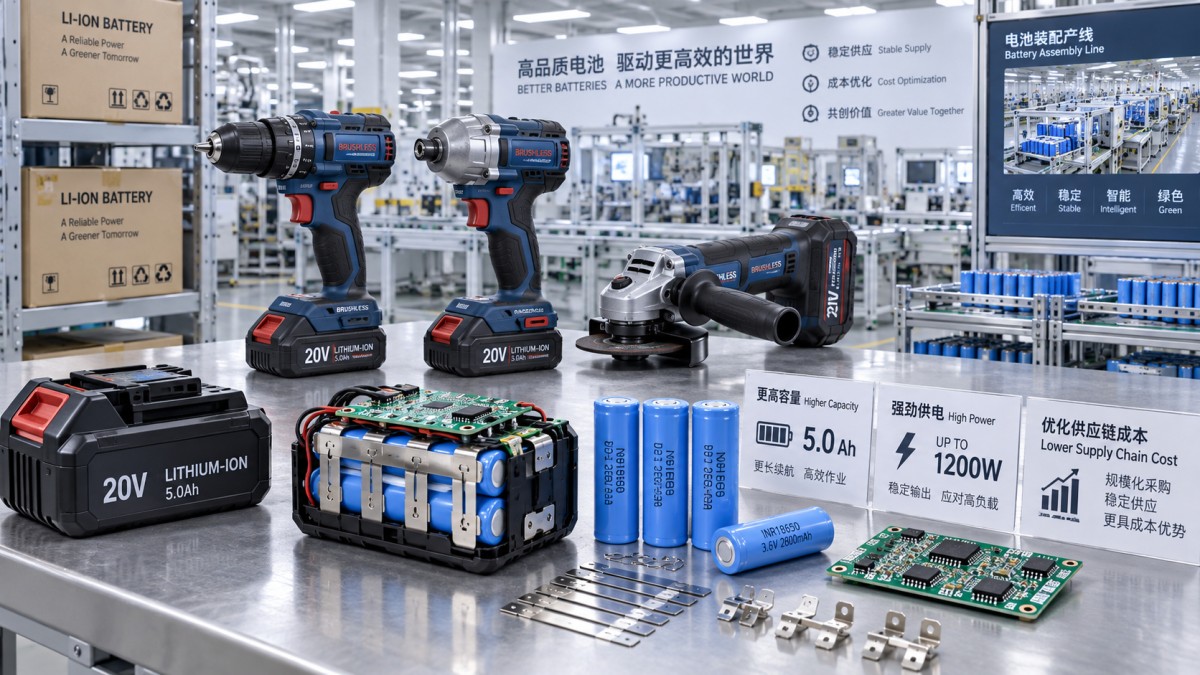
Capacity is visible; usable energy and power are the purchasing issue
Battery packs are often compared by voltage and amp-hour rating alone. That is an incomplete comparison. Nominal watt-hours provide a more meaningful starting point because they combine voltage and capacity. Even so, two packs with similar nominal watt-hours can behave differently in an actual tool because voltage sag, cell resistance, thermal limits, and battery-management settings affect usable energy under load.
For a light-duty drill used intermittently, a lower-cost pack with modest discharge capability may be acceptable if it meets the approved performance requirement. For repeated fastening, concrete drilling, metal cutting, or long-duty-cycle work, the battery is subjected to higher current and heat. In those situations, price comparison should include expected output stability and thermal behavior. Saving on the pack while causing tool shutdowns or slower work cycles can be more expensive than a higher unit price.
The BMS and pack assembly are not minor add-ons
The battery-management system (BMS) controls and monitors conditions that directly affect safety, tool performance, and pack life. Depending on design, it may measure voltage, current, and temperature; disconnect the pack during fault conditions; communicate with the charger or tool; and manage cell balancing. The electronics bill of materials can fluctuate with semiconductor availability, connector prices, printed circuit board supply, and the required level of protection.
Procurement teams sometimes see a simplified replacement pack quoted at a lower price and assume the saving comes from better cell purchasing. It may instead reflect fewer sensors, lower-rated switching components, less robust thermal protection, or limited communication capability. That does not automatically make the product unsuitable, but it means the comparison has changed. The relevant question is whether the pack provides the protection functions and tool-platform behavior required by the approved specification.
Assembly quality also affects cost. Spot-weld consistency, nickel-strip thickness, insulation placement, terminal retention, sealing, and pack testing are easy to overlook because they are not visible on a quotation. Yet weak interconnections or inadequate insulation can increase resistance and heat under demanding loads. Ask suppliers to identify what is fixed in the bill of materials and what may be substituted. This is especially important when a tool design depends on a specific connector geometry, battery communication protocol, or charger interface.
Freight, regulation, and inventory timing change landed cost
Lithium-ion batteries are regulated dangerous goods for transport. Packing method, state of charge, documentation, carrier acceptance, routing, and mode of transport can all affect delivered cost and lead time. Air freight is usually more restrictive and expensive than ocean or ground movement, while urgent replenishment can erase a favorable ex-works cell or pack price.
Battery packs also occupy space and weight in a shipment. A procurement decision that focuses on unit price but ignores carton density, pallet configuration, customs handling, and warehouse requirements can misstate the true cost difference between two sources. Rework, relabeling, damaged-goods management, and fragmented deliveries are further costs when supply is poorly coordinated.
Inventory timing matters because battery markets can move while stock is in transit or sitting in storage. Holding a large quantity may protect a tool production schedule during a shortage, but it can expose the buyer to price declines and aging inventory. Holding too little stock can force premium freight or spot buying. The right coverage level depends on demand predictability, supplier lead time, alternative-cell qualification status, and the business impact of a tool production interruption.
Demand cycles create price pressure even without a shortage
Tool demand is not constant. Construction activity, infrastructure work, seasonal outdoor use, distributor promotions, and manufacturing schedules can create concentrated demand for finished tools and replacement batteries. At the same time, cell producers may prioritize orders that offer long production runs, predictable forecasts, or less frequent model changes. A buyer placing irregular small releases may receive weaker pricing than one providing a credible rolling forecast, even when both purchase the same pack.
Demand uncertainty also encourages suppliers to build risk into quotations. Frequent changes in forecast volume, last-minute capacity requests, or unclear engineering approval status make it harder for a pack assembler to reserve cells and components. Clearer demand signals can therefore reduce avoidable price volatility. This does not require a rigid annual commitment in every case; a rolling forecast with defined flexibility bands can be enough to improve planning.
A practical way to evaluate a battery price increase or decrease
When a revised quotation arrives, start by freezing the comparison basis. Confirm the pack voltage, cell configuration, nominal watt-hours, cell manufacturer or approved source range, discharge rating, BMS functions, enclosure, charger compatibility, packaging, delivery term, and warranty responsibilities. Without this baseline, a lower offer may simply represent a lower specification.
- Break out the cost movement. Request a concise explanation of changes in cells, electronics, mechanical parts, labor, freight, and currency exposure. The goal is transparency, not necessarily access to a supplier’s confidential margin.
- Check the date relationship. Compare the effective date of the price change with the supplier’s inventory position, purchase cycle, and contract terms. Material-market headlines alone are not enough evidence.
- Review technical equivalence. Have engineering or quality teams verify any alternate cell, BMS component, connector, or pack construction before commercial acceptance.
- Calculate landed and operational cost. Include freight, packaging, import handling, expected replacement exposure, downtime sensitivity, and inventory carrying cost where relevant.
- Choose the right commercial mechanism. A fixed price may suit stable volume and a short planning horizon. A defined adjustment formula may be more appropriate when material exposure is significant and orders extend over a longer period.
Price-adjustment clauses work best when they are narrow and understandable. They should state which input is being tracked, the reference period, the adjustment frequency, the threshold for movement, and whether increases and decreases are treated symmetrically. A one-way clause that passes through market increases but ignores decreases leaves the buyer exposed. Equally, a formula should not be applied to the entire finished-pack price when only part of that price is tied to the indexed material.
Where lowest-cost sourcing can become a tool-performance risk
A cheaper replacement pack deserves extra scrutiny when it is intended for high-load cordless tools, harsh sites, or professional fleets. Warning signs include vague cell descriptions, capacity claims without watt-hour information, no stated current rating, unexplained changes in pack weight, inconsistent terminal details, or reluctance to define protection behavior. These signals do not prove a defect, but they justify a more detailed technical review before approval.
It is also risky to treat a battery as a generic consumable where the tool uses electronic communication between pack, charger, and motor controller. Compatibility involves more than physical fit. Incorrect temperature sensing, communication logic, charge termination, or overcurrent thresholds can affect runtime, charging behavior, and protection response. A qualified alternate may be commercially useful, but qualification should precede substitution rather than follow a field problem.
Questions buyers often raise during battery negotiations
Should a fall in lithium prices immediately reduce cordless battery quotations?
Not necessarily. Lithium is only one component of the cell and pack cost, and suppliers may be using cells or materials purchased earlier. Ask for the applicable cost period, the battery chemistry, and the share of the finished-pack cost that is genuinely exposed to the claimed change.
Is a higher amp-hour rating always worth paying for?
Only when the added runtime is useful in the application and the pack can deliver the required power. For intermittent use, a smaller pack may offer a better cost and weight balance. For continuous or high-load work, insufficient power capability can reduce output even when nominal capacity looks adequate.
Can two packs with the same voltage be compared as equivalents?
No. Verify watt-hours, cell type, current capability, BMS protection, physical dimensions, terminals, communication requirements, charger compatibility, and tested tool performance. Voltage alone does not establish functional equivalence.
- Last One:No more articles
- Next Article:What drives Kevlar protective clothing price differences?Sep 24, 2026
Recommended News