
Search News
Industry Portal
Hot Articles
What Drives Industrial Brushless Tools Pricing Across Duty Cycles and Battery Platforms?
Time
Click Count
What Really Drives Industrial Brushless Tools Pricing Across Duty Cycles and Battery Platforms?
Industrial brushless tools pricing usually looks simple on a quote sheet and much less simple once the tools hit the field. Two impact wrenches may appear close in voltage, torque class, and list price, yet behave very differently in a steel fabrication line, a façade installation crew, or a utility maintenance fleet. That gap is where procurement teams either protect margin or accidentally buy the wrong cost structure.
The headline number is not just about the BLDC motor. Price is shaped by the duty cycle the tool is designed to survive, the battery platform it belongs to, how much electronic control and thermal protection are built in, and how expensive the failure consequence is when uptime matters more than unit cost. In practice, buyers are not purchasing a drill, grinder, or fastening tool in isolation. They are buying runtime continuity, charging logistics, service predictability, and sometimes operator fatigue reduction.
That is why experienced sourcing teams compare industrial brushless tools the same way they would compare other critical hardware systems: not only by nameplate output, but by the real operating environment. SHSS has long looked at industrial tools in that broader context of physical reliability, where motors, batteries, fasteners, lighting, access systems, and PPE all sit on the same operational chain. A tool that stalls under heat or burns through packs too quickly does not stay a “tool issue” for long; it becomes a schedule issue, a labor issue, and sometimes a safety issue.
Duty cycle changes the price more than many buyers expect
One of the most common purchasing mistakes is comparing brushless tools intended for intermittent use against tools built for repeated heavy-load cycles. Brushless architecture improves efficiency and reduces wear points compared with brushed designs, but it does not make every tool equally industrial.
A light fastening application with short trigger pulls and cooling time between cycles puts far less stress on the motor windings, controller, gearbox, and battery than continuous overhead anchoring, repetitive structural fastening, or metal cutting. Vendors price for that stress. Better thermal management, more durable bearings, stronger gear materials, reinforced housings, and smarter current control all add cost. They also reduce the chance of performance drop-off during long shifts.
This is where quote comparisons become misleading. If one supplier is pricing around occasional assembly work and another is pricing around sustained industrial use, the cheaper option may only be cheaper on paper. On demanding sites, a lower upfront price can turn into battery churn, tool rotation headaches, and higher spare inventory.
A useful procurement question is not “What torque does it claim?” but “At what duty cycle can that output be repeated without thermal derating or shortened service life?” Many spec sheets do not answer that cleanly, so buyers often need field clarification.
Battery platform economics are rarely neutral
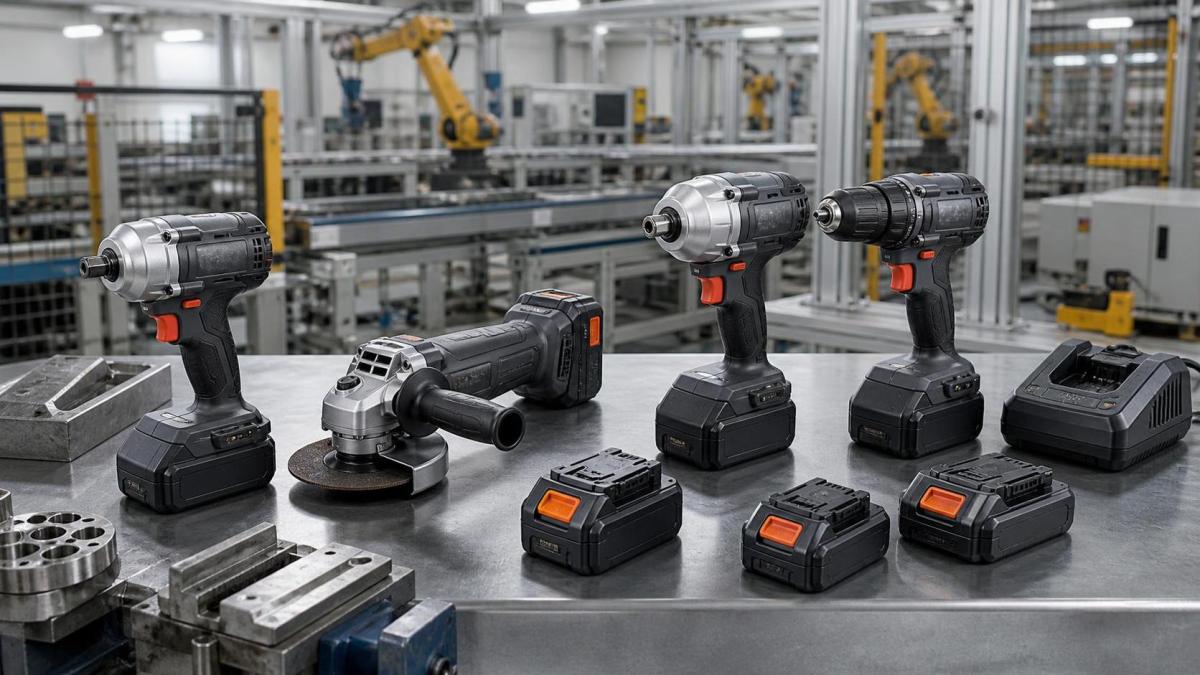
Battery platform strategy can easily outweigh the tool body price difference, especially for fleets. Procurement teams sometimes focus on a single SKU cost while operations lives with charger count, pack interchangeability, replacement lead times, and platform lock-in for the next three to five years.
Higher-rate Li-ion packs cost more for good reasons. They need to deliver current quickly, manage heat, communicate with the tool and charger, and maintain usable output under load. In industrial brushless tools pricing, the battery often reflects not just stored energy, but discharge capability and protection logic. A pack that can support a high-torque impact wrench or grinder during repeated peaks is not equivalent to a lower-demand pack used mainly for inspection or light fastening.
Platform breadth matters too. If a contractor or plant maintenance team can run drills, drivers, saws, lights, and specialty fastening tools on one battery family, the higher initial investment may be justified. If the platform only serves a narrow group of tools, then every future expansion risks adding chargers, stock complexity, and idle battery inventory.
There is also a less visible cost: operational mismatch. A battery platform with attractive purchase pricing but poor runtime consistency under heavy load can create extra pack swapping and more charging stations in the field. That may not show up in unit comparisons, but supervisors notice it immediately.
Torque class is only one layer of the pricing logic
In fastening-heavy environments, buyers understandably gravitate toward torque numbers. But the market has learned to advertise peak values aggressively, and peak output alone is not a sufficient basis for cost comparison.
What usually justifies a higher price is the combination of torque, repeatability, compactness, and control. A tool that produces high output in a lab burst is one thing. A tool that can do it repeatedly in confined spaces, with electronic speed selection, kickback mitigation, and manageable vibration, is another. In assembly, steelwork, and infrastructure maintenance, consistency often matters more than the biggest number on the carton.
The same applies across adjacent hardware categories. Whether one is evaluating structural fasteners, smart access devices, or high-output LED systems, the hidden value is often in control accuracy and lifecycle reliability rather than a headline metric. Brushless tool procurement follows that same pattern.
Electronics, protection features, and software add cost for a reason
Brushless tools depend on electronics more heavily than older brushed platforms. Motor controllers, overload protection, cell monitoring, soft start behavior, communication between battery and tool, and in some cases connected fleet features all affect price.
Some buyers see these features as optional. Sometimes they are. For low-risk, low-duty applications, simpler tools may be the better value. But in production maintenance, MEP installation, industrial shutdown work, or municipal field service, protection logic is not cosmetic. It can prevent overheating, reduce abrupt failure, and extend pack life. Those are real cost variables even when the savings are not immediate on day one.
Connected functions deserve a more careful view. Tool tracking, usage data, and lockout controls may help large fleets, but only if the organization will actually use that data. Otherwise, buyers are paying for digital features with little procurement payoff. The right question is operational relevance, not whether the feature exists.
Maintenance risk, service model, and downtime exposure often decide the true winner
When teams compare industrial brushless tools pricing, they often spend hours on discount tiers and too little time on service structure. That is backwards for any fleet used daily.
Brushless motors eliminate brush replacement, but they do not eliminate maintenance risk. Gear wear, switch failure, battery degradation, charger failure, housing damage, and controller faults still exist. What changes is the failure profile. Repairs may be less frequent in some applications, but more dependent on parts availability and authorized service channels.
If a supplier offers attractive pricing but weak local support, the apparent savings can disappear during a shutdown, a large installation project, or a peak construction period. Procurement should ask practical questions: How long are battery and tool turnaround times? Are common wear components stocked regionally? Is there a swap program? Are chargers universal across markets, or does localization create friction?
This point matters even more in organizations already managing other reliability-critical assets. The same discipline used to evaluate security hardware uptime or smart lighting lifecycle payback should be applied to tool fleets. The issue is not just purchase cost. It is continuity.
A simple comparison framework for sourcing teams
Where overbuying happens
It is easy to overpay for industrial-grade performance that a team will never use. A maintenance department doing mostly light-duty fastening across dispersed sites may not need the same battery discharge capacity or torque reserve as a steel erection crew. A fit-out contractor working indoors may value compactness and charging convenience more than maximum peak output. Buying above the real duty requirement sounds safe, but it can trap budget in oversized platforms and expensive packs.
The opposite mistake is just as common: buying to spec-sheet minimums without thinking about environment. Heat, dust, long shifts, awkward access, and operator turnover all punish lower-tier tools faster than buyers expect. On those jobs, paying more upfront can be the cheaper decision.
What to ask before approving the purchase
Before settling on price, it helps to get answers to a few non-glamorous questions:
- What is the actual daily trigger time or workload pattern, not the assumed one?
- How many tools can share one battery family without creating operational compromise?
- Is runtime under heavy load more important than compact pack size?
- What failure would hurt more: tool body replacement, battery shortage, or charger bottlenecks?
- Can the supplier explain service support in your region in plain terms?
If those answers are vague, the quote is not really complete.
Industrial brushless tools pricing makes sense when viewed as an operating system, not a shelf product. Duty cycle tells you how hard the tool will be pushed. Battery platform tells you how expensive the ecosystem becomes. Service support tells you whether the low price stays low once work starts. Buyers who line up those three factors usually make better decisions than buyers who chase either the cheapest body or the highest advertised output.
In most tenders, the right buy is not the most powerful option or the most economical-looking one. It is the tool platform whose cost structure actually matches the work.
Recommended News