
Search News
Industry Portal
Hot Articles
Physical Security Risks in 2026: Where Facility Upgrades Are Headed
Time
Click Count
As 2026 draws closer, physical security is no longer a narrow conversation about locks, cameras, and perimeter fences.
It is becoming a broader facility decision shaped by automation, compliance exposure, labor volatility, and the resilience demands placed on industrial, commercial, and civic sites.
That shift matters because the next generation of upgrades will not sit in one department.
Access control, structural hardware, intelligent lighting, powered tools, and protective equipment are increasingly judged as one connected risk system.
For organizations planning capital improvements, physical security in 2026 is best understood as a practical framework for protecting people, assets, operations, and uptime at the same time.
Why Physical Security Is Expanding Beyond Traditional Guarding
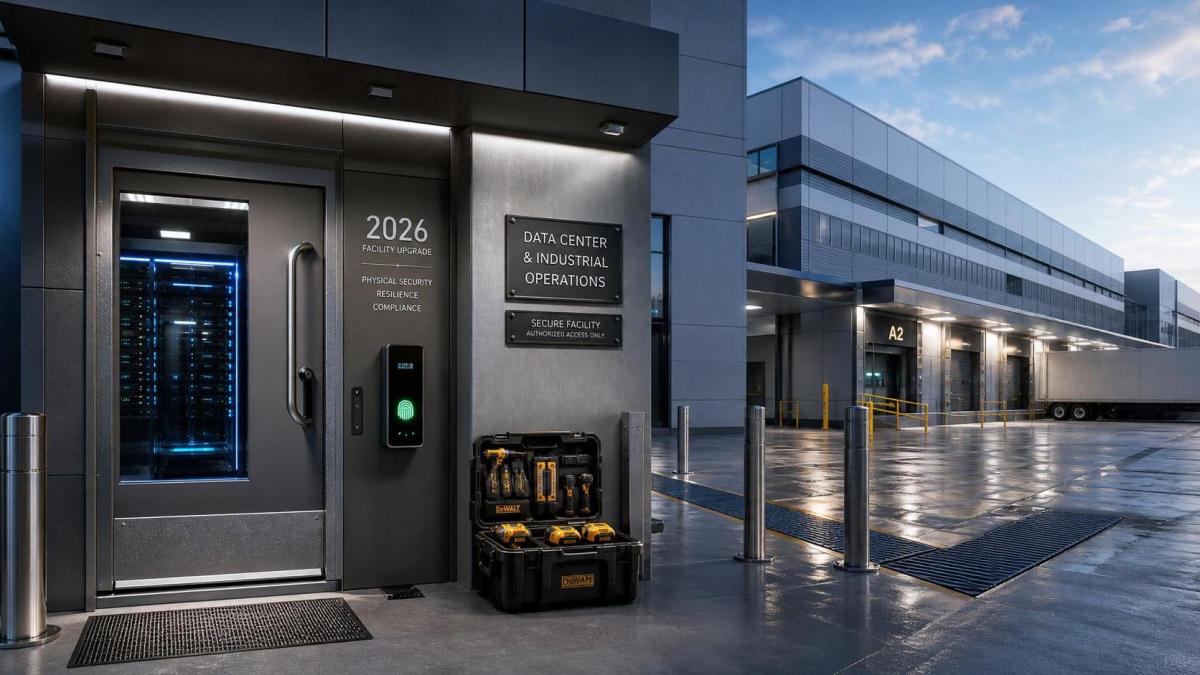
The older model treated physical security as a set of separate safeguards.
A site had doors, badges, lights, fences, and personal safety rules, but each piece was often purchased and managed on its own.
That model is weakening.
Facilities now face blended risks where a mechanical weakness, a visibility gap, or an access control failure can interrupt operations just as seriously as a digital incident.
A poorly secured service entrance may expose server rooms.
An underlit loading zone may raise injury risk, theft risk, and vehicle conflict at once.
A low-grade fastener in a harsh environment can turn into a maintenance and liability problem, not just a hardware issue.
This is where the SHSS perspective is useful.
Its focus on smart access, high-strength hardware, smart lighting, brushless tools, and PPE reflects how real facilities actually operate.
The physical edge of security is built from many small decisions that either reinforce each other or leave gaps between systems.
The Main Risk Signals Shaping 2026 Upgrades
Several trends are pushing physical security budgets toward more integrated facility upgrades.
Biometric access is moving from premium feature to operational baseline
High-risk facilities can no longer rely on shared credentials, mechanical keys, or basic card systems alone.
Biometric access now supports stronger identity assurance, faster throughput, and cleaner audit trails.
At the same time, privacy law and data handling expectations are becoming stricter.
That means physical security upgrades must consider both recognition accuracy and compliance architecture from the start.
Infrastructure resilience is under closer scrutiny
Extreme weather, vibration, corrosion, and intensive usage cycles are changing how sites evaluate physical components.
Doors, enclosures, anchors, brackets, bolts, and mounting systems are receiving more attention because failure at these points creates cascading exposure.
In physical security planning, material performance is becoming as important as monitoring technology.
Workforce conditions affect security performance
Labor shortages and faster project schedules leave less room for weak processes.
Sites need tools that support accurate installation, lighting that improves visibility, and PPE that remains wearable during long shifts.
Physical security fails more often in execution than in design.
2026 planning is increasingly about reducing those execution gaps.
Where Facility Investments Are Actually Headed
The most credible upgrade path is not a single product category.
It is a layered approach that treats the built environment as a coordinated defense system.
This direction reflects a simple truth.
Physical security depends on both intelligent detection and dependable physical infrastructure.
If one layer is weak, the whole facility becomes easier to disrupt.
How Different Site Types Are Reframing Physical Security
Not every facility carries the same risk profile, but the upgrade logic is becoming more consistent across sectors.
Industrial plants and advanced manufacturing sites
These sites need access restriction around hazardous zones, reliable hardware under vibration, and PPE that supports sustained work in tough environments.
Physical security here is tied directly to continuity, safety, and maintenance discipline.
Data centers and technical buildings
The pressure is on secure identity management, auditability, and tamper-resistant physical boundaries.
Biometric verification, reinforced doors, monitored access points, and controlled lighting all work together in these environments.
Commercial campuses and mixed-use developments
These projects balance convenience, visitor flow, emergency access, and energy costs.
Smarter lighting and flexible access systems often deliver both operational savings and stronger physical security performance.
Urban infrastructure and public assets
Street lighting, transport nodes, utility sites, and remote enclosures need long-life components and low-maintenance security design.
In these cases, lifecycle economics matter as much as initial protection levels.
What to Evaluate Before Approving a 2026 Upgrade
Many physical security projects fail because the decision process looks only at device specifications.
A stronger review should test how each upgrade performs in the actual operating environment.
- Check whether identity systems meet legal requirements for biometric collection, storage, and retention.
- Review material durability against vibration, weather exposure, corrosion, and forced-entry resistance.
- Assess lighting quality for visibility, camera support, pedestrian safety, and adaptive control.
- Confirm installation methods, including torque consistency, tool suitability, and maintenance access.
- Compare lifecycle cost, not just purchase cost, especially for long-hour LED systems and heavy-use hardware.
- Verify whether PPE supports actual wear duration, movement, and compliance in the field.
This is also where cross-disciplinary intelligence becomes valuable.
Security compliance, structural mechanics, and procurement modeling rarely sit in one document, yet they shape the outcome of every serious facility program.
That integrated view is increasingly necessary for judging physical security risk with accuracy.
A Practical Reading of the Next Two Years
The important change is not that every site will adopt the same technology.
The change is that physical security decisions are being tied more tightly to operational resilience and asset value.
In practice, that means upgrades are moving toward systems that are measurable, durable, compliant, and easier to manage across the full facility lifecycle.
The strongest 2026 plans will not chase isolated features.
They will map risk by zone, identify where mechanical and human failure can create exposure, and prioritize investments that strengthen several layers at once.
For that reason, the next step is usually a structured review of access points, hardware integrity, lighting coverage, installation quality, and worker protection conditions.
Once those conditions are visible, physical security stops being a reactive purchase and becomes a clearer facility strategy.
Recommended News