
Search News
Industry Portal
Hot Articles
Physical Security System Standards: Key Requirements and Common Compliance Gaps
Time
Click Count
Physical Security System Standards: Key Requirements and Common Compliance Gaps
For quality control and security managers, understanding physical security system standards is not a paperwork exercise. It is where procurement, installation, audit readiness, and actual incident prevention meet. A site can have premium cameras, biometric readers, smart locks, barriers, and alarms, then still fail an audit because wiring segregation is poor, event logs are incomplete, door hardware is not rated for the opening, or privacy controls around biometric data were treated as an IT issue only. Those are the gaps that usually hurt.
If you are reviewing a new deployment or cleaning up an older one, use this as a working checklist. The goal is practical: know what to verify, where standards usually apply, and what tends to go wrong before an auditor, insurer, regulator, or incident report points it out for you.
Start with the standards map, not the device catalog
One recurring mistake is selecting hardware first and checking compliance later. That reverses the logic. Physical security systems usually sit under several overlapping requirement sets:
- Life safety and egress rules, often driven by local building code and fire code.
- Electrical installation requirements, including grounding, power supply, cable routing, and backup power.
- Security system performance standards, which vary by market and application.
- Privacy and data protection rules if access control uses biometrics, video analytics, or cloud storage.
- Sector-specific requirements for data centers, critical infrastructure, healthcare, transport, or government facilities.
In practice, that means you should build a standards register for each project. Not a generic one. A site in the EU using facial or iris recognition needs a very different review path from a warehouse using badges and turnstiles in another jurisdiction. GDPR may be relevant for biometric processing in Europe, while U.S. projects often run into state-level biometric privacy rules and industry contract requirements. If your team cannot name the governing code, test basis, and certification expectations for each subsystem, you are not ready for procurement yet.
Access control: check the opening, not just the reader
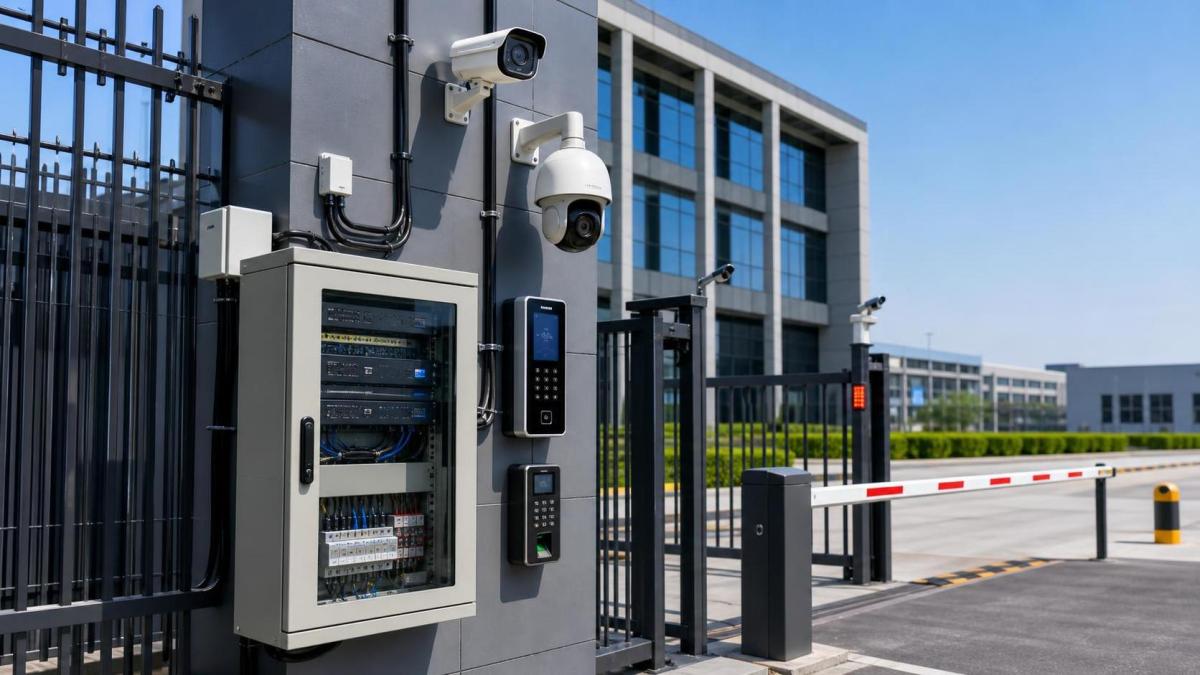
A compliant access control point is a complete assembly. Reader, controller, lock, door leaf, frame, exit device, request-to-exit, door position sensor, power supply, and emergency release all matter together. Teams often certify the credential technology in conversation, but ignore whether the actual door behavior meets code.
What to verify on every controlled opening:
- Fail-safe or fail-secure behavior matches the risk profile and local egress requirements.
- Fire-rated doors keep their listing when electrified hardware is added. Field modifications are a common audit problem.
- Door release on fire alarm, power loss, or emergency input is documented and tested.
- Forced door, held-open, tamper, and anti-passback logic are configured and actually logged.
- Mechanical strength of hardware fits the opening use case. A high-security lock on a weak frame is decorative security.
One of the most common compliance gaps is undocumented change on site. Installers swap a strike, add a maglock, bypass a sensor during commissioning, or leave a temporary override in place. Six months later, the as-built drawing and real door behavior no longer match. QC teams should treat walk-testing and as-built verification as mandatory closeout work, not optional snagging.
Biometric systems need two reviews: security performance and data governance
This is where projects get overconfident. A biometric reader may perform well in a demo and still create compliance exposure. You need to review both recognition reliability and lawful handling of biometric data.
On the technical side, ask for the actual basis of performance claims. If a vendor says a device resists spoofing or works in low light, request the test context and certification evidence where available. For presentation attack detection, liveness, template security, and matching accuracy, avoid treating marketing claims as equivalent to independently verified performance. Where standards or test reports are referenced, confirm version, scope, and whether the deployed configuration matches the tested one.
On the governance side, check these points without shortcuts:
- What biometric data is stored: raw image, template, encrypted template, or tokenized reference.
- Where it is stored: edge device, controller, local server, or cloud.
- Retention period, deletion trigger, and access rights.
- Legal basis and notice requirements for the target market.
- Incident response process if biometric data is exposed or improperly enrolled.
If these answers live only in a vendor slide deck, assume the control is weak until proven otherwise. For EU-facing deployments, biometric processing can trigger strict GDPR review depending on purpose and context. Exact obligations depend on use case and jurisdiction, so legal interpretation should be checked against current local guidance.【待核实】
Perimeter protection fails when detection is not matched to response
A fence sensor, radar unit, thermal camera, or beam detector is only compliant in a meaningful sense if alarms can be assessed and acted on in time. Many perimeter systems technically detect intrusion but generate nuisance alarms at a rate operators stop trusting.
When you review perimeter security, focus on environmental fit. Wind load, vibration, vegetation, rain, dust, headlight glare, animal movement, and site geometry all affect system performance. Acceptance testing should be done in realistic site conditions, not only during calm daytime installation windows. If the vendor provides detection range or classification accuracy, verify whether that number assumes a clean line of sight, a specific target size, or fixed environmental parameters.
A useful field question is simple: when the system alarms at 02:00, what happens in the next 60 seconds? If there is no clear answer covering video pop-up, location tagging, operator instruction, escalation path, and evidence retention, the perimeter design is incomplete.
Power, backup, and survivability are where many audits get uncomfortable
Security teams often inherit power design decisions from electrical contractors, then discover later that battery autonomy, cabinet ventilation, circuit labeling, or surge protection was never validated against the security system’s operating profile.
Review these items closely:
If the facility claims resilience, ask for witnessed failover records. Not brochures. Not design intent. Actual test evidence.
Integration is a compliance topic, not just a convenience feature
Modern sites link access control, video surveillance, intrusion detection, intercom, visitor management, building management, and sometimes smart lighting or emergency communication. Integration improves response, but it also widens the attack surface and makes responsibility blurry.
The gap shows up when one subsystem is upgraded and the event chain breaks quietly. A door forced alarm no longer calls the correct camera preset. A fire release input opens a door but leaves the audit trail incomplete. Time synchronization drifts, and incident reconstruction becomes unreliable. For QC and security managers, interface control documents and version control matter more than they sound. Keep an updated record of protocols, firmware dependencies, API connectors, and cybersecurity ownership for each integration point.
Also be careful with cloud-connected security platforms. Remote management, mobile credentials, and analytics can be operationally useful, but they raise questions around data residency, patch management, identity administration, and service continuity. If those are outside the original compliance scope, bring them in before rollout.
Documentation quality predicts audit pain
You can often tell in one hour whether a site will struggle in an audit. Open the document set. If you find mismatched device lists, outdated drawings, incomplete maintenance logs, missing commissioning records, and unclear exception approvals, the technical system may still work, but compliance confidence is already weak.
At minimum, keep these current:
- Approved submittals and product certifications relevant to the installation.
- As-built drawings with door schedules, device locations, and wiring architecture.
- Commissioning and acceptance test records.
- Preventive maintenance schedule and fault history.
- User access matrix, admin rights review, and change logs.
- Data handling and retention procedures for video and biometrics where applicable.
This sounds basic, but many common compliance gaps are not engineering failures. They are evidence failures. The control may exist, yet nobody can prove configuration, test status, or approval history.
A practical closeout check before you sign anything
Before final acceptance, walk the site with three lenses at once: code compliance, operational reality, and maintainability. That means testing doors the way users actually use them, reviewing alarm handling in the control room, checking whether replacement parts and firmware support are available, and confirming that site staff understand routine override and emergency procedures.
If you need one rule of thumb, use this: any physical security system standard is only as strong as the last undocumented field change, the least-tested door, or the integration nobody owns. Catch those early and the rest of the compliance work gets much cleaner.
For teams working across smart access, biometric security, hardware strength, and critical facility protection, that discipline matters more than buying the most advanced device on the market. Standards give you the baseline. Careful verification is what turns that baseline into a system you can trust.
Recommended News