
Search News
Industry Portal
Hot Articles
How preload loss can affect high-strength fasteners for bridges
Time
Click Count
How Preload Loss Can Affect High-Strength Fasteners for Bridges
Preload loss is one of the quieter failure mechanisms in bolted bridge connections. It rarely produces an immediate, dramatic event. More often, a connection that was correctly assembled gradually loses part of its clamping force through settlement, vibration, coating compression, temperature movement, corrosion, or repeated traffic loading. The bolts may still look intact during a visual walkdown, yet the joint is no longer behaving as its designer intended.
For high-strength fasteners for bridges, this distinction matters. A high-strength bolt does not protect a connection simply because its material has a high tensile capacity. Its value comes from the tension introduced during installation and the frictional restraint or clamping action created between connected steel surfaces. Once that tension falls below the level assumed by the connection design, load paths can change. Slip can begin at interfaces intended to remain stationary, fatigue demand can rise at bolt holes, and local movement can progressively damage protective coatings.
In bridge work, preload should be treated as a whole-system condition rather than a bolt property. The bolt, nut, washer, steel plates, faying surfaces, installation method, access conditions, and inspection record all influence the final result. This is why a fastener review that focuses only on bolt grade or mill certification can miss the more consequential question: will the assembled joint retain the required clamping force over its service life?
What preload actually does in a bridge connection
Preload is the tensile force created in the bolt when the nut is tightened. That tension compresses the connected parts. In a slip-critical connection, the principal purpose is to create enough normal force across prepared faying surfaces that shear is transferred through friction rather than through bolt bearing. In a bearing-type connection, preload can still improve joint stability and resistance to loosening, although the design load path may ultimately involve contact between the bolt shank and the hole.
This difference should not be blurred during technical evaluation. A joint designed as slip-critical can be particularly sensitive to preload loss because its assumed slip resistance depends directly on sustained clamping force and surface condition. If the plates move, the effects may extend beyond a small amount of displacement. Repeated micro-slip can enlarge holes, fret coating systems, create corrosion initiation points, and introduce fatigue stresses where the connection was expected to remain essentially static.
The practical lesson is simple: bolt tension is not a one-time installation target. It is the mechanism that keeps the connection working. Torque is only one means of producing that tension, and a specified torque value alone does not prove that a predictable preload was achieved.
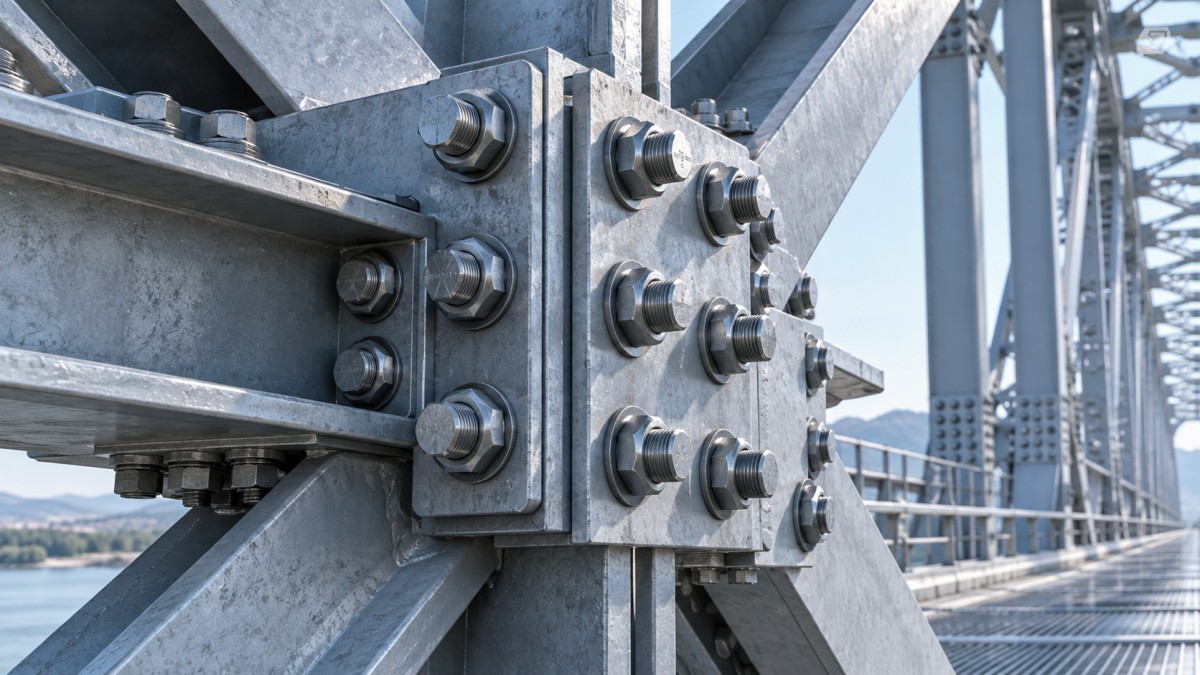
Why installed bolt tension falls after assembly
The most common early reduction comes from embedment, sometimes called settlement. The mating surfaces in a bolted assembly are not perfectly smooth. Under high compressive force, small asperities in the bolt head bearing surface, nut face, washers, coating layers, and steel plates flatten or seat. Even a small loss of grip length can reduce bolt elongation enough to produce a meaningful reduction in tension, especially in relatively short-grip assemblies.
Coatings require particular attention. Zinc-rich systems, paint overspray, surface contamination, damaged galvanizing, or an unapproved coating beneath a washer can alter both friction and settlement behavior. There is no universal rule that “painted steel is unacceptable” or that “galvanized bolts are unsuitable.” The issue is whether the complete bolted assembly and faying-surface preparation match the governing specification and the connection design assumptions. Friction coefficients, coating thickness, curing condition, and installation procedure cannot be treated as unrelated details.
Vibration and cyclic loading add another layer. Bridge connections experience varying stress ranges from truck traffic, braking, wind, deck movement, and, in some locations, seismic action. Properly preloaded structural bolts are generally resistant to spontaneous loosening because the clamped parts remain compressed. But when joint movement develops, when preload was marginal from the beginning, or when the connection includes geometry that promotes rotation or transverse slip, cyclic action can accelerate loss of tension.
Thermal effects are often underestimated in long bridge structures. Steel members, bolts, deck components, and adjacent materials do not always heat and cool at the same rate. A connection near an expansion region, exposed to strong solar heating, or linking elements with different thermal behavior may see repeated changes in clamping force. A single temperature cycle is not usually the concern; thousands of cycles combined with settlement and vibration can be.
Corrosion makes the issue more complicated rather than merely weaker. Rust products can occupy more volume than the original metal, disrupt contact surfaces, trap moisture, and damage coatings. At the same time, section loss in the bolt, nut, washer, or plate reduces available capacity. An evaluator should avoid assuming that a visibly corroded connection is simply “tighter” because corrosion products fill gaps. That condition may conceal loss of reliable bearing surfaces and an unpredictable preload state.
What preload loss changes structurally
The first consequence is often movement at the faying surface. In a slip-critical splice, reduced clamping force lowers slip resistance. Once slip occurs, the connected plates may reposition until bolts contact the sides of their holes. That shift can be small, but its engineering significance may not be. The joint has moved from friction-based load transfer toward bearing behavior, potentially changing stiffness, stress distribution, and fatigue performance.
A second consequence is a less favorable load split within the connection. Bolts do not always share load equally in real structures. Hole tolerances, fabrication fit-up, plate distortion, and connection geometry already create variation. When some bolts lose more preload than others, local slip or contact can cause individual fasteners to attract higher cyclic demand. The bolt that appears least remarkable in a layout may become the one exposed to the harshest repeated stress range.
Then comes fatigue. High-strength bolts are not immune to fatigue simply because they have high tensile strength. Fatigue is driven by stress range, detail geometry, loading cycles, and the way the joint transfers load. A stable preloaded joint can limit changes in bolt force under service loading. A joint that has slipped, settled, or developed prying action may expose bolts and adjacent steel to a different loading regime. This is why loose or suspect fasteners near fatigue-sensitive details deserve more than a quick retightening decision.
There are also operational consequences. Movement can crack paint at plate edges, create reddish staining around interfaces, loosen locknuts on attached components, or generate audible clicking under live load. None of these signs independently proves preload loss. They are, however, useful prompts for a more disciplined inspection, particularly around cross-frame connections, diaphragms, splices, bearing-adjacent details, and connections exposed to persistent moisture or deicing salts.
Installation choices that create avoidable risk
Many preload problems originate before the bridge enters service. A recurring mistake is treating torque as a direct measurement of bolt tension. Torque is heavily influenced by friction under the nut, at the washer face, and in the threads. Lubrication condition, zinc coating, dirt, reuse, damaged threads, and even inconsistent tool calibration can change the relationship between torque and tension. Two bolts tightened to the same torque can develop materially different preloads.
For this reason, recognized structural bolting procedures generally rely on controlled installation methods rather than an isolated torque number. In North American work, project documents may refer to the Research Council on Structural Connections (RCSC) Specification and to applicable ASTM structural bolting assembly requirements, including ASTM F3125/F3125M where relevant. In European projects, EN 14399 is commonly associated with preloaded structural bolting assemblies. The applicable bridge authority specification still governs; standards should not be mixed casually across a project.
Turn-of-nut, calibrated wrench procedures, twist-off-type tension-control assemblies, and direct tension indicators are all used in appropriate circumstances. Each has limits. Turn-of-nut installation depends on proper initial snug-tight condition and sufficient rotation access. Calibrated wrench methods require verification with the actual lot, assembly condition, and equipment setup. Tension-control bolts can be useful where access is constrained, but they do not eliminate the need to confirm assembly compatibility, installation sequence, and inspection requirements. Direct tension indicators can provide a visible indication of compression, yet they must be installed and interpreted correctly.
The field environment matters as much as the procedure. A crew working from a lift under wind, rain, limited lighting, or difficult overhead access may not achieve the same repeatability as a controlled shop trial. Tool selection deserves attention here. High-output cordless or pneumatic tools can improve installation speed, but power is not the same as control. A suitable fastening tool must deliver repeatable operation within the specified procedure, and its use must be coordinated with access planning, reaction-arm safety, and PPE requirements.
A practical evaluation approach for existing and new bridge work
When reviewing high-strength fasteners for bridges, start by separating a suspected preload issue from a general corrosion or fabrication issue. Confirm the connection’s intended behavior: slip-critical, bearing-type, or another specified arrangement. Then review the original bolt assembly, washer arrangement, faying-surface treatment, hole type, and installation method. A bolt grade stamped on the head is not enough to reconstruct whether the connection was assembled correctly.
For an in-service joint, records can be as valuable as visual findings. Installation logs, lot traceability, pre-installation verification records, inspection reports, change notices, and photographs may reveal whether substitutions occurred or whether field conditions changed from the approved method. If the concern is serious, evaluation may require a bridge engineer to define an inspection and remediation plan rather than allowing routine maintenance personnel to tighten bolts indiscriminately.
Retightening is not automatically a safe cure. If slip has occurred, if holes have elongated, if coatings have been damaged, or if a bolt has been significantly corroded, simply applying more torque can hide the condition without restoring the original connection performance. Reuse rules, replacement requirements, and installation procedures should follow the governing specification and project-specific engineering direction. The correct action may range from targeted verification to replacement of assemblies, surface repair, or redesign of a detail that repeatedly loses tension.
At SHSS, high-strength hardware is viewed as part of the physical chain that keeps heavy infrastructure coherent under real operating conditions. That perspective is useful because bridge fasteners are often small relative to the steel they join, yet they carry the consequences of fabrication quality, installation discipline, environmental exposure, and maintenance decisions all at once.
The decision point is not the bolt’s strength alone
A bridge bolt can meet material requirements and still perform poorly in a connection that loses preload. The technical evaluation should therefore move beyond “Is this a high-strength bolt?” to “Can this assembly achieve, verify, and retain the required clamping force in this specific joint?” That question brings together design classification, faying-surface condition, coating compatibility, installation method, inspection access, and expected exposure.
The most reliable prevention usually happens before installation: specify compatible assemblies, define the required procedure clearly, verify it under field-representative conditions, and preserve records that allow future inspection teams to understand what was installed. Once a bridge is carrying traffic, preload loss is no longer just a fastening detail. It becomes a connection-performance issue that should be assessed with the same care as any other fatigue or durability concern.
- Last One:No more articles
- Next Article:What to verify before choosing a vertical farming LED lighting supplierSep 30, 2026
Recommended News