
Search News
Industry Portal
Hot Articles
How to Evaluate a Private Label Hardware Supplier in Europe
Time
Click Count
Choosing a private label hardware supplier Europe partner has become a board-level decision, not a routine purchasing step. Product reliability, regulatory exposure, delivery resilience, and brand trust now sit on the same table, especially in hardware categories tied to safety, building performance, and industrial uptime.
That matters even more across Europe, where private label programs often span multiple markets, languages, compliance regimes, and end-use environments. A supplier that looks competitive on price can still create hidden risk if traceability, certification discipline, or engineering consistency are weak.
For sectors tracked closely by SHSS, including brushless tools, biometric access devices, high-strength fasteners, smart lighting, and PPE, evaluation must go beyond catalog breadth. The real question is whether the supplier can support a durable brand position in a demanding market.
What evaluation really means in the European market
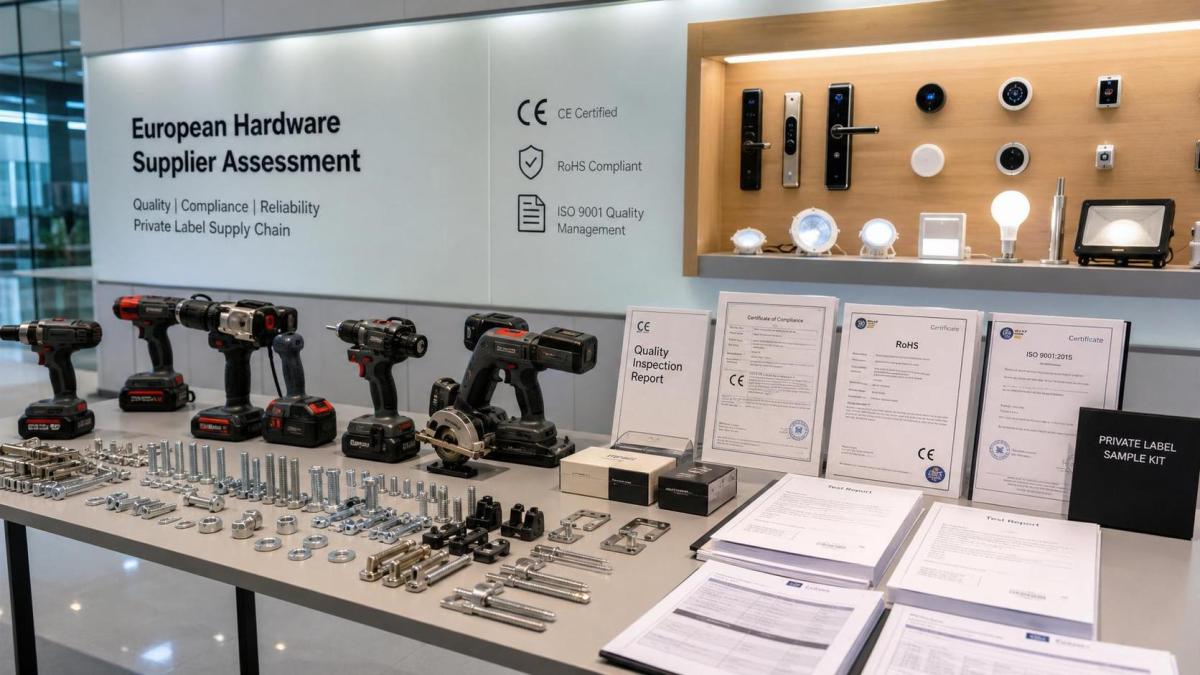
A private label hardware supplier Europe relationship usually combines manufacturing, customization, compliance support, packaging execution, and ongoing quality control. It is not simply OEM production with a logo added at the end.
In practical terms, evaluation means checking whether the supplier can convert your commercial concept into market-ready hardware with predictable outcomes. That includes technical integrity, legal conformity, and supply continuity over time.
Europe adds a specific layer of complexity. Requirements around CE marking, RoHS, REACH, EN standards, packaging obligations, energy performance, data protection, and product documentation can affect launch speed and post-sale risk.
A capable supplier understands that compliance is not a final checkbox. It is part of product design, sourcing choices, factory processes, labeling, and after-sales recordkeeping.
Why this topic deserves closer attention now
European buyers face tighter scrutiny on product claims, sustainability signals, and data handling. At the same time, supply chains remain exposed to energy costs, geopolitical shifts, and material volatility.
These pressures are especially visible in smart and safety-related hardware. A biometric reader touches cybersecurity and GDPR questions. A high-strength fastener touches structural liability. Smart lighting touches energy standards and interoperability.
In other words, the wrong private label hardware supplier Europe choice can damage far more than margin. It can delay approvals, increase warranty claims, weaken channel confidence, and restrict expansion into new countries.
The stronger suppliers are responding by investing in documentation systems, test capacity, engineering collaboration, and multi-country compliance awareness. That is why evaluation frameworks now matter much more than broad promises.
The first screen: category fit and technical depth
Not every supplier is equally credible across all hardware segments. Some are strong in metal forming but weak in electronics. Others understand smart devices but struggle with harsh industrial environments.
The first filter should be category relevance. Ask whether the supplier has repeatable experience in the exact product family you plan to private label.
- Brushless tools require motor efficiency, battery safety, thermal control, and durability testing.
- Biometric security hardware requires optical accuracy, firmware discipline, and secure data architecture.
- Fasteners require metallurgy control, thread precision, heat treatment consistency, and load verification.
- Smart lighting requires driver quality, protocol compatibility, lumen maintenance, and environmental protection ratings.
- PPE requires material validation, fit performance, user safety documentation, and certification integrity.
A serious private label hardware supplier Europe candidate should speak comfortably about failure modes, not only sales features. That usually reveals whether engineering is real or outsourced.
Compliance is a commercial capability, not a legal footnote
Many supplier shortlists collapse at this stage. Hardware may look acceptable physically, yet the supporting paperwork, declarations, test reports, or data controls are incomplete or outdated.
For Europe, the evaluation should include both product compliance and process compliance. The details vary by category, but the discipline should be visible everywhere.
This is where intelligence-led review adds value. In SHSS-tracked segments, compliance weaknesses often appear at the intersection of mechanics, electronics, and digital control, not in a single document.
How to judge manufacturing reliability beyond the factory tour
Factory visits still matter, but polished workshops can hide unstable production discipline. A better approach is to test how the supplier manages variation, documentation, and change control.
Ask for evidence on incoming inspection, in-process control, final testing, nonconformance handling, and corrective action closure. The answer should be specific, documented, and current.
Pay close attention to component traceability. For connected locks, LED drivers, motors, battery cells, coated fasteners, or filtration media, upstream inconsistency quickly becomes downstream warranty cost.
A dependable private label hardware supplier Europe partner should also explain how engineering changes are approved. Silent substitutions are one of the most common causes of quality drift in private label programs.
Signals that usually indicate stronger control
- Stable revision history for drawings, firmware, and packaging artwork.
- Defined sampling plans tied to product risk.
- Clear retention of batch records and test data.
- Failure analysis that identifies root cause, not just symptom.
- Supplier qualification for critical materials and subassemblies.
Commercial fit matters as much as technical fit
Many sourcing reviews focus heavily on unit cost. That is necessary, but incomplete. The more useful question is whether the commercial model supports your intended market position.
A supplier built for large, low-mix volume may underperform when your strategy needs product variants, multilingual packaging, or staged market entry. Another supplier may be flexible but too expensive for scale retail.
When reviewing a private label hardware supplier Europe option, compare commercial factors in context:
- Minimum order quantities versus launch strategy
- Tooling ownership and design rights
- Lead times under normal and peak demand
- Warranty terms and failure responsibility
- Packaging localization and labeling flexibility
- After-sales parts, service, or firmware support
This is often where long-term margin is protected. A slightly higher unit price can be justified if it lowers returns, simplifies approvals, and shortens replenishment cycles.
Different hardware categories require different risk lenses
Evaluation should reflect the product’s role in the field. Not all hardware carries the same operational consequences when it fails.
For structural fasteners, the focus falls on material integrity, fatigue resistance, and certification traceability. For smart lighting, energy efficiency and control compatibility may matter more than pure component cost.
For access control and biometric devices, data protection, anti-spoofing performance, software updates, and cybersecurity posture become central. For PPE, field conditions and regulatory evidence can outweigh aesthetic branding options.
This is why SHSS often frames hardware evaluation around the real-world role of each product: power, protection, access, connection, and endurance. That lens keeps sourcing decisions close to operational reality.
A practical path to shortlist and validate
A useful shortlist usually becomes clearer when evaluation happens in stages instead of one broad negotiation. Early discipline saves time later.
Stage one: document review
Check certifications, test reports, declarations, manufacturing scope, reference projects, and export readiness. Eliminate suppliers that rely on vague future promises.
Stage two: technical discussion
Review drawings, tolerances, firmware architecture, materials, test protocols, and category-specific standards. Strong teams answer directly and identify risks early.
Stage three: sample and pilot validation
Test samples under realistic use conditions. Include packaging checks, installation feedback, and stress scenarios relevant to the European end market.
Stage four: operational alignment
Confirm service levels, forecasts, order handling, incident response, and quality escalation paths. A private label hardware supplier Europe agreement should be operationally precise before scale begins.
From evaluation to smarter next steps
The best supplier decision usually comes from combining technical evidence, compliance depth, and commercial realism. No single scorecard captures everything, but a structured review exposes weak assumptions quickly.
Before moving forward, define the product role, the target market, the acceptable risk level, and the documentation threshold required for launch. That makes discussions with any private label hardware supplier Europe candidate far more productive.
Where products touch critical safety, building access, or infrastructure performance, it also helps to compare suppliers through a broader intelligence lens. Technical quality, legal readiness, and lifecycle economics should be judged together, not in isolation.
That approach creates a stronger base for private label growth in Europe: fewer surprises, better market credibility, and a supply chain that can support expansion instead of slowing it down.
Recommended News