
Search News
Industry Portal
Hot Articles
How to Evaluate a Smart Hardware Supplier in Southeast Asia
Time
Click Count
How to Evaluate a Smart Hardware Supplier in Southeast Asia
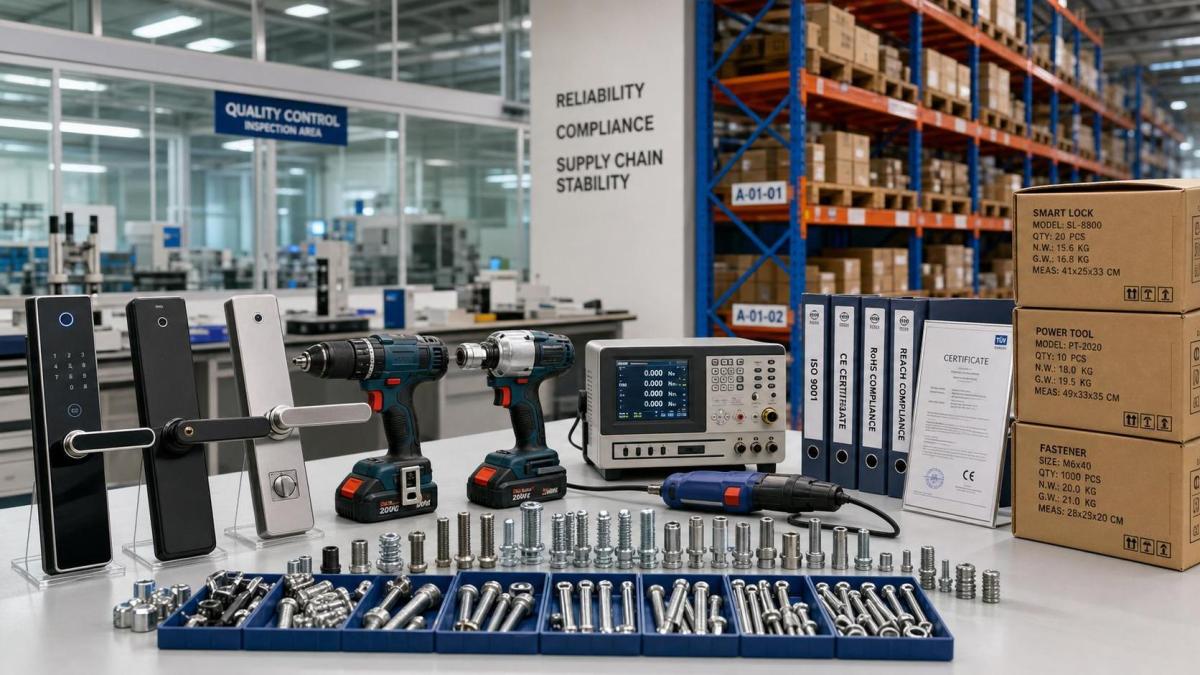
Choosing the right smart hardware supplier Southeast Asia offers is no longer just about price or lead time.
For business evaluators, the real task is measuring reliability, compliance, resilience, and upgrade capacity across several product groups.
That matters even more in security systems, smart lighting, industrial tools, high-strength fasteners, and protective equipment.
A strong smart hardware supplier Southeast Asia buyers trust should support both immediate delivery and long-term operating performance.
This guide breaks the evaluation process into practical checkpoints that reduce sourcing risk and improve final supplier selection.
Start With Category Fit, Not a General Pitch
Not every smart hardware supplier Southeast Asia market participants promote is strong across every category.
Some are excellent in biometric access control.
Others are better at BLDC tools, DALI lighting, structural fasteners, or industrial PPE.
So the first step is narrowing the supplier’s real competence by product family and application scenario.
Ask where most of their revenue comes from.
A supplier focused on commercial smart locks may not understand bridge fastener traceability or respirator certification depth.
In actual procurement work, specialization usually beats broad catalogs.
What to verify first
- Top product lines and annual output share
- Core export markets and customer industries
- Typical project size and technical complexity
- In-house engineering depth by category
- Failure cases and corrective actions
Check Product Reliability Beyond the Sample Stage
A polished sample proves very little.
A capable smart hardware supplier Southeast Asia buyers keep working with should deliver stable quality at production scale.
That means repeatability across batches, materials, firmware versions, and subcontracted components.
For tools, check torque consistency, battery cycle performance, motor heat control, and drop resistance.
For smart security hardware, examine false acceptance rates, low-light performance, latency, and offline fallback behavior.
For fasteners, verify hardness, tensile strength, coating quality, and lot traceability.
For lighting, request lumen maintenance data, driver lifespan, and control protocol compatibility.
For PPE, look at fit consistency, material durability, and certification validity under target-use conditions.
Useful reliability questions
- What does incoming material inspection cover?
- Which tests are done on every batch?
- What is the field failure rate over twelve months?
- How are firmware and component changes controlled?
- Can they share real warranty claim patterns?
Measure Compliance Readiness Early
Compliance problems rarely appear in the quotation stage.
They usually surface later, when shipments are scheduled or installation is already planned.
That is why any smart hardware supplier Southeast Asia sourcing teams review should be checked for destination-market readiness.
Recent market shifts make this more important.
Security products now face deeper scrutiny around biometric data, cloud storage, and privacy rules.
Lighting and electrical products must align with safety, EMC, and energy efficiency requirements.
PPE and mechanical hardware often need test records that stand up to industrial audits.
Documents worth reviewing
- ISO certifications and scope details
- CE, RoHS, EMC, or market-specific declarations
- Biometric privacy and data handling policies
- Third-party lab reports with recent dates
- Material safety and origin records
Ask who owns compliance internally.
If the answer is vague, the risk is usually real.
Test Supply Chain Resilience, Not Just Factory Capacity
A reliable smart hardware supplier Southeast Asia businesses select should not depend on one fragile upstream source.
This is especially critical for chips, sensors, batteries, forged metal inputs, and specialized fabrics.
Lead time promises are easy.
Supply chain transparency is harder, and much more useful.
Ask about second-source planning, safety stock rules, and dependency on imported subcomponents.
Then compare this with their actual delivery history.
The more obvious signal is whether they can explain disruption response without resorting to generic statements.
Operational indicators that matter
Look for Engineering Depth and Product Roadmap Strength
A transactional vendor can fill an order.
A strategic smart hardware supplier Southeast Asia companies value can improve products over time.
That distinction becomes important once deployment scales across facilities, cities, contractors, or channel networks.
Ask whether engineering is truly internal.
Then review how they handle firmware updates, optical design, battery systems, alloy selection, ergonomic improvements, or protective material upgrades.
This also tells you whether future customization is realistic.
In fast-moving categories, stagnant suppliers quickly become replacement risks.
Signs of real innovation capacity
- Documented R&D team structure
- Recent model updates with measurable improvements
- Clear protocol support such as Zigbee or DALI
- Test fixtures, validation labs, or pilot lines
- Custom development process with milestones
Evaluate Commercial Terms Through Total Risk
The cheapest quote can become the most expensive decision.
When assessing a smart hardware supplier Southeast Asia sourcing teams shortlist, compare total operating risk, not unit price alone.
A lower-cost biometric reader with poor algorithm stability can create reinstallation costs.
A cheaper LED system with weak driver quality can erase savings through maintenance visits.
A low-priced fastener with inconsistent heat treatment can produce much worse outcomes.
This also means contract terms deserve close review.
Terms to compare carefully
- Warranty scope and claim turnaround
- Spare parts support period
- Penalty or remedy for quality deviation
- Engineering change notification rules
- Forecast flexibility and reorder terms
Use a Structured Supplier Evaluation Scorecard
A scorecard keeps supplier review grounded in evidence.
It also helps teams compare two seemingly similar offers from the smart hardware supplier Southeast Asia market more objectively.
Weight the criteria based on project risk.
For example, compliance may matter more for biometrics, while durability may dominate in tools or PPE.
Suggested scoring areas
- Category specialization
- Quality consistency
- Compliance readiness
- Supply chain resilience
- Engineering and roadmap strength
- Commercial terms and after-sales support
This approach turns a supplier conversation into a decision framework.
That usually leads to better long-term outcomes than relying on presentations alone.
Final Decision Signals to Watch
Before choosing any smart hardware supplier Southeast Asia offers, pause and test one final point.
Can the supplier answer technical, operational, and compliance questions with consistent detail across teams?
When sales, engineering, and quality managers tell the same story, confidence usually rises for a reason.
When answers conflict, hidden issues often surface later.
The best smart hardware supplier Southeast Asia decision is rarely the loudest or the cheapest.
It is the supplier that proves dependable performance, audit readiness, and practical innovation under real business pressure.
Use that standard, and supplier selection becomes a disciplined growth decision rather than a short-term purchase event.
Recommended News