
Search News
Industry Portal
Hot Articles
Hardware Application References in Europe: What Projects Prove Compliance
Time
Click Count
In Europe, application references do more than decorate a product brochure. They show where hardware has already faced real regulations, live operating pressure, and formal procurement review. For that reason, hardware application references Europe often become the fastest way to judge whether a solution is commercially credible, legally usable, and technically mature.
This matters across physical security, industrial tools, high-strength fasteners, smart lighting, and protective equipment. A claimed specification may look strong on paper. A verified project in a hospital, transit hub, factory, bridge upgrade, or municipal retrofit says much more about compliance discipline and long-term fit.
For SHSS, which tracks the hard interface between safety, mechanics, and intelligent control, European references are especially useful. They connect product performance with actual obligations around GDPR, CE marking, EN standards, energy efficiency, worker protection, and public infrastructure accountability.
Why European project references carry unusual weight
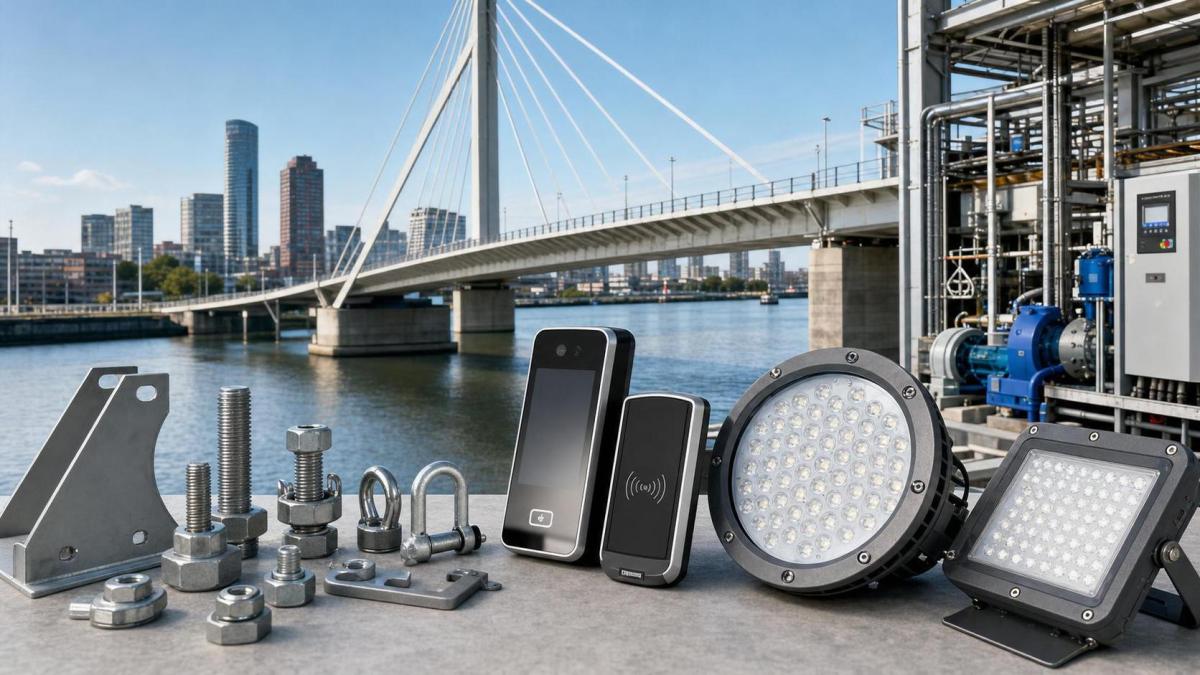
A European reference project usually reflects more than customer acceptance. It often indicates that a product survived layered checks involving safety documentation, installation practice, environmental limits, and data governance.
That is why hardware application references Europe are watched closely during market entry and supplier comparison. They help separate products that are merely export-ready from products that are genuinely deployable in regulated environments.
In practical terms, compliance in Europe is rarely one certificate. It is a chain. Design conformity, testing records, installer competence, maintenance plans, and user privacy controls may all matter at once.
A project reference becomes valuable when it proves that chain worked in real conditions. That may include airport access control, public lighting renewal, industrial assembly, rail-side fastening, or hazardous-site PPE deployment.
What “proof of compliance” actually means
The phrase sounds simple, but it is often misunderstood. Compliance is not the same as product existence, and it is not the same as one passing lab result.
Within hardware application references Europe, proof usually appears through four linked signals: lawful market placement, suitability for the application, operational reliability, and acceptable lifecycle control.
The four signals behind a useful reference
This is where many references fail scrutiny. They mention a prestigious site, but provide little detail about the compliance path, operating duration, or boundary conditions that made the deployment valid.
Which project types matter most across SHSS focus areas
Not all references have equal value. The most useful hardware application references Europe come from projects where consequences of failure are visible, measurable, and costly.
Biometric access and smart security
References from data centers, logistics hubs, government buildings, and commercial campuses are especially meaningful. These sites test both recognition performance and privacy discipline.
A credible reference should clarify whether biometric templates stay on-device or move to the cloud. It should also show how consent, retention, fallback access, and anti-spoofing were handled.
In Europe, a facial or iris system is not judged by speed alone. It is judged by whether the entire workflow aligns with GDPR and site security governance.
Industrial brushless tools
References in automotive assembly, steel fabrication, MEP installation, and infrastructure maintenance are more informative than showroom demonstrations. They reveal battery endurance, torque consistency, vibration behavior, and downtime economics.
A good European reference also indicates whether the tool platform fits workplace safety expectations, charger logistics, and fleet-level service support.
Fasteners and high-strength hardware
Bridge retrofits, wind projects, rail infrastructure, and heavy equipment manufacturing provide stronger evidence than general distribution references. These projects expose fatigue resistance, corrosion performance, and traceability requirements.
For this category, hardware application references Europe are persuasive only when they describe load conditions, material grades, coatings, inspection procedures, and service life assumptions.
Smart LED lighting
Municipal streetlighting, warehouses, campuses, parking structures, and plant facilities are important reference classes. They show whether controls, sensors, and communication protocols deliver measurable savings without operational complexity.
Projects using DALI or Zigbee are particularly useful because they demonstrate integration reality, not just luminaire efficiency. Maintenance access and software longevity matter as much as initial wattage reduction.
PPE and protective gear
References from chemical processing, tunneling, demolition, emergency response, and mining-adjacent work offer better insight than catalog claims. They show how protective gear performs under heat, dust, abrasion, and long wear periods.
The strongest references explain certification scope, replacement cycles, user training, and compatibility with the broader safety system.
How to read a reference without being misled
A named project is only the starting point. The real task is to understand whether the reference matches the target use case closely enough to support a decision.
Usually, the most revealing questions are about boundaries, not headlines. What conditions existed on site? Which standard applied? What happened after twelve months of use?
- Check whether the project environment resembles the intended deployment.
- Ask which regulations or EN standards were specifically relevant.
- Confirm whether installation was pilot-scale or full operational rollout.
- Look for maintenance data, not only commissioning success.
- Review integration dependencies, especially software and network layers.
- Separate supplier claims from independently auditable project facts.
This approach is important because hardware application references Europe often include strong brands and prestigious sites. Brand association alone does not prove repeatability across other locations, climates, or risk categories.
Why this topic is becoming more important now
Several pressures are converging. Public buyers want accountable spending. Private operators want lower lifecycle risk. Regulators expect traceability. At the same time, AIoT hardware is becoming more interconnected and more scrutinized.
That raises the value of references that prove not just product function, but deployment discipline. A biometric device now touches cyber policy. A smart luminaire touches data, energy, and control architecture. A fastener touches structural liability.
From the SHSS perspective, this is the real meeting point of mechanics and intelligence. The market increasingly rewards products that are both physically dependable and administratively defensible.
A practical framework for the next evaluation step
The most effective use of hardware application references Europe is comparative, not decorative. References work best when translated into a structured review model before any shortlist is finalized.
Build the review around these dimensions
- Compliance path: certificates, declarations, privacy controls, and site approvals.
- Performance proof: actual runtime, recognition accuracy, load endurance, or lighting savings.
- Project similarity: sector, climate, duty cycle, user volume, and integration depth.
- Lifecycle resilience: maintenance access, spare availability, firmware support, replacement policy.
- Commercial credibility: scale of deployment, repeat orders, and post-installation retention.
That framework helps turn scattered references into decision evidence. It also makes it easier to compare very different hardware categories on a common risk basis.
The next move is usually straightforward: map intended project conditions, filter references by similarity, and request the missing compliance details behind each case. That is where hardware application references Europe stop being marketing support and start becoming operational intelligence.
Recommended News