
Search News
Industry Portal
Hot Articles
Smart City Monitoring Systems: How to Compare ROI and Deployment Scope
Time
Click Count
Smart city monitoring systems have moved far beyond isolated cameras and control rooms. They now connect lighting, access control, structural assets, worker safety, and urban response into one operating layer that can be measured in cost, uptime, risk reduction, and service quality.
That shift matters because deployment decisions are becoming capital decisions. A city-scale platform may touch roads, buildings, energy use, compliance, and public security at once, so comparing options requires a clearer view of ROI and a realistic understanding of deployment scope.
What smart city monitoring systems really include
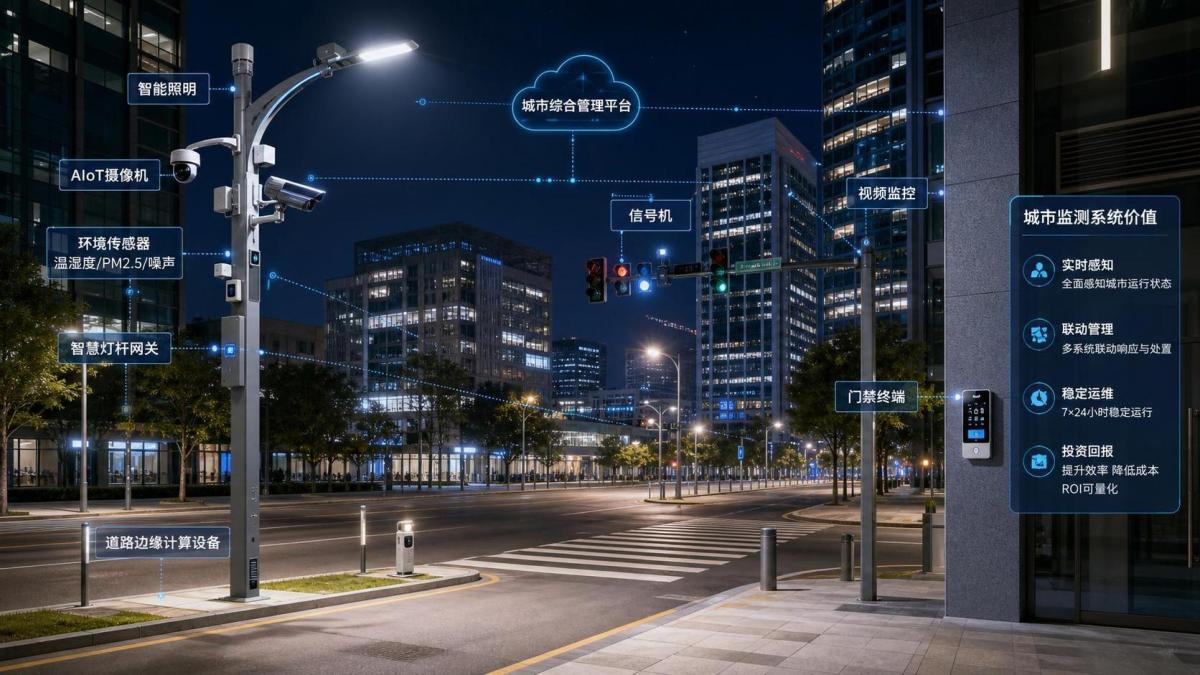
In practice, smart city monitoring systems are not one product. They are a coordinated stack of sensors, networks, software, field hardware, and operating procedures that turn physical infrastructure into observable, manageable assets.
That stack often includes video surveillance, biometric entry points, smart streetlights, environmental sensing, edge devices, and data dashboards. In more mature deployments, it also includes maintenance workflows, alert routing, and incident evidence retention.
This is where the broader SHSS perspective becomes useful. Urban monitoring performance depends not only on software intelligence, but also on the reliability of physical components that keep operations intact under stress.
A camera mast is only as dependable as its fasteners. A biometric gate is only as credible as its recognition speed, privacy controls, and fail-safe design. Smart lighting only earns its place when energy savings, uptime, and controllability are all visible.
Why ROI is now the central comparison point
For many projects, the old purchasing logic focused on unit price. That approach misses the real economics of smart city monitoring systems, where value appears across multiple departments and over several budget cycles.
A lower-priced deployment can become expensive if integration is weak, maintenance is frequent, or data quality is inconsistent. A higher upfront investment may perform better if it reduces field visits, energy waste, false alarms, and downtime.
ROI should therefore be read as a blended outcome. It includes direct savings, avoided losses, compliance protection, and the ability to scale without rebuilding the core architecture.
That is especially true for systems tied to smart LED lighting, biometric security, and industrial-grade hardware. Long-lifespan luminaires, hardened mounting systems, and edge-enabled controllers often change the payback profile more than headline software features do.
Core ROI dimensions worth measuring
A useful comparison framework should stay operational, not theoretical. The table below highlights common evaluation dimensions.
Deployment scope changes the investment logic
Two systems can look similar on paper and still have very different deployment implications. Scope determines how much site preparation, integration effort, training, and governance work sits behind the purchase.
A corridor-level security deployment is not the same as a district-wide monitoring program. One may focus on controlled access and incident logging. The other may involve transport corridors, street lighting, public buildings, and environmental sensing.
This is why smart city monitoring systems should be compared at three levels: device scope, site scope, and network scope. Missing that distinction often leads to underbudgeted integration and overstated payback expectations.
Typical scope categories
- Single-site scope: buildings, gates, parking areas, perimeter lines, and local lighting controls.
- Multi-site scope: campuses, transport hubs, industrial parks, and linked municipal facilities.
- City-network scope: street corridors, critical intersections, utility nodes, and command platforms.
- Mixed critical scope: places where public access, data security, and operational continuity overlap.
Each category changes the role of field hardware. In broad deployments, mounting integrity, weather tolerance, power stability, and maintainability become financial issues, not just engineering details.
Where value shows up in real urban operations
The strongest smart city monitoring systems create value across connected use cases. They do not only report what happened. They help operators reduce waste, improve response, and extend the useful life of assets already in place.
Smart lighting is a clear example. When luminaires use protocols such as DALI or Zigbee, lighting becomes a sensing and communications layer. That can support occupancy detection, adaptive brightness, fault alerts, and lower electricity spend.
Biometric security adds another layer of value in sensitive facilities. Faster identity verification can improve throughput while reducing card misuse, shared credentials, and manual guard intervention.
Structural hardware is less visible but just as important. High-strength fasteners, stable enclosures, and vibration-resistant assemblies protect uptime in bridges, roadside cabinets, stations, and industrial utility zones.
Even PPE fits the monitoring picture when deployments involve hazardous maintenance environments. Safer field interventions reduce incident exposure and keep service teams operational during faults, inspections, or emergency repair work.
How to compare systems without getting lost in features
Feature lists can be misleading because they flatten meaningful differences. A better method is to compare smart city monitoring systems against the operational outcomes they must support.
Start with the event chain. What needs to be detected, verified, transmitted, acted on, and archived? Then test whether the proposed system stays reliable at each step under real deployment conditions.
That assessment should include software and hardware together. Edge AI accuracy means little if lighting columns fail early, access terminals struggle in low light, or replacement parts are difficult to source.
Practical comparison points
- Map each subsystem to a measurable business outcome.
- Separate pilot performance from full-scale deployment assumptions.
- Check whether open protocols support future interoperability.
- Model maintenance cost over the full hardware lifespan.
- Review biometric and cloud data handling against regional compliance rules.
- Stress-test the system against weather, vibration, tampering, and power instability.
Risk factors that deserve closer attention
Some deployment risks stay hidden until rollout begins. Network bottlenecks, privacy objections, weak mounting hardware, and fragmented vendor responsibilities can all damage ROI after approval is already secured.
Compliance risk is especially easy to underestimate. Systems involving facial or iris recognition must address consent logic, data minimization, storage controls, and audit trails from the beginning.
Another common issue is overexpansion. A broad smart city monitoring systems plan may look attractive, but a phased rollout usually performs better when governance, integration, and service support are still maturing.
The strongest programs typically begin where measurable outcomes are easiest to verify: traffic-sensitive corridors, critical facilities, energy-intensive lighting networks, or access-controlled environments.
A more useful next step
A good evaluation process starts with a scope map, not a vendor brochure. List the assets, environments, security priorities, and service obligations that the monitoring layer must support.
Then build a comparison matrix around lifecycle cost, physical reliability, compliance readiness, and expansion flexibility. That approach gives smart city monitoring systems a fair assessment grounded in operations rather than presentation.
For organizations tracking developments through SHSS, the most useful lens is convergence. Urban intelligence performs best when secure access, durable hardware, smart lighting, and field safety are evaluated as one connected operating system.
That is usually the point where ROI becomes clearer, deployment scope becomes manageable, and the next decision can be made with fewer assumptions and better evidence.
Recommended News