
Search News
Industry Portal
Hot Articles
Which smart hardware standards enable interoperable street lighting?
Time
Click Count
A replacement controller fits the socket, joins the network, and appears on the operator’s dashboard. Yet the luminaire will not dim correctly, its energy readings are unavailable, and maintenance alarms arrive under unfamiliar names. Each component may be described as “open,” but the system still fails the practical test of interoperability.
For technical evaluators, smart hardware standards must be assessed as a stack of interfaces—not a single compatibility label. DALI-2 and D4i address luminaire control and data; Zhaga Book 18 and ANSI C136.41 address different approaches to physical and electrical connection; TALQ supports communication between outdoor-device networks and management software. Wireless standards provide another layer, without automatically making the complete system interchangeable.
The procurement question is therefore not simply, “Which standards does this streetlight support?” It is: “Which functions can cross each interface, under which certified configuration, without proprietary dependencies?”
Map the interfaces before comparing certificates
A connected streetlight contains several boundaries where compatibility can break down. Separating them makes specifications clearer and prevents one certification from being mistaken for proof of end-to-end integration.
These layers are complementary. A mechanically interchangeable controller can still depend on a proprietary network. An openly integrated management platform can still control luminaires whose driver data is inaccessible.
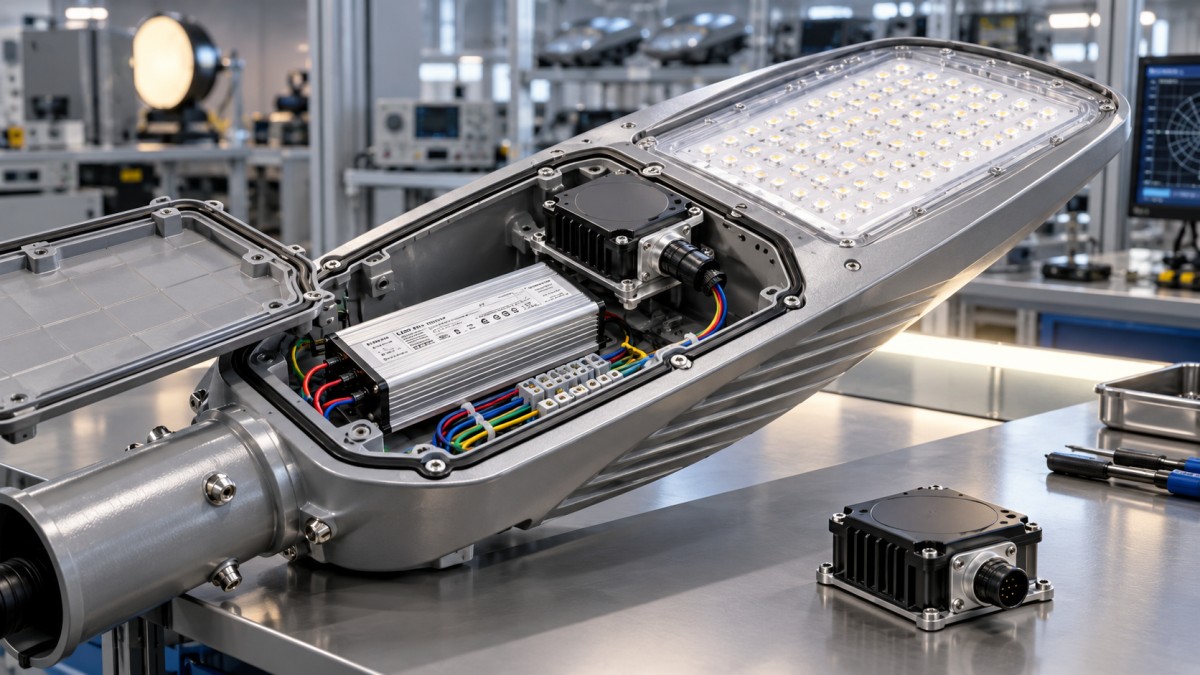
DALI-2 and D4i: where standardized control becomes useful data
DALI-2 establishes a tested digital lighting interface
DALI is based on the IEC 62386 series. DALI-2 certification, administered by the DALI Alliance, adds defined testing and verification for supported product categories, including control gear and control devices.
For street lighting, this matters at the connection between the LED driver and the luminaire controller. Standardized digital commands reduce dependence on manufacturer-specific dimming behavior and provide a basis for status reporting. However, DALI-2 certification does not mean every product supports every DALI function. Device types, implemented features, and application requirements must still align.
Ask suppliers to identify the exact certified driver and controller models, not merely state that their equipment is “DALI compatible.” Where a controller acts as a DALI application controller, confirm that its implemented behavior matches the intended luminaire architecture.
D4i adds requirements for intelligent luminaires
D4i extends DALI-2 with a defined set of requirements intended to support connected luminaires. D4i LED drivers provide standardized luminaire, energy, and diagnostic data under the relevant DALI specifications. Integrated bus-power provisions also support suitable luminaire-mounted control devices.
The data specifications commonly associated with D4i include:
- Part 251: luminaire data, helping identify and describe the lighting asset.
- Part 252: energy reporting, supporting consumption monitoring.
- Part 253: diagnostics and maintenance information, supporting fault investigation and service planning.
The practical value is not simply having more data. A replacement controller can interpret standardized information without requiring a custom driver integration for each luminaire supplier. Nevertheless, not every field an operator might want is necessarily populated or supported. Request a sample data export and distinguish mandatory information from optional fields.
Power deserves particular attention. A DALI bus supply is not interchangeable with an auxiliary supply for a communications module. Where a design requires a 24 V auxiliary supply, verify the applicable requirements, available output, and controller demand. Do not assume that every D4i configuration provides identical power resources.
Zhaga Book 18 and ANSI C136.41 are not equivalent sockets
Both specifications are relevant to replaceable outdoor-lighting controls, but they describe different interface approaches. Selecting between them affects the luminaire’s electrical design, controller options, and maintenance practices.
Zhaga Book 18: a low-voltage interface for outdoor modules
Zhaga Book 18 defines an interface between outdoor luminaires and sensing or communication modules. Its compact, low-voltage connection is commonly combined with D4i to support interoperable control devices.
Zhaga-D4i certification brings these elements together through coordinated certification requirements. It is more informative than a claim that a product simply has a “Zhaga-style socket.” Evaluators should check certification for the actual luminaire and control device, along with their application conditions and applicable specification editions.
Also examine installation details: socket position, module clearance, environmental sealing, and whether the selected controller can operate from the available power. Physical compatibility does not guarantee that an oversized or power-hungry module suits every installation.
ANSI C136.41: a locking interface with dimming contacts
ANSI C136.41 defines a locking-type photocontrol interface that includes dimming capability. It is widely associated with five- and seven-contact arrangements, extending the familiar three-contact power interface with additional contacts.
Unlike the low-voltage Zhaga approach, this architecture includes mains connections. Additional contacts support dimming and related functions, but the presence of a seven-contact receptacle does not prove that the installed driver and controller use matching control methods.
For an ANSI C136.41-based design, require a contact-assignment drawing, supported control-interface details, and electrical ratings. If digital communication is proposed, verify how it is implemented. Never infer DALI support, standardized diagnostics, or multi-vendor data exchange from socket geometry alone.
TALQ addresses the management boundary—not the radio link
A municipality may operate several outdoor-lighting networks while wanting one central management system. TALQ addresses this integration problem by specifying an application interface between a central management system and outdoor-device networks, typically through gateway functionality.
That distinction is important: TALQ does not prescribe the radio technology between individual streetlights. One deployment may use a mesh network, another cellular connectivity. Their management interfaces can still follow TALQ.
For evaluators, the expected benefit is a more consistent way to exchange asset information, commands, measurements, and events across supported functions. This can reduce custom integration work and make management-system replacement more practical.
However, a TALQ certificate is not evidence that every feature visible in a supplier’s proprietary dashboard will be available through another platform. Certification scope and implemented functionality matter. Request the certified product identity, protocol version, supported functions, and a demonstration using the proposed central management system and gateway combination.
Pay particular attention to operational meaning. An alarm called “lamp failure” in one platform may need a precise mapping to a driver fault or communications fault. Interoperability requires consistent interpretation, not merely successful message delivery.
Which wireless smart hardware standards support an open deployment?
The right network depends on geography, asset density, ownership, and operational constraints. No single wireless technology is the universal street-lighting standard.
- Wi-SUN FAN: provides an IPv6-based field-area networking approach with certification covering defined networking functions. Confirm the certified profile, regional frequency plan, security arrangements, and compatibility of network infrastructure.
- LoRaWAN: can support suitable monitoring and control applications, but application payloads, regional parameters, downlink availability, and device provisioning remain important. LoRaWAN connectivity alone does not standardize lighting commands.
- Cellular IoT: technologies such as LTE-M and NB-IoT use standardized mobile-network connectivity. The application interface, subscription arrangements, coverage, and device-management implementation still determine practical portability.
- Zigbee: may suit particular local-network designs, but a generic Zigbee claim is insufficient. Verify the application profile, outdoor network engineering, and supported lighting behavior.
A standardized radio connection can carry proprietary application messages. Ask whether controllers can move to another network operator or management environment, who holds provisioning credentials, and what must be replaced if the original supplier exits the market.
Turn certification claims into an acceptance test
Certificates are valuable evidence, but they are strongest when attached to a defined bill of materials and a repeatable test plan. A pilot using only one supplier’s integrated equipment rarely exposes the boundaries that matter during later replacement.
- Verify product identities. Check relevant certification databases where available. Match model numbers and applicable hardware or firmware versions to the products being offered. Record specification editions and certification scope.
- Perform a cross-vendor controller swap. Replace the control module without changing the luminaire driver. Test startup, dimming, power recovery, and the required data readings.
- Trace data end to end. Follow an energy value or diagnostic event from the driver through the controller and network into the management platform. Check units, timestamps, asset identifiers, and missing-data handling.
- Exercise management integration. Demonstrate schedules, commands, alarms, and inventory exchange through the specified TALQ interface—not only through the supplier’s native dashboard.
- Test abnormal conditions. Disconnect communications, interrupt power, and simulate supported fault conditions safely. Confirm local behavior, recovery, and event reporting.
Define pass criteria before testing. “Dimming works” is ambiguous; a documented command, expected response, permitted delay, and recovery behavior are testable. Where energy data is used for financial purposes, verify its accuracy requirements separately: standardized reporting does not establish billing-grade metering.
Keep safety, cybersecurity, and interoperability separate
Interoperability certification does not replace electrical safety, electromagnetic compatibility, radio approval, or environmental qualification. Applicable requirements depend on the installation market. For example, IEC 60598-1 and IEC 60598-2-3 are relevant to luminaire safety, while ingress protection and impact resistance require their own evidence.
Likewise, an open interface is not automatically secure. Procurement requirements should cover device identity, authenticated access, encrypted communications where appropriate, secure updates, vulnerability handling, and credential transfer. Relevant frameworks, such as IEC 62443, may inform requirements, but any compliance claim must identify its actual scope.
The maintenance team also needs a clear answer to a simple question: who can restore service when the original cloud service is unavailable? Local schedules, fallback lighting behavior, configuration backups, and authorized access procedures belong in the specification.
Specify interfaces, not an “open system” promise
A defensible street-lighting specification identifies each boundary separately: the physical connector, driver-control interface, required data fields, field-network profile, and management-system interface. It then attaches certification evidence and acceptance tests to the exact products proposed.
DALI-2 and D4i support standardized luminaire control and data. Zhaga Book 18 and ANSI C136.41 support different connection architectures. TALQ addresses management integration. Wireless standards carry communications, but require additional application and operational alignment.
Interoperability is demonstrated when another qualified supplier can replace a component while preserving the functions the operator actually needs. That is the standard against which certificates, interface claims, and pilot results should ultimately be judged.
Recommended News