
Search News
Industry Portal
Hot Articles
What to evaluate in an IoT lighting platform for smart street projects
Time
Click Count
A smart street project can look technically sound at tender stage and still become difficult to operate within a few years. The usual cause is not the LED luminaire itself. It is the control platform sitting between thousands of field devices, municipal operations teams, communications networks, maintenance contractors, and future urban systems.
For a technical evaluator, an IoT lighting platform should be assessed as operational infrastructure rather than as a dashboard with remote switching. The platform must continue to manage lighting safely when connectivity is intermittent, support equipment from more than one supplier, expose usable data to authorized systems, and remain maintainable after the original deployment team has moved on. Energy reporting matters, but it is only one part of that test.
The strongest evaluation starts with the operating model: which assets will be controlled, who will respond to alarms, what communications are available by area, what systems must exchange data, and what happens when a gateway, network segment, or cloud service becomes unavailable. Features should be judged against those conditions, not against a generic product checklist.
Start with the decisions the platform must make in the field
Street lighting control is often described in simple terms: dim lights when roads are quiet, raise output when activity is detected, and report faults centrally. In practice, the control logic may need to distinguish between arterial roads, pedestrian paths, public squares, school zones, industrial estates, tunnels, and environmentally sensitive corridors. Each can have different schedules, safety requirements, maintenance access windows, and tolerance for lighting changes.
A platform should therefore support policy-based control that is understandable to the operating authority. Evaluators should ask whether lighting profiles can be created by asset group, location, calendar, astronomical event, sensor input, or emergency instruction. Equally important is whether the resulting behavior can be reviewed before deployment and traced afterward. A system that permits many rules but makes interactions impossible to inspect can create unsafe or expensive operating errors.
Local autonomy deserves particular attention. A street controller should have a defined fallback schedule or control state when it loses connection to its gateway or central service. The evaluator should establish what continues locally, how long the device can operate under fallback conditions, whether an operator can see that a device is running in degraded mode, and how the device reconciles commands when communication returns.
This is more than a resilience question. Constant round trips to a central application can add avoidable network dependency to basic lighting behavior. Edge-based decisions can keep priority functions running during outages and reduce traffic from routine telemetry. However, edge intelligence must be auditable. The authority needs to know which logic sits in the node, gateway, or cloud, who can change it, and how changes are versioned and rolled back.
Adaptive lighting should also be evaluated against the quality of its inputs. Motion, traffic, ambient-light, weather, and occupancy data may improve outcomes, but an unreliable sensor or poorly positioned detector can produce inappropriate lighting changes. Determine how input quality is monitored, what rule applies when a sensor is silent or implausible, and whether the lighting policy remains safe without it. A platform should fail into a known lighting state, rather than simply follow the last received command indefinitely.
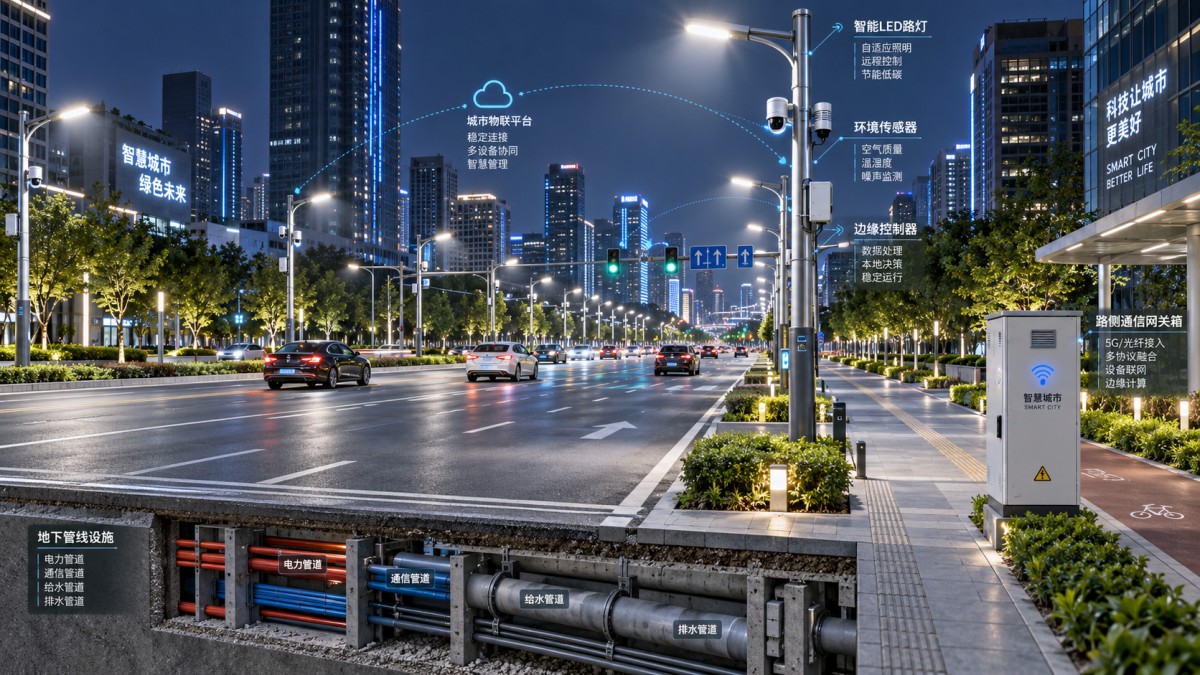
Interoperability is a lifecycle requirement, not a protocol label
Claims of interoperability are common because most platforms can point to at least one supported lighting interface or wireless technology. That statement alone says little about whether a city can replace luminaires, controllers, gateways, or applications over time without rebuilding the network.
Evaluation should separate the physical/control interface from the management layer. A controller may connect to a luminaire through a recognized socket or dimming interface, while the wider system uses proprietary device messages, enrollment procedures, data models, and firmware tools. Replacing an individual part may be easy; moving the operating system or adding a second hardware supplier may not be.
The practical question is whether the platform can manage the specific functions required across mixed equipment, including commissioning, switching, dimming, metering where available, fault reporting, firmware updates, location data, and asset attributes. Partial support is common. A platform may identify a third-party controller and turn it on or off, yet not expose diagnostic data or permit remote software maintenance. Those gaps often emerge after procurement, when operational teams try to standardize workflows.
A useful technical review asks suppliers to demonstrate defined tasks using representative devices, not only to provide a compatibility statement. The demonstration should include a new device joining the network, an existing asset being replaced, a failed node being identified, a group policy being applied, a firmware update being staged, and operational data being exported. The test should show the permissions, manual steps, and data loss involved in each task.
Open interfaces are valuable only when they are governed. An API without stable documentation, access controls, usage limits, or a support commitment can become another operational dependency. Request the interface specification, change-management policy, sample payloads, and a description of how backward compatibility is handled. It is sensible to define in the contract what data the authority can retrieve, at what frequency, and through what method.
Test scale through operations, not endpoint counts
Large endpoint claims can be misleading. A platform may technically register a high number of nodes while struggling with the operational workload generated by those nodes: alarm bursts after a power event, mass configuration changes, firmware campaigns, radio-network repairs, or a contractor updating asset records across several districts.
Scale should be assessed at the levels that match the proposed deployment. That includes the maximum devices per gateway or network segment, expected message frequency, alarm handling under abnormal conditions, report generation time, simultaneous user activity, and the capacity to manage bulk changes without losing visibility. A city does not need every telemetry value in real time if that traffic drains batteries, consumes communications capacity, or overwhelms operators. It does need timely and trustworthy exception reporting.
Commissioning is often the point where platform design becomes visible. Mapping a small pilot may be manageable through a mobile app and manual validation. The same process can become slow and error-prone across a city-wide rollout. Review how the platform establishes the relationship between the physical pole, luminaire, controller, geographic location, circuit, communications path, and maintenance record. Ask how the system handles a controller installed on the wrong pole, a duplicate asset identifier, an inaccurate GPS position, or a replacement made during an overnight repair.
Asset data needs clear ownership and a controlled source of truth. Lighting teams may maintain pole and luminaire information in one system, electrical teams may track cabinets elsewhere, and a contractor may maintain work orders in another application. An IoT lighting platform does not have to replace all of those systems. It should, however, make its asset model explicit and support controlled synchronization. Otherwise, fault tickets, maps, inventory, and energy reports gradually diverge.
Maintenance workflows deserve the same scrutiny as control features. A useful platform should translate device alerts into information a maintenance team can act on: asset location, suspected fault type, severity, recurrence, relevant electrical or communications status, and recent command history. An alert that merely reports “offline” may represent a failed controller, a gateway problem, a planned power interruption, a backhaul outage, or an inventory error. The system should preserve enough context to prevent technicians from treating every alert as a site visit.
Cybersecurity must extend from the node to the operator account
Connected street lighting expands the attack surface of a public asset network. The concern is not limited to an attacker changing a dimming level. Compromised credentials, insecure remote access, unpatched gateways, exposed APIs, and weak supplier support processes can affect service continuity and provide a route toward connected municipal environments.
Technical evaluation should examine how every layer establishes trust. At the device level, look for unique identities, secure credential provisioning, protection against unauthorized firmware, and a credible approach to software updates. At the gateway and platform level, assess encrypted communications, segmentation options, audit logging, vulnerability handling, access controls, and recovery procedures. The answer should describe an implementation process, not simply state that encryption is used.
User administration is frequently underexamined. Municipal employees, electrical contractors, systems integrators, and support personnel rarely need the same rights. The platform should provide role-based access, allow administrative privileges to be separated from routine operational roles, and retain an audit trail for material actions such as policy changes, firmware releases, credential updates, and bulk commands. For critical operational functions, evaluators may also require multi-factor authentication and a documented approval process.
Security depends on lifecycle support. Ask how long device and gateway software will receive security fixes, how vulnerabilities are reported and communicated, how emergency updates are delivered, and whether patches can be tested on a subset of assets before broad deployment. A technically capable device with no realistic patch path becomes a long-lived liability once installed on thousands of poles.
Clarify data rights before data becomes operationally important
Lighting networks can generate asset status, operating hours, dimming behavior, fault events, energy-related information, and, where external sensors are integrated, contextual environmental or mobility data. The platform provider may host or process that information, but the municipal authority should establish its rights to access, retain, export, and govern it.
The discussion should go beyond ownership language in a contract. Define whether historical data remains available if the service ends, what export formats are provided, how long records are retained, where data is processed, who can access it for support purposes, and how data is deleted or transferred at termination. Where sensor data could be linked to identifiable activity, privacy and local legal obligations require separate consideration from routine lighting telemetry.
Data quality is equally important for financial and operational decisions. Energy savings calculations need a stated baseline, reliable operating-state records, and a clear understanding of whether reported consumption is measured, estimated, or inferred from a dimming profile. A dashboard can present precise-looking figures without proving their evidentiary value. Evaluators should be able to trace a report back to the source data, its time basis, missing-data treatment, and assumptions.
Use a pilot to challenge the proposed operating model
A pilot should not be limited to proving that lights can be switched remotely. Its purpose is to reveal whether the platform can be operated, maintained, secured, and expanded under local conditions. Include areas with different communications conditions, road types, lighting schedules, and maintenance constraints. Deliberately test loss of connectivity, controller replacement, gateway restart, policy rollback, user permission changes, bulk configuration, alarm floods, data export, and firmware update recovery.
Acceptance criteria should be written before the pilot begins. They should specify observable outcomes: the fallback lighting behavior, time and steps needed to locate a fault, accuracy of asset association, reporting availability, access-control behavior, recovery from failed updates, and ability to export agreed data. This turns the pilot from a demonstration exercise into evidence for procurement.
The platform selected for a smart street project should make the next decade of operational choices easier, not merely make the first installation look connected. A credible choice is one that preserves safe local lighting behavior, keeps field maintenance practical, permits controlled integration and replacement, and gives the asset owner usable control over systems and data. Those qualities may be less visible than an attractive control screen, but they determine whether connected lighting remains an asset once the project moves beyond its launch phase.
- Last One:No more articles
- Next Article:When custom hardware solutions for facilities reduce retrofit costsOct 07, 2026
Recommended News