
Search News
Industry Portal
Hot Articles
BLDC Motor Technology Trends Shaping Power Tools in 2026
Time
Click Count
BLDC motor technology is moving from feature advantage to baseline expectation
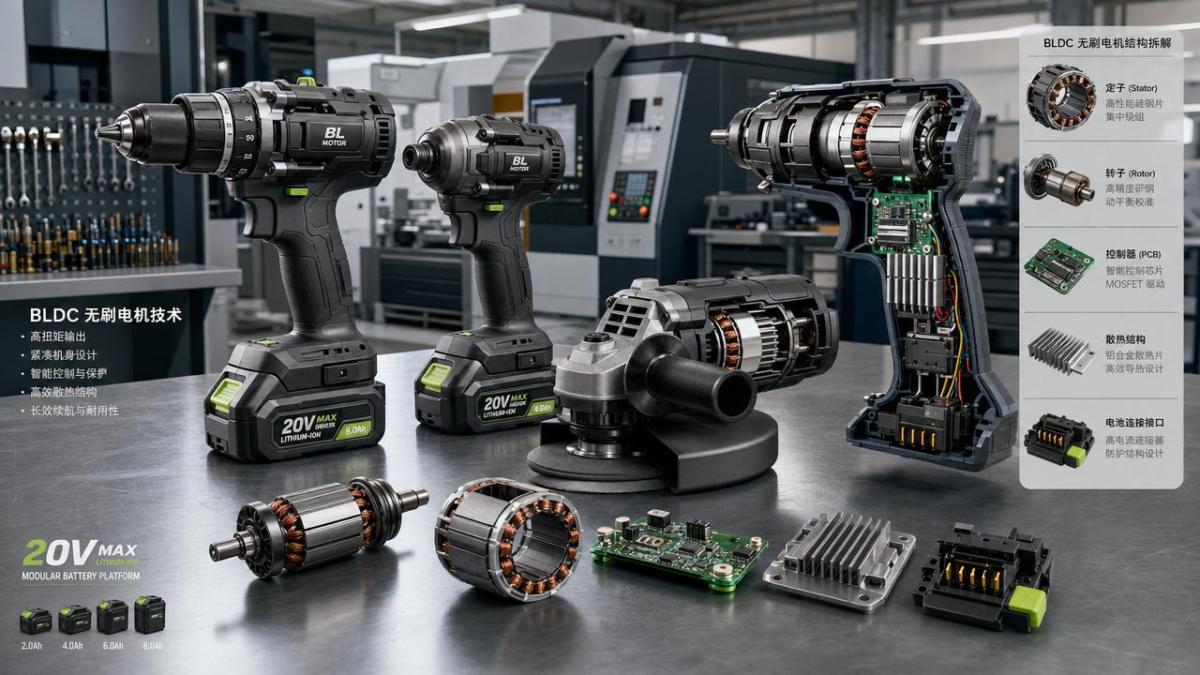
In 2026, BLDC motor technology no longer signals premium positioning alone. It increasingly defines the minimum performance threshold for serious professional power tools.
That shift matters because tool value is now judged across torque density, runtime stability, maintenance burden, heat control, and digital compatibility.
The market is not only asking whether a tool is brushless. It is asking how intelligently the motor system converts energy into reliable output.
This is where BLDC motor technology becomes a broader industrial story. It connects battery chemistry, controller design, firmware tuning, thermal materials, and jobsite productivity.
From the SHSS perspective, that convergence is familiar. Modern smart hardware no longer wins through one isolated component.
Whether in biometric security, smart lighting, high-strength hardware, or protective equipment, competitive advantage now comes from tightly stitched system performance.
Power tools are following the same path. BLDC motor technology sits at the center of that transition.
The recent signals are clearer than they were two years ago
Several market signals show why this technology shift is accelerating rather than leveling off.
First, higher output is being packed into lighter housings. Compact drills, impact drivers, and grinders now promise performance once reserved for larger corded platforms.
Second, uptime is becoming a sales argument. Users increasingly compare how long a tool maintains usable torque, not just how long it spins without load.
Third, service expectations are changing. Fewer wear parts and reduced brush replacement are old news. The newer concern is predictive durability under repeated heavy cycles.
More noticeably, digital control is entering routine evaluation. Speed consistency, kickback response, soft-start behavior, and battery communication are now part of product positioning.
This explains why BLDC motor technology is discussed less as a motor upgrade and more as a system architecture decision.
What is pushing the shift
The important point is that these drivers reinforce each other. Better batteries expose weak motor control. Better controllers reveal weak heat dissipation. Faster work cycles magnify both.
Why torque density alone no longer tells the full story
A few years ago, headline torque could dominate comparisons. In 2026, that metric still matters, but it rarely settles the discussion.
BLDC motor technology is now judged by how well it preserves usable performance under heat, dust, vibration, and fluctuating load.
That distinction is crucial in industrial fastening, metalworking, construction, and maintenance environments where workload spikes are normal rather than occasional.
A motor that produces impressive bursts but derates quickly may look strong on a spec sheet and weak in daily economics.
This is also where the SHSS lens adds context. In high-strength fasteners, material integrity matters under repeated stress, not just peak force.
The same logic applies to BLDC motor technology. Sustainable force delivery creates more business value than isolated peak numbers.
The stronger evaluators are now checking
- How quickly torque drops after repeated fastening or cutting cycles
- How the controller responds to stall risk and kickback events
- Whether runtime remains productive under heavy-load applications
- How motor temperature affects battery draw and component life
- Whether firmware updates can improve performance after deployment
These checks reflect a broader market maturity. BLDC motor technology is no longer exciting because it is new. It is valuable because it is measurable.
Control intelligence is becoming the hidden differentiator
One of the less visible changes in 2026 is the growing role of control logic inside the tool.
The motor, inverter, sensors, and embedded firmware increasingly act as a coordinated decision layer rather than independent components.
That matters because BLDC motor technology performs best when electronic commutation is tuned for real operating conditions, not generic laboratory assumptions.
In practical terms, smarter control can smooth startup, reduce current spikes, limit overheating, and maintain better accuracy in fastening applications.
More advanced systems also support fleet management and service visibility. Usage data, fault patterns, and battery interaction can guide replacement timing.
This mirrors changes across smart lighting and access control, where the control layer often determines real-world value more than the visible hardware shell.
As a result, BLDC motor technology is moving closer to Edge AIoT logic, even when the tool itself is not marketed as a smart device.
The business impact reaches beyond the tool itself
A common mistake is to treat motor selection as a narrow engineering issue. In reality, the effect spreads across operations, budgeting, and product positioning.
For field use, better BLDC motor technology can reduce interruptions, operator fatigue, and heat-related slowdowns during repetitive tasks.
For channel strategy, stronger motor efficiency supports clearer differentiation in crowded cordless portfolios where cosmetic design no longer carries enough weight.
For lifecycle economics, lower maintenance is only the first layer. Longer service intervals and steadier output can improve total asset productivity.
For compliance and safety, improved control precision may also reduce misuse risk in high-torque applications.
That makes BLDC motor technology relevant to the same “absolute safety” mindset that shapes SHSS coverage across tools, security systems, lighting, and PPE.
Where the impact becomes visible first
- Heavy fastening, where sustained torque affects joint consistency
- Metal cutting and grinding, where heat buildup changes real productivity
- Installation work, where lighter tools with stable output reduce fatigue
- Connected fleets, where diagnostic transparency shapes service planning
The next judgments should focus on system resilience, not brochure claims
Looking ahead, the strongest market positions will likely come from systems that stay efficient under stress and stay updateable over time.
That means BLDC motor technology should be evaluated as a package: motor design, magnets, controller quality, heat path, software tuning, and battery communication.
It is also worth watching whether brands can maintain performance consistency across an entire platform, not just a flagship model.
In actual business review, several questions now carry more weight than they did before.
- Does the tool deliver repeatable output during long duty cycles?
- Is the control architecture mature enough for protection and precision?
- Can the platform support future battery and firmware evolution?
- Are thermal and durability claims supported by application-level testing?
These questions help separate short-term specification advantage from durable market value.
What deserves attention now
BLDC motor technology will keep shaping power tools in 2026 because it sits at the intersection of performance, safety, electrification, and smart control.
The more meaningful change is not that brushless tools are becoming common. It is that expectations around them are becoming sharper and more technical.
A practical next step is to compare tools by sustained output, thermal behavior, control intelligence, and ecosystem compatibility rather than by peak torque alone.
It also helps to track how application demands are changing across construction, industrial maintenance, urban infrastructure, and smart jobsite environments.
That broader view aligns with the SHSS approach to smart hardware: physical performance matters most when it is connected to operational resilience.
For anyone assessing future tool value, the useful question is no longer whether BLDC motor technology matters. It is which motor systems will keep delivering when conditions become less forgiving.
Recommended News