
Search News
Industry Portal
Hot Articles
Physical Security Trends in 2026: What Facilities Need Next
Time
Click Count
In 2026, physical security is moving beyond perimeter control and becoming part of operational strategy. Facilities now face a wider mix of risks, including unauthorized access, compliance pressure, infrastructure downtime, workplace safety exposure, and the growing overlap between cyber and physical systems.
That shift matters across industrial sites, commercial buildings, logistics hubs, campuses, utilities, and smart city infrastructure. A modern physical security program must protect people and assets, but it also needs to support continuity, data integrity, maintenance efficiency, and confidence in daily operations.
Viewed through that lens, the next generation of facility protection is not defined by one device. It is shaped by how access control, biometrics, hardware reliability, lighting intelligence, and protective measures work together as a coordinated system.
Why physical security is being redefined
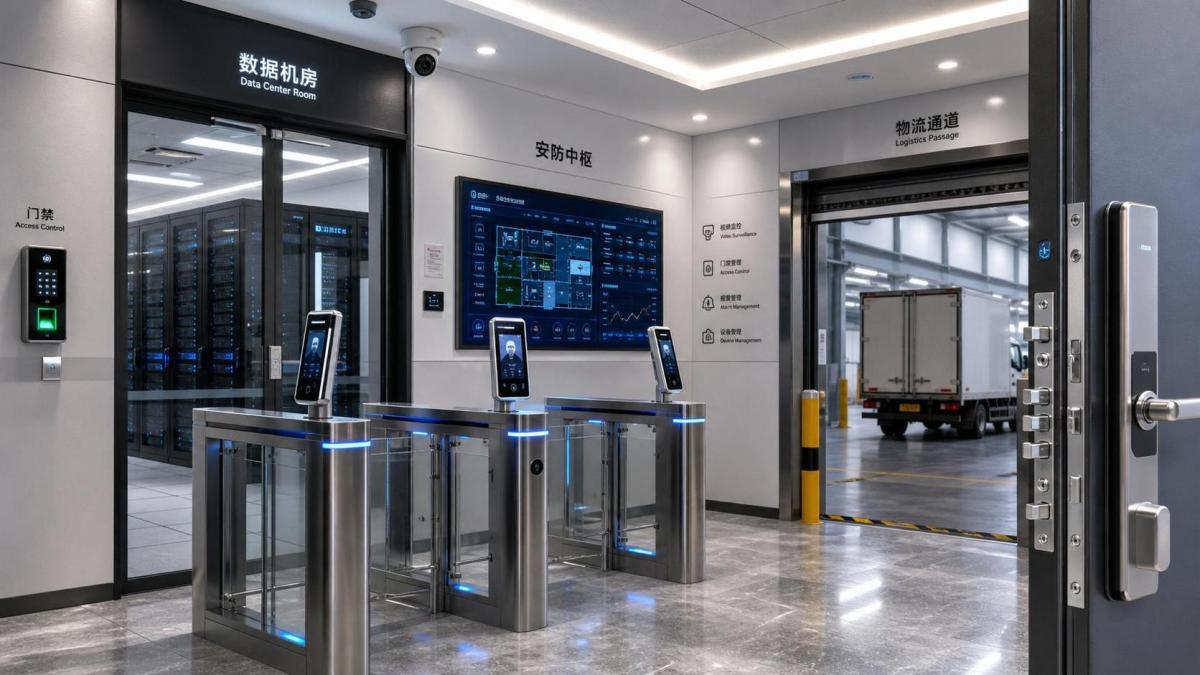
The old model treated physical security as a defensive layer at the edge of a site. That model still matters, but it is no longer enough for environments that depend on connected devices, automated workflows, and tightly controlled access zones.
In practice, facilities now operate as living networks. Doors, cameras, turnstiles, smart lighting, alarms, visitor systems, and maintenance tools all generate signals. Those signals help determine whether a site is secure, compliant, productive, and resilient.
This is why physical security in 2026 is increasingly linked to broader business outcomes. A poorly designed entry process can slow labor flow. Weak hardware can create failure points. Incomplete identity verification can undermine both safety and accountability.
The technologies shaping the next facility standard
Several technology streams are converging at once, and their value becomes clearer when they are assessed together rather than in isolation.
Smarter access control and biometric trust
Credential-based access is giving way to identity-centered control. Facial recognition, iris authentication, and other biometric methods reduce reliance on lost badges, borrowed cards, and shared codes.
For sensitive facilities, the gain is not just convenience. It is the ability to verify who entered, when they entered, and whether their authorization matched the zone, shift, or task.
This is especially relevant in data centers, laboratories, high-value storage areas, transport hubs, and multi-tenant buildings. In those settings, stronger identity assurance improves physical security while supporting audits and incident reviews.
AIoT integration and real-time response
Connected physical security platforms are becoming more predictive. Instead of waiting for an incident, systems increasingly identify anomalies through occupancy patterns, door activity, lighting changes, environmental alerts, or unusual access attempts.
That changes response quality. A forced door event paired with abnormal corridor movement and low-light conditions tells a richer story than any isolated alarm.
As SHSS often highlights in its AIoT and smart hardware coverage, the strength of modern protection lies in intelligence stitching. The real advantage comes from joining sensors, hardware, and decision logic into one operational picture.
Hardware durability as a security issue
Physical security is not only digital recognition and software orchestration. It still depends on mechanical strength. Weak fasteners, degraded hinges, poor enclosure design, or unreliable locks can undermine even advanced systems.
Facilities with heavy vibration, weather exposure, repeated impact, or high traffic need security hardware that performs under stress. In such cases, high-strength fasteners and robust metal components become part of the security architecture, not just construction details.
Lighting and visibility as active protection
Smart LED systems are also becoming more relevant to physical security. Lighting now supports surveillance quality, route guidance, occupancy awareness, and emergency coordination.
A corridor, loading bay, stairwell, or perimeter path with adaptive lighting is easier to monitor and safer to use. Integrated lighting controls can reduce blind spots, improve camera performance, and support evacuation protocols during outages or incidents.
Where these trends matter most
Not every site needs the same configuration. What matters is matching the physical security approach to operational risk, traffic patterns, and infrastructure criticality.
The common thread is that physical security must reflect how a place actually operates. A system that looks comprehensive on paper may fail if it ignores traffic peaks, maintenance practices, environmental stress, or local compliance rules.
What decision quality looks like in 2026
The strongest programs are not necessarily the most complex. They are the ones built on clear priorities, measurable risk reduction, and realistic operational fit.
A useful way to assess physical security investments is to examine five dimensions together.
- Identity integrity: whether the system truly verifies individuals, not just credentials.
- Mechanical reliability: whether doors, enclosures, mounting points, and fasteners can withstand sustained use.
- Visibility and awareness: whether lighting, sensors, and monitoring create a reliable view of site conditions.
- Compliance readiness: whether data capture, storage, and retention meet legal and policy obligations.
- Lifecycle efficiency: whether maintenance, training, and upgrades remain manageable over time.
Compliance deserves special attention. As biometric use expands, physical security decisions increasingly intersect with privacy law, data governance, and cross-border storage rules. Stronger authentication can create new obligations if consent, retention, and system access are poorly defined.
This is where an intelligence-led view becomes valuable. SHSS frames security not as a narrow product category, but as an ecosystem that spans biometrics, structural hardware, connected lighting, and last-line worker protection.
From isolated tools to coordinated protection
One of the most important physical security trends in 2026 is system convergence. Facilities are moving away from disconnected layers that require separate monitoring, duplicate maintenance, and fragmented decision-making.
A more coordinated model connects entry points, structural hardware, smart lighting, emergency workflows, and protective equipment logic where needed. That does not mean every component must share one vendor. It means the operating model should support one clear risk picture.
In higher-risk environments, this coordination can extend to worker authorization and protective readiness. Access to a hazardous area may depend not only on identity, but also on time window, training status, and required protective gear.
That level of integration is especially relevant in advanced manufacturing, energy sites, transport infrastructure, and critical public facilities where physical security and safety outcomes are tightly connected.
Practical steps to evaluate the next move
Before expanding budgets or replacing infrastructure, it helps to test the current environment against practical questions rather than broad assumptions.
- Map which spaces truly require identity-level access, and which only need monitored entry.
- Inspect mechanical weak points, including fasteners, fixtures, mounting assemblies, and exposed hardware.
- Review whether lighting supports surveillance quality during night operations, low traffic periods, and emergency events.
- Check if access logs, biometric records, and retention policies align with compliance obligations.
- Prioritize systems that can scale across facilities without creating inconsistent security rules.
These steps create a more grounded basis for comparison. They also help separate visible upgrades from meaningful security gains.
The next phase of physical security will reward disciplined judgment. Facilities that align biometric trust, resilient hardware, smart visibility, and compliance planning are likely to gain more than protection alone. They gain continuity, clearer accountability, and a stronger foundation for future operations.
A sensible next move is to review one site, one critical workflow, and one high-consequence access zone in detail. That focused assessment often reveals where physical security needs to evolve first, and where investment will matter most.
Recommended News