
Search News
Industry Portal
Hot Articles
Smart Lock Exporter Checklist: Certifications, Lead Times, and Risks
Time
Click Count
Smart lock exporter checklist: what really matters before price
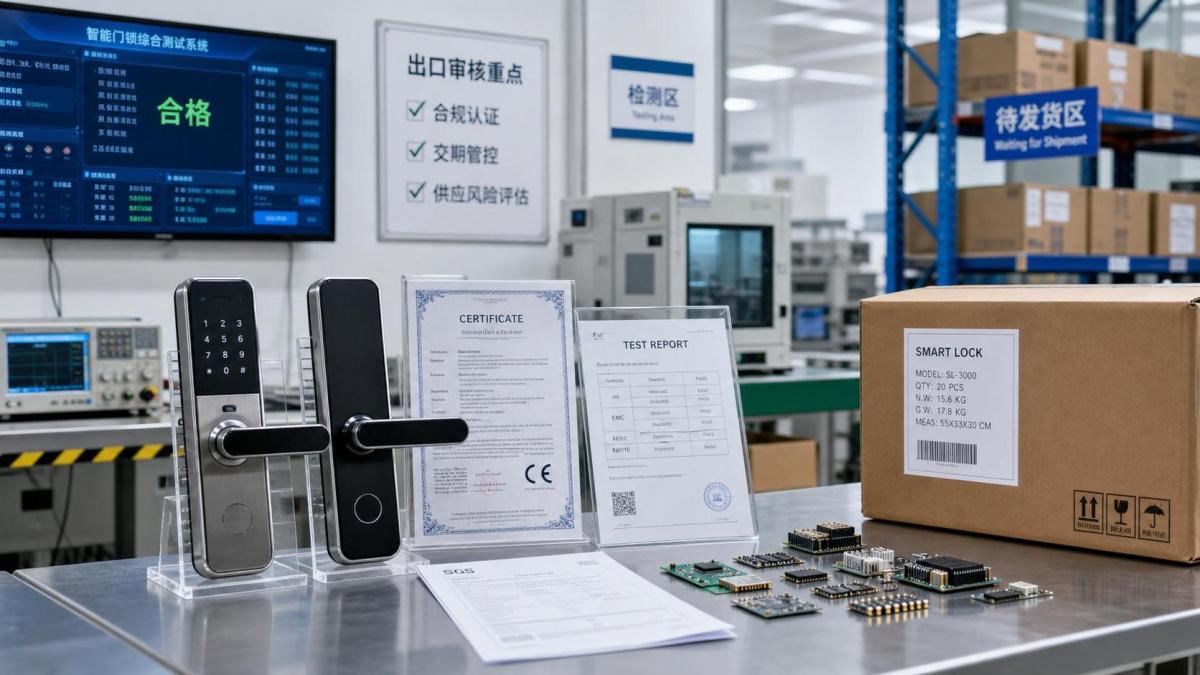
A smart lock exporter can look competitive on paper and still create avoidable risk after the order is placed.
That is why experienced sourcing teams rarely start with unit cost alone.
In smart access hardware, compliance, firmware stability, delivery discipline, and after-sales support often decide whether a project stays on track.
This matters even more in buildings, campuses, rental housing, logistics sites, and commercial facilities where lock failure becomes an operational issue.
SHSS follows this wider picture closely across smart access, industrial hardware, lighting, and safety systems.
The same discipline used to assess high-strength fasteners or biometric security devices applies here too: verify the weak points before scale exposes them.
So the practical question is not simply who offers the cheapest lock.
It is which smart lock exporter can support compliance, delivery, and product reliability without creating hidden cost later.
How do you tell whether a smart lock exporter is actually qualified?
A qualified smart lock exporter should be able to prove three things quickly.
First, the company understands destination-market regulations.
Second, its factory controls consistency, not just samples.
Third, it can support digital security after shipment.
For market access, common documents include CE, FCC, RoHS, UKCA, and sometimes ANSI or BHMA related claims for hardware performance.
The exact mix depends on whether the lock is sold into residential, hospitality, office, or public-sector channels.
Needless to say, certificates alone are not enough.
A credible smart lock exporter should also match each document to the actual model, radio module, firmware version, and battery configuration.
In real sourcing work, the faster test reports can be cross-checked, the lower the compliance risk tends to be.
It also helps to ask whether production is vertically controlled or heavily outsourced.
A smart lock exporter that manages assembly, firmware flashing, and final inspection in one system usually handles traceability better.
A quick qualification screen
If a supplier answers vaguely on these basics, the smart lock exporter is not yet ready for large-volume business.
Which certifications and data-security documents deserve the closest attention?
This is where many comparisons become too narrow.
A smart lock exporter is not only shipping hardware.
It may also be shipping Bluetooth communication, cloud APIs, mobile-app permissions, and sometimes biometric or access-log data.
For electronic compliance, wireless approvals and EMC reports are the first layer.
For market credibility, product safety declarations, battery transport documents, and material compliance records should follow.
The less obvious layer is cyber and privacy governance.
When a smart lock exporter offers app control, cloud dashboards, or biometric modules, questions around encryption, data retention, and user consent become unavoidable.
This is especially relevant for projects tied to multi-site real estate, education, healthcare, and critical commercial infrastructure.
The SHSS view is useful here.
Physical protection and digital trust should be evaluated together, because a strong lock body cannot compensate for weak credential handling.
- Ask whether mobile credentials and admin passwords are encrypted in transit and at rest.
- Confirm whether server locations and data processors can be disclosed.
- Check if firmware rollback, access-log export, and vulnerability response procedures exist.
- Verify whether biometric templates, if used, stay on-device or move to the cloud.
A serious smart lock exporter will treat these questions as normal due diligence, not as inconvenient barriers.
Lead times look fine on the quote, but what usually changes later?
Quoted lead time and real lead time are often different things.
The quote may reflect ideal production conditions, standard finish, and stable component availability.
Actual delivery usually depends on details that appear later.
For example, custom mortise dimensions, app localization, packaging changes, and private-label firmware can all stretch timelines.
Chip supply and battery sourcing remain another variable.
Even when the smart lock exporter assembles locally, radio modules, sensors, and semiconductors may come from different tiers of suppliers.
A cleaner way to evaluate lead time is to split it into stages.
When a smart lock exporter can map each stage clearly, forecast accuracy is usually much stronger.
What risks are easiest to miss during supplier comparison?
The most expensive risks are often not visible in the sample box.
One common blind spot is finish durability.
A smart lock exporter may show a clean indoor finish, but humid coastal projects and high-turn rental properties need stronger coating performance.
Another overlooked issue is mechanical cycle life under rough handling.
The lock body, clutch, handle return, and battery contacts all deserve attention.
In practice, smart access hardware behaves more like a security system than a simple decorative item.
That is why SHSS often frames smart locks beside other mission-critical hardware categories.
Like fasteners or PPE, failure cost can exceed replacement cost.
- Do not assume app usability equals stable firmware.
- Do not accept battery-life claims without test conditions.
- Do not overlook local door standards, backset options, and installation tolerances.
- Do not ignore spare parts policy, because service delays damage downstream trust quickly.
A useful comparison habit is to score risk exposure, not just features.
The best smart lock exporter is often the one with fewer unresolved questions, not the one with the longest feature sheet.
When should you choose one smart lock exporter over another?
Selection becomes easier when the project is translated into a decision matrix.
For hospitality, software integration, audit trails, and fast replacement support may rank highest.
For residential distribution, installation simplicity, finish options, and packaging consistency may matter more.
For commercial projects, code alignment, credential security, and long-term firmware support become central.
A higher quote can still be the lower-risk choice if the smart lock exporter provides stronger compliance files, steadier lead times, and clearer service obligations.
That is usually the smarter decision for projects where delay penalties or brand exposure are significant.
Before confirming any program, narrow the review to a short checklist:
- Match compliance files to the target market and exact model.
- Break lead time into sampling, production, testing, and shipment milestones.
- Test mechanical reliability and digital security together.
- Review spare parts, firmware support, and claims response before scaling volume.
A dependable smart lock exporter should make those checks easier, not harder.
If the answers remain inconsistent, the risk is already visible.
The most practical next step is to document application needs, compare suppliers against one scoring sheet, and validate the weak points with samples and records before the first large order.
Recommended News