
Search News
Industry Portal
Hot Articles
Zigbee Lock vs Bluetooth Lock: Which Fits Multi-Unit Projects Better?
Time
Click Count
Choosing between a Zigbee lock and a Bluetooth lock shapes far more than the opening method on a door. In apartments, condos, student housing, and mixed-use schemes, that decision affects network design, maintenance workload, resident turnover, and long-term operating cost.
The comparison matters now because access control is no longer an isolated hardware choice. It sits inside a wider AIoT stack that may also include smart lighting, building automation, compliance logging, and cloud-based security workflows.
From the SHSS perspective, smart access belongs to the same critical infrastructure layer as biometric security, connected lighting, and durable hardware. A lock network must therefore be judged not only by convenience, but by coordination, resilience, and operational fit.
What separates a Zigbee lock from a Bluetooth lock
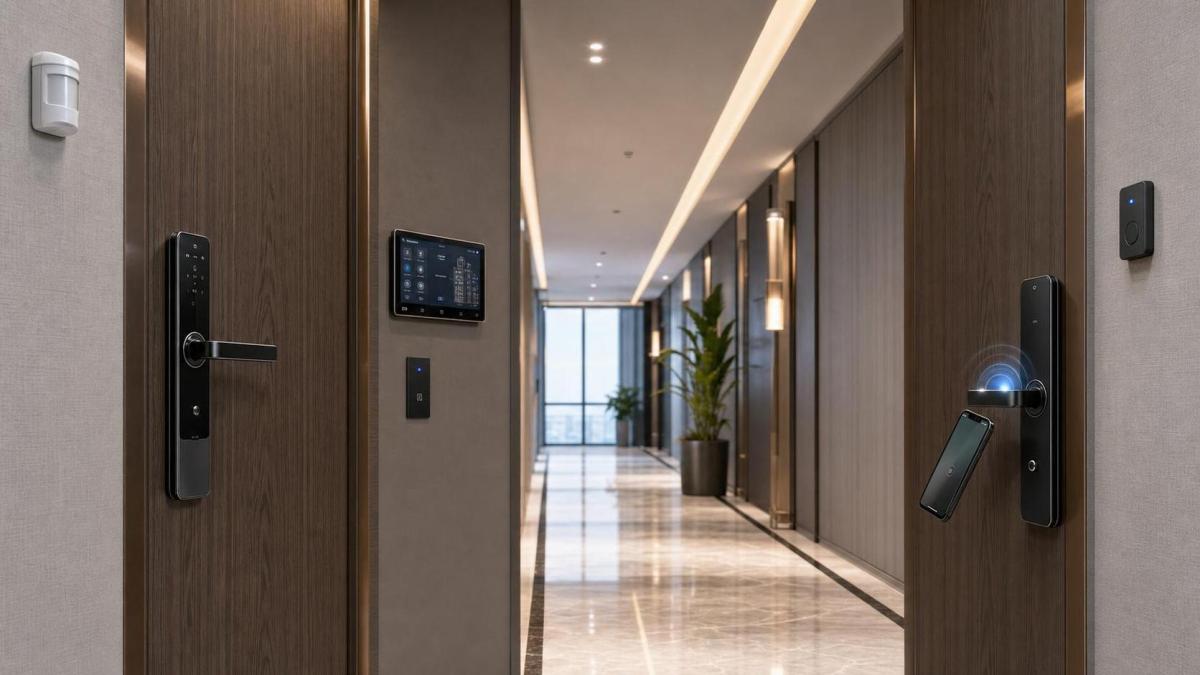
At a basic level, both products replace traditional keys with digital credentials. The main difference is how they communicate with the wider property system.
A Bluetooth lock usually connects directly to a nearby phone, tablet, or local gateway. It is simple, familiar, and often attractive for smaller sites or retrofit projects with limited infrastructure.
A Zigbee lock works inside a low-power mesh network. Devices relay signals through nearby nodes, which helps the system extend coverage across corridors, common areas, and multiple floors.
That architecture changes the conversation. A Bluetooth lock often performs well at the single-door level. A Zigbee lock tends to show its real value when dozens or hundreds of openings need coordinated control.
Why multi-unit projects push the decision in a different direction
In a detached home, lock selection is mostly personal preference. In multi-unit properties, the lock becomes part of shared building operations.
Move-ins, move-outs, temporary credentials, cleaning access, contractor permissions, and audit trails all create recurring management tasks. The larger the property, the more those tasks reward centralized visibility.
This is where a Zigbee lock often gains attention. Because it is designed for networked communication, it can support coordinated status monitoring, remote updates, and tighter alignment with smart building platforms.
Bluetooth solutions can still work well, especially in boutique developments or phased retrofits. The issue is not capability alone, but how much manual intervention remains after deployment.
Core comparison points that affect real operations
The table below highlights where a Zigbee lock and a Bluetooth lock tend to differ in multi-unit conditions.
For properties already considering Zigbee-based lighting or occupancy systems, a Zigbee lock can fit naturally into the same building intelligence strategy. That shared protocol logic can simplify future expansion.
Where a Zigbee lock usually performs better
A Zigbee lock is rarely chosen because it sounds more advanced. It is chosen because certain operational problems become easier to manage at scale.
Large door counts and shared areas
When one project includes unit doors, amenity rooms, package rooms, side entrances, and plant areas, system coherence matters. A Zigbee lock supports that coherence better than isolated device logic.
Frequent credential changes
Short-term residents, staff rotation, and contractor scheduling create constant permission updates. A Zigbee lock can reduce site visits and manual resets when platform integration is properly configured.
System-level visibility
Properties increasingly want to know which doors are online, which batteries are low, and which credentials are active. That operational view is often stronger in a Zigbee lock environment.
Cross-domain building intelligence
SHSS tracks how access, lighting, and security data are becoming linked. A Zigbee lock can support those connected scenarios, especially where common-area automation and energy efficiency are also priorities.
When Bluetooth remains the practical choice
Bluetooth should not be dismissed as the weaker option. In the right setting, it can be the more rational one.
- Small properties with limited shared access points.
- Retrofit projects where adding hubs or mesh nodes is constrained.
- Sites that prioritize local mobile unlocking over centralized workflows.
- Budget-sensitive phases where full smart infrastructure will come later.
In those conditions, a Bluetooth lock may deliver acceptable security and resident convenience without the overhead of a broader network design. The limit appears when the project later tries to scale.
The hidden cost question is not hardware alone
Upfront unit price often dominates early discussions. Yet lock economics in multi-unit projects usually depend more on lifecycle management than on hardware sticker price.
A cheaper lock can become expensive if staff must visit doors frequently, troubleshoot disconnected devices manually, or manage access changes unit by unit.
A Zigbee lock may require more planning at the beginning, but that investment can pay back through lower maintenance friction, better oversight, and reduced turnover handling time.
Bluetooth solutions can still win on total cost when the property is small, operational complexity is low, and remote administration is not a major requirement.
Security, compliance, and resilience deserve equal weight
Protocol choice should never be separated from security policy. Credential encryption, firmware update practice, audit logging, and user provisioning rules matter as much as wireless range.
This is especially relevant in buildings handling sensitive traffic, mixed commercial tenancy, or regulated data environments. SHSS regularly emphasizes that physical access is part of a wider security posture, not a standalone gadget decision.
The better question is whether the chosen platform supports secure onboarding, reliable event records, and clean role-based permissions. A Zigbee lock often has an advantage when integrated into managed systems, but implementation quality still decides the outcome.
A practical decision framework for upcoming projects
Before selecting any lock family, it helps to score the project across a few operational factors.
- Door count today and likely door count after expansion.
- Need for remote unlocking, monitoring, and credential revocation.
- Existing smart building stack, especially Zigbee lighting or sensors.
- Expected turnover frequency for residents, guests, and contractors.
- Tolerance for site-level manual maintenance.
- Security and audit requirements from owners, operators, or insurers.
If the answers point toward central visibility, integrated controls, and future scaling, a Zigbee lock is usually the stronger fit. If the project remains simple and localized, Bluetooth may be sufficient.
What to evaluate next
The most useful next step is to map door types, resident workflows, and management tasks before comparing brands. That reveals whether the project needs convenience at the edge or coordination across the property.
From there, compare gateway requirements, battery expectations, integration options, credential models, and maintenance routines. A Zigbee lock stands out when the building is being designed as a connected system rather than a collection of separate doors.
In multi-unit work, the best lock is the one that still feels manageable after occupancy begins. That is why the Zigbee lock conversation is less about wireless preference and more about operating discipline, scale, and long-term building intelligence.
Recommended News