
Search News
Industry Portal
Hot Articles
EU Rule Takes Effect: Biometric Access Devices Need EN 301 489-37
Time
Click Count
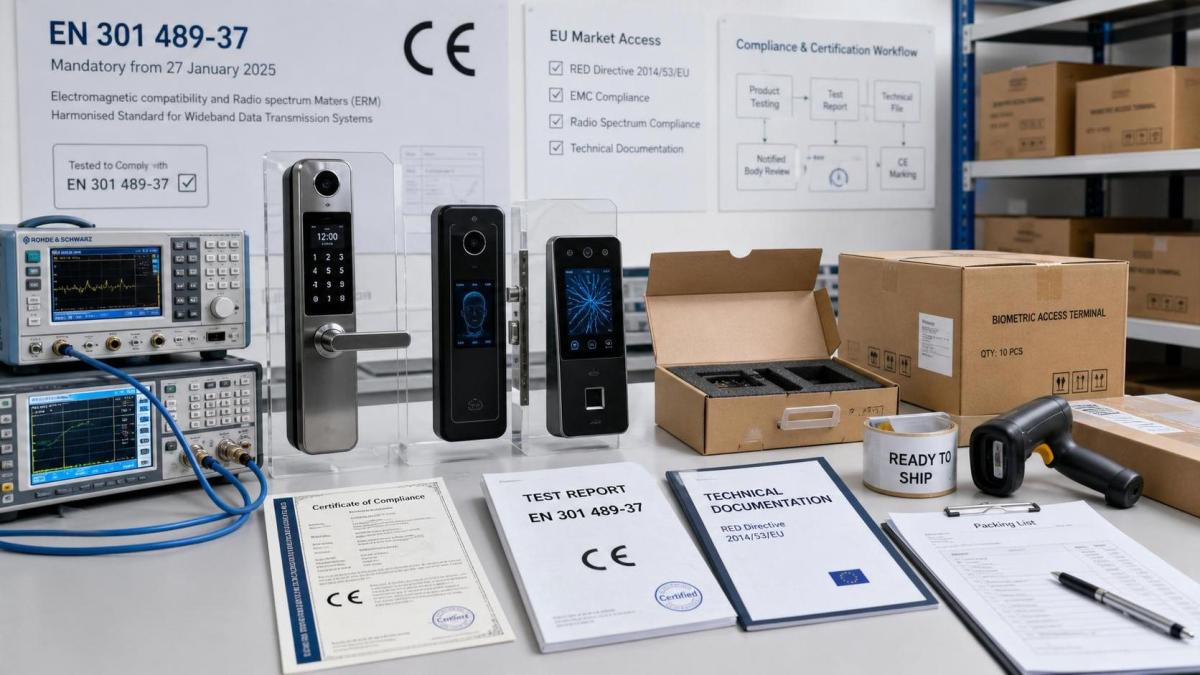
On July 22, 2026, the EU began mandatory enforcement of EN 301 489-37:2025 for biometric access control devices sold in its market, bringing a concrete compliance change for 3D facial recognition locks and iris or vein biometric locks. For exporters, importers, certification-related service providers, and buyers involved in connected access systems, this is not just a technical update: it affects market entry, the validity basis of CE marking, and customs clearance, making it a practical issue for shipment planning and product readiness.
What the Rule Change Confirms
The confirmed change is that, from July 22, 2026, EN 301 489-37:2025 is formally mandatory in the EU for relevant products. The requirement applies to 3D facial recognition locks and iris or vein biometric locks sold in the EU market, and those products must complete the relevant EMC-specific certification.
The information provided also makes clear that the rule directly affects product access to the EU market, the effectiveness of CE marking, and customs clearance procedures for affected goods. Devices that have not obtained the required certification may be rejected by customs authorities in EU member states.
The standard is described as setting strict radio-frequency immunity limits for IoT-connected biometric terminals, with direct relevance to Iris/Vein Biometric Locks and 3D Facial Recognition products.
Where the Pressure Will Appear First
Export shipments now face a documentation threshold
From an industry perspective, exporters of affected biometric access devices are likely to feel the impact first because market entry and customs handling are directly tied to certification status. The main pressure point is no longer only product shipment readiness, but whether the product dossier, CE-related compliance basis, and supporting certification materials align with the new mandatory standard before dispatch.
Manufacturers of connected biometric terminals need closer technical alignment
Manufacturing companies producing IoT-enabled biometric locks may be affected at the product design verification and release stage. Analysis shows that the stricter radio-frequency immunity limits mentioned in the event summary make technical confirmation more important for devices using 3D facial recognition, iris recognition, or vein recognition functions. What deserves closer attention is whether internal testing, external certification preparation, and technical file updates are synchronized with the new requirement before products are offered for the EU market.
Buyers and channel partners may need to revisit procurement conditions
Distributors, project buyers, and channel-side participants could be affected through procurement screening and delivery acceptance. Where the affected products are intended for the EU market, procurement teams may need to pay closer attention to whether certification status, compliance statements, and technical documents are complete enough to support customs clearance and lawful market placement. This matters especially where delivery timing depends on goods moving without clearance interruption.
Certification and testing service providers are drawn into earlier-stage review
Certification-related companies and testing service institutions may see greater demand for earlier compliance review rather than late-stage document handling. Observably, once customs rejection becomes a stated consequence for uncertified devices, the commercial cost of incomplete compliance rises, and service work shifts closer to pre-shipment verification, test planning, and technical document readiness.
What Companies Should Check Now
Review whether affected product lines fall within the enforcement scope
Companies should first check whether their EU-bound products include 3D facial recognition locks or iris or vein biometric locks, particularly where those devices function as IoT-connected terminals. The event summary clearly links the standard to these categories, so product classification and scope review become an immediate practical step.
Reassess the compliance basis behind CE-related documentation
Analysis shows that one of the most immediate business issues is not only obtaining the relevant EMC certification, but also confirming whether existing CE-related documentation remains aligned with the now-mandatory standard. For firms already shipping to the EU, this deserves attention in technical files, declarations, certification records, and shipment paperwork.
Adjust delivery schedules around certification and customs risk
What deserves closer attention is the effect on delivery planning. Because uncertified equipment may be refused by member-state customs, companies should treat certification status as a scheduling condition for export orders rather than a post-order administrative step. This is particularly relevant for projects with fixed installation windows or time-sensitive procurement cycles.
Keep watching for execution wording and downstream document changes
The input does not provide further operational detail on how all market participants will apply the rule in practice, so companies should avoid assuming a fully uniform implementation pattern beyond the confirmed requirement itself. Observably, later changes may appear in certification wording, customs document checks, procurement specifications, tender documents, and customer-side compliance requests, all of which should be monitored.
Why This Looks More Like an Execution Signal Than a Distant Policy Trend
Analysis shows that this development is better understood as an implemented compliance requirement rather than a preliminary policy discussion. The reason is straightforward: the event is tied to a confirmed effective date, a defined standard number, identified product categories, and a stated consequence for uncertified goods at customs.
At the same time, it is still too early to overstate downstream market outcomes. From an industry perspective, the more useful reading is that the rule has crossed into execution territory, while the exact pace of adjustment across procurement practice, document review, and supplier qualification still requires observation through actual enforcement and market feedback.
How to Read the Change at This Stage
In practical terms, this update signals that EMC compliance under EN 301 489-37:2025 has become a direct access condition for certain biometric access control products entering the EU market. The immediate significance lies in certification readiness, CE-related compliance support, and customs clearance reliability.
It is more appropriate to understand this as a landed rule change with immediate operational relevance, while keeping expectations measured on how quickly all related business processes will adjust. For companies exposed to EU-bound biometric access devices, the sensible near-term focus is compliance confirmation, shipment discipline, and continued tracking of how the requirement is reflected in transaction documents and market practice.
Basis of This Article and What Still Needs Verification
This article is based on the user-provided news title, event date, and event summary. For developments of this type, commonly relevant source categories may include official announcements, regulator releases, customs or trade authority information, industry association notices, standards organization documents, and reporting from authoritative media. No specific official source link was provided in the input, so the exact official reference path still requires ongoing verification.
Further observation is still needed on detailed implementation language, certification interpretation, tender document updates, customs review practice, market feedback, and how companies in the supply chain carry the requirement into day-to-day execution.
Recommended News