
Search News
Industry Portal
Hot Articles
When should you choose grade 10.9 over 8.8 high tensile bolts?
Time
Click Count
Choosing grade 10.9 over 8.8 high tensile bolts is not simply a matter of buying greater strength. For technical evaluators, the decision depends on required preload, joint geometry, service loads, and the governing design standard. Grade 10.9 can provide greater capacity within a constrained bolt size, but that advantage only becomes useful when the surrounding joint and installation process can support it.
Choose 10.9 when a verified calculation shows that 8.8 cannot provide the required bolt resistance or retained clamp force within the available space. Keep 8.8 when it meets the design requirements with adequate margin and offers a simpler, more controllable fastening system. Neither choice can compensate for weak threads, poor joint geometry, or unreliable tightening.
What actually changes between property classes 8.8 and 10.9?
Although “grade” is common purchasing language, ISO metric fasteners use the term property class. Under ISO 898-1, the class designation describes nominal tensile strength and the nominal relationship between yield and tensile strength. It does not identify the coating, corrosion resistance, thread tolerance, or suitability for a particular structural assembly.
The first number, multiplied by 100, indicates nominal tensile strength in MPa. Multiplying that value by the second number divided by ten gives nominal yield strength. Actual specified minimum properties require closer attention:
These values summarize common ISO 898-1 requirements for the applicable bolt sizes. Confirm the current standard, product geometry, test requirements, and specified diameter range before using them in an approval calculation. Special head designs or reduced-loadability fasteners need additional checks.
One distinction matters immediately: 10.9 is stronger, not appreciably stiffer. Both classes have essentially the same elastic modulus. With identical geometry, their elastic extension under the same axial load is therefore similar.
The strongest reason to choose 10.9: more usable preload in limited space
Consider a machinery flange where the bolt diameter, hole pattern, and surrounding clearance are already fixed. If class 8.8 cannot maintain enough clamp force to prevent separation or slip, class 10.9 may offer a practical route without enlarging the connection.
For an M16 coarse-thread bolt, the tensile stress area is approximately 157 mm². Using the proof stresses above gives:
- Class 8.8 proof load: 157 × 580 ≈ 91 kN.
- Class 10.9 proof load: 157 × 830 ≈ 130 kN.
If an illustrative preload target were set at 70% of proof load, the corresponding values would be approximately 64 kN and 91 kN. That is about 43% more initial clamp force from the same thread size—not a universal 43% increase in joint capacity.
The 70% figure is an illustration, not an installation instruction. Actual targets must account for tightening scatter, torsional stress during installation, relaxation, service loading, and the governing design method. Structural preloading rules may use a different basis entirely.
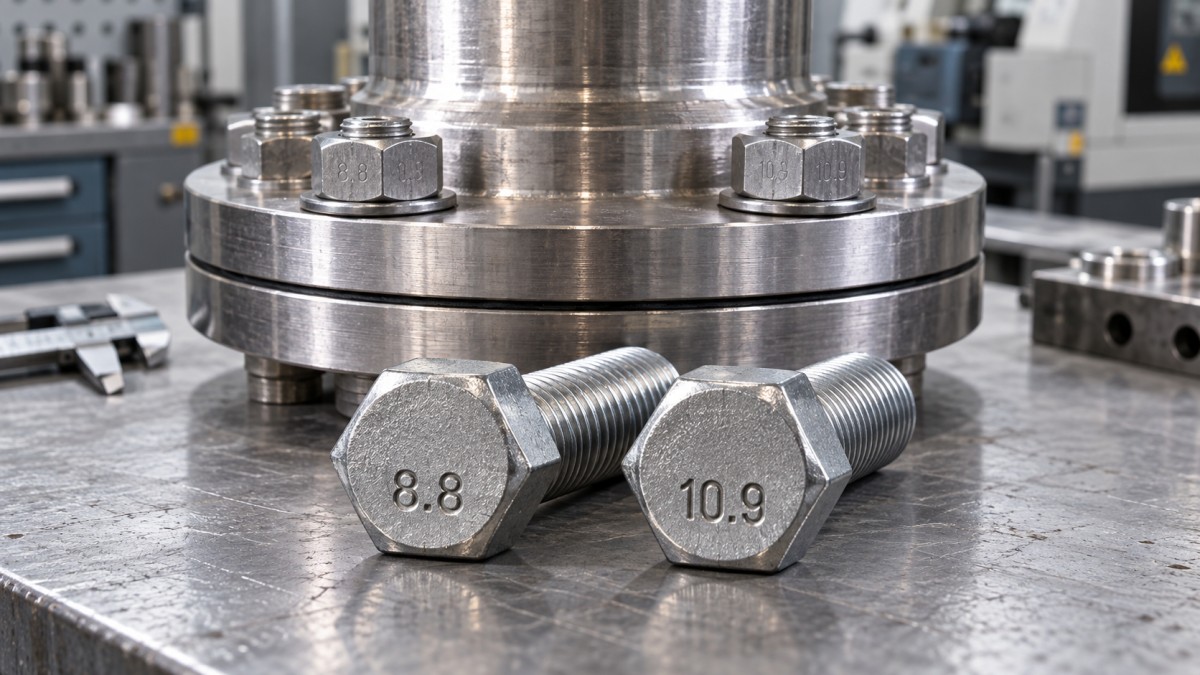
The higher preload becomes valuable only if the nut, washer, bearing surfaces, tapped threads, and clamped material can withstand it. Otherwise, changing the bolt simply moves the failure elsewhere.
Four situations where grade 10.9 high tensile bolts deserve consideration
1. Bolt diameter or bolt count cannot increase
Compact gearboxes, machine frames, and retrofit interfaces often leave little room for larger fasteners. A higher property class can provide additional tensile resistance while preserving the existing envelope.
However, downsizing a bolt because 10.9 is stronger changes more than strength. It also affects stiffness, bearing pressure, thread engagement, and fatigue behavior. Recalculate the connection rather than matching tensile capacities alone.
2. The connection needs greater retained clamp force
Friction-dependent joints rely on clamp force to resist relative movement. Where the design standard permits it, higher preload can improve slip resistance and reduce the likelihood of joint opening.
That benefit depends on the contact surfaces. Paint creep, compressible gaskets, soft aluminum, embedment, and thermal expansion differences can reduce preload after assembly. A stronger bolt does not prevent these losses. Sometimes a better washer arrangement, stiffer flange, or revised surface treatment delivers more value than a property-class upgrade.
3. Calculated bolt resistance governs the design
If bolt tension, shear, or combined loading is the controlling limit state, 10.9 may increase the available design resistance. The increase must come from the relevant code equations, not a simple ratio of nominal strengths.
Check whether threads lie in the shear plane, whether prying introduces additional tension, and whether the connected plate governs through bearing, tear-out, or net-section failure. If the plate already controls, stronger bolts may add cost without increasing the connection’s rated capacity.
4. A qualified assembly or equipment design specifies 10.9
For an approved structural assembly or an OEM-controlled machine connection, the specified property class is part of the system. Substituting 8.8 may remove essential preload or resistance; substituting 10.9 may also invalidate the approved arrangement.
For example, European structural connections may require assemblies conforming to EN 14399 for preloading or EN 15048 for non-preloaded applications. A loose ISO 898-1 class 10.9 bolt is not automatically an acceptable replacement for a qualified assembly. Likewise, metric property classes should not be treated as direct substitutes for ASTM structural fastener specifications.
Where 10.9 does not solve the problem
Vibration is a frequent reason buyers request stronger bolts. But transverse movement, loss of clamp force, and self-loosening are joint-behavior problems—not merely insufficient tensile strength.
Higher preload may help prevent movement when the connection is designed for it. It does not replace suitable joint geometry, a validated tightening process, or an appropriate locking strategy.
Fatigue needs similar care. Higher ultimate strength does not produce a proportional improvement in the fatigue resistance of a threaded connection. Thread-root stress concentration, surface condition, manufacturing process, mean stress, and cyclic stress range all matter.
In a properly preloaded joint that remains closed, only part of an external tensile load increment reaches the bolt, according to the relative stiffnesses of bolt and clamped members. If separation occurs, bolt load fluctuations can rise sharply. The useful question is therefore not “Which class is strongest?” but “Which design keeps the bolt’s cyclic stress range acceptable?”
The installation process can decide the choice
A drawing may specify a precise preload, while the shop floor controls only torque. Those are not equivalent.
The familiar approximation T = K × F × d relates torque, preload, and nominal diameter through a friction-dependent nut factor. Changes in coating, lubricant, thread condition, and bearing surface can significantly alter the preload achieved at the same torque.
Do not reuse an 8.8 torque value for a 10.9 bolt and assume the upgrade is complete. Equally, do not apply a generic higher torque without verifying the joint’s capacity and friction conditions.
Depending on criticality and the applicable standard, control may involve calibrated torque tools, torque-angle procedures, direct tension indicators, ultrasonic elongation measurement, or another validated method. Each has limitations. Large impact wrenches are useful for productivity, but tool output alone is not evidence of achieved clamp force.
Where installation access is poor, lubrication varies, or inspection is limited, class 8.8 may remain the more practical choice—provided it satisfies the design. A theoretically stronger connection is not an improvement if its required preload cannot be achieved consistently.
Coatings and mating components need a separate approval
Moving to 10.9 raises the importance of hydrogen embrittlement control. Higher-strength steels are generally more susceptible, and hydrogen may enter during processes such as acid cleaning and electroplating. Under sustained tensile stress, a susceptible fastener can suffer delayed fracture.
This does not mean every plated 10.9 bolt is unsuitable. It means coating selection, process controls, and applicable standards must be reviewed deliberately. Post-plating baking can reduce risk but should not be treated as a guarantee that risk has disappeared.
Non-electrolytic zinc-flake systems may be considered where appropriate, although pretreatment, friction characteristics, and assembly compatibility still require confirmation. Hot-dip galvanizing also needs specification-level review, including thread clearances and restrictions for the selected fastener system.
The surrounding hardware deserves equal attention:
- Nuts: Use a compatible property class under ISO 898-2 or the governing assembly specification. Class 10 nuts commonly accompany class 10.9 bolts, but nut style and system requirements matter.
- Washers: Verify the required hardness, dimensions, and bearing performance. A soft washer can deform under increased preload.
- Tapped holes: Check internal-thread material and engagement length for stripping resistance.
- Clamped parts: Evaluate local crushing, flange bending, and settlement, especially with aluminum, thin plate, or coated surfaces.
A decision sequence for technical approval
Before approving an upgrade, establish what currently limits the connection. “More safety margin” is not specific enough to justify changing a controlled fastener specification.
- Identify the governing requirement. Is it tensile resistance, shear resistance, slip prevention, separation control, fatigue, or compliance with an existing design?
- Calculate the complete joint. Include external loads, prying, stiffness, thread engagement, bearing, preload loss, and relevant safety factors.
- Compare alternatives. A larger 8.8 bolt, improved bolt layout, or stiffer flange may outperform a same-size upgrade to 10.9.
- Validate assembly conditions. Confirm coating, lubrication, tightening method, tool capability, and inspection acceptance criteria.
- Document procurement controls. Specify property class, dimensions, coating, compatible components, traceability, and required inspection documentation.
For safety-critical service, head markings alone are not enough evidence. Require documentation appropriate to the application and risk, and verify that supplied components match the approved specification.
The practical choice: stronger only where strength is useful
Choose grade 10.9 high tensile bolts when a constrained connection genuinely needs their higher resistance or preload capability, and when the complete assembly can deliver that benefit reliably.
Choose grade 8.8 when it already meets the governing requirements with suitable margins. Avoid adding tightening demands, coating complications, or procurement cost without a demonstrated engineering return.
The best selection is not the highest number on the bolt head. It is the fastening system whose calculated performance, installation controls, and service conditions agree.
- Last One:No more articles
- Next Article:How much do 600W LED grow lights cost to run for 12 hours a day?Oct 17, 2026
Recommended News