
Search News
Industry Portal
Hot Articles
BLDC Motor Technology Explained for Longer Tool Life
Time
Click Count
BLDC Motor Technology Explained for Longer Tool Life
For technical evaluations of modern tools, BLDC motor technology matters because motor design shapes runtime, heat, maintenance cycles, and long-term reliability.
That is especially true in industrial drilling, fastening, cutting, and repetitive assembly environments where downtime costs more than the tool itself.
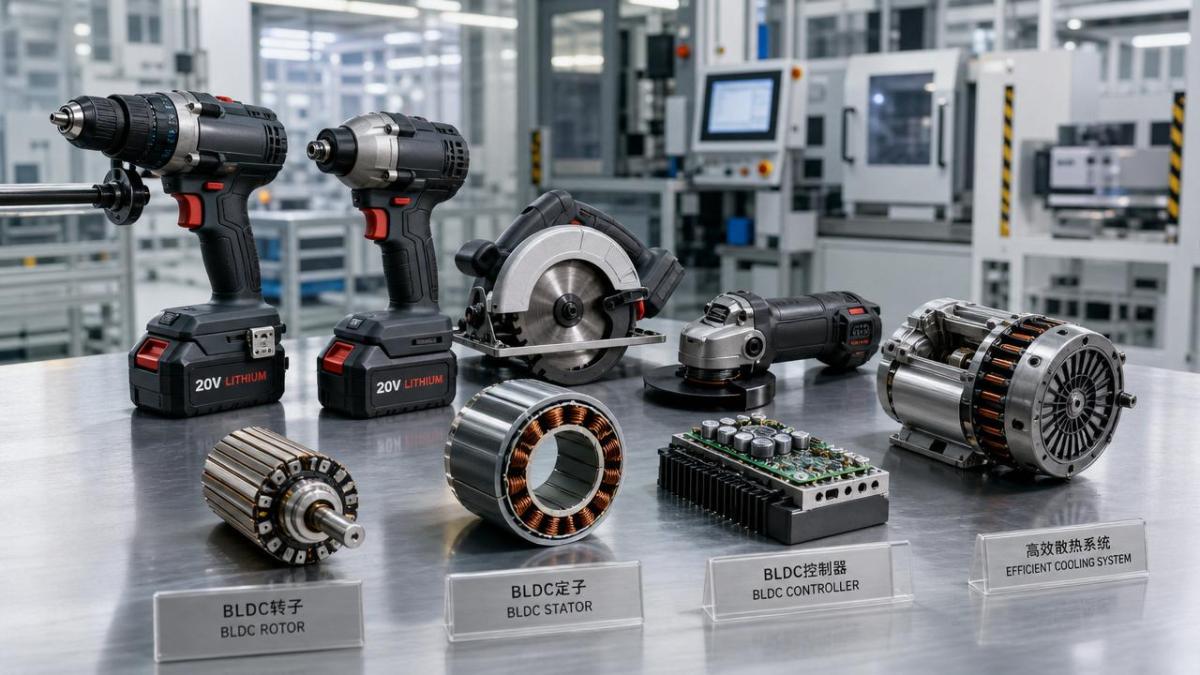
Unlike brushed motors, brushless systems remove physical commutator contact. That single design change reduces wear at the source.
It also opens the door to smarter speed control, better thermal behavior, and more stable torque delivery under variable loads.
In practical terms, BLDC motor technology helps tools last longer, hold calibration better, and stay productive in harsh jobsite conditions.
For organizations focused on lifecycle cost, this is not just a motor upgrade. It is a platform decision.
What BLDC Motor Technology Actually Means
BLDC motor technology refers to brushless DC motor systems that use electronic commutation instead of mechanical brushes.
A typical architecture includes permanent magnets on the rotor, windings on the stator, sensors or sensorless control logic, and a power electronics controller.
The controller switches current in precise sequences. That keeps the rotor turning without the friction, sparking, and carbon dust seen in brushed designs.
From a technical review perspective, the motor cannot be judged alone. BLDC motor technology is really a motor-plus-controller system.
This is why two tools using brushless branding may perform very differently in the field.
The quality of the inverter stage, control algorithm, bearing design, cooling path, and battery integration all affect final service life.
Why BLDC Motor Technology Extends Tool Life
The strongest advantage is reduced mechanical wear. No brushes means no brush erosion, no commutator scoring, and fewer friction-related failure points.
That directly lowers maintenance demand in high-cycle applications such as repetitive fastening or production line drilling.
Heat is the next major factor. BLDC motor technology generally converts electrical power more efficiently, so less energy becomes waste heat.
Lower internal temperature protects winding insulation, magnets, bearings, grease, and nearby electronic components.
This also matters for battery-powered systems. Less heat in the drive train often means less battery stress and more stable current draw.
More importantly, electronic control allows the motor to respond intelligently to load spikes. That reduces shock events inside the tool.
- Soft-start logic limits sudden inrush and gear impact.
- Torque management prevents overload from becoming repeated internal abuse.
- Thermal protection reduces insulation degradation during extended duty cycles.
- Speed regulation helps the tool stay within its efficient operating window.
Taken together, these features explain why BLDC motor technology often supports longer usable life, not just better headline performance.
Key Technical Factors to Evaluate
When comparing platforms, motor type alone is not enough. A serious evaluation should look at the full electrical and mechanical stack.
1. Controller Quality
The controller is the brain of BLDC motor technology. Poor commutation logic can create torque ripple, overheating, noise, and unstable starts.
Look for smooth low-speed control, fast overload response, and well-managed current limiting under sustained load.
2. Thermal Path Design
A high-efficiency motor still fails early if heat cannot escape. Housing material, airflow path, rotor balance, and stator placement all matter.
Check whether published performance reflects continuous duty or only short bursts measured in ideal lab conditions.
3. Bearing and Gearbox Matching
BLDC motor technology can generate high torque density, but that advantage disappears if the gearbox and bearings are undersized.
In many failures, the motor survives while the drivetrain wears out from repeated peak loading.
4. Battery and Power Electronics Integration
For cordless tools, battery chemistry and battery management strongly affect motor behavior. Voltage sag can distort real-world performance.
A well-designed system balances peak output with cell protection, thermal safety, and repeatable torque across charge levels.
BLDC Motor Technology vs. Brushed Motor Systems
For technical decision-making, side-by-side comparison remains useful because service life depends on several linked variables.
The table shows why BLDC motor technology often wins in total lifecycle value even if acquisition cost starts higher.
The gap becomes more obvious where uptime, consistency, and thermal resilience matter more than lowest purchase price.
Where Field Performance Improves Most
In real operations, BLDC motor technology delivers the clearest gains in demanding duty profiles rather than occasional light use.
- High-cycle fastening where repeatable torque protects both hardware and operator pace.
- Metal drilling where sustained load makes heat buildup the main life-limiting factor.
- Construction tools exposed to dust, vibration, and fluctuating battery conditions.
- Precision assembly where stable speed matters more than raw peak power alone.
This is also why industrial tool portfolios increasingly move toward fully brushless platforms paired with smarter battery systems.
From a broader market view, the shift aligns with AIoT-connected maintenance, better diagnostics, and tighter energy efficiency targets.
Common Risks and Misread Signals
One common mistake is treating BLDC motor technology as a guarantee of long life. It is an enabler, not automatic proof.
If sealing is poor, bearings are weak, or firmware is crude, a brushless tool can still disappoint in heavy use.
Another risk is overvaluing peak torque marketing. Short burst figures may hide poor continuous performance.
Technical reviews should ask for duty-cycle data, thermal protection thresholds, service records, and failure mode patterns.
In business terms, the real question is simple: how long does the tool hold output, accuracy, and safety under actual workload?
A Practical Evaluation Checklist
A structured review makes BLDC motor technology easier to compare across brands, price levels, and application classes.
- Confirm continuous power, not only peak output claims.
- Review thermal management design and overload protection logic.
- Check bearing, gearbox, and housing durability under vibration.
- Compare battery integration and performance at low charge states.
- Ask for service data, warranty trends, and common field failures.
- Match motor behavior to the real duty cycle of the target application.
That approach usually reveals whether BLDC motor technology is being used as a genuine engineering advantage or only as a sales label.
Final Takeaway
BLDC motor technology supports longer tool life because it cuts wear, improves efficiency, and enables intelligent control under stress.
Still, the best results come from system-level design, not the motor label alone.
When evaluation focuses on controller quality, thermal stability, drivetrain strength, and field duty cycle, purchasing decisions become clearer.
That is the practical path to selecting tools that deliver not just power, but dependable lifecycle value.
Recommended News