
Search News
Industry Portal
Hot Articles
BLDC Motor Technology in 2026 Cordless Tool Design
Time
Click Count
In 2026, cordless tool development is no longer driven by battery size alone. BLDC motor technology has become a system-level decision that shapes torque behavior, thermal limits, runtime, reliability, and even service economics.
That shift matters across construction, industrial assembly, infrastructure maintenance, and smart city operations. In these environments, tool failure, excess heat, or unstable power delivery quickly turns into downtime, safety risk, and lost productivity.
Seen through the SHSS perspective, brushless tool design sits beside high-strength hardware, protective gear, and intelligent urban systems. It is part of the same larger requirement: physical performance that remains precise under pressure.
Why BLDC motor technology is central to 2026 cordless tool design
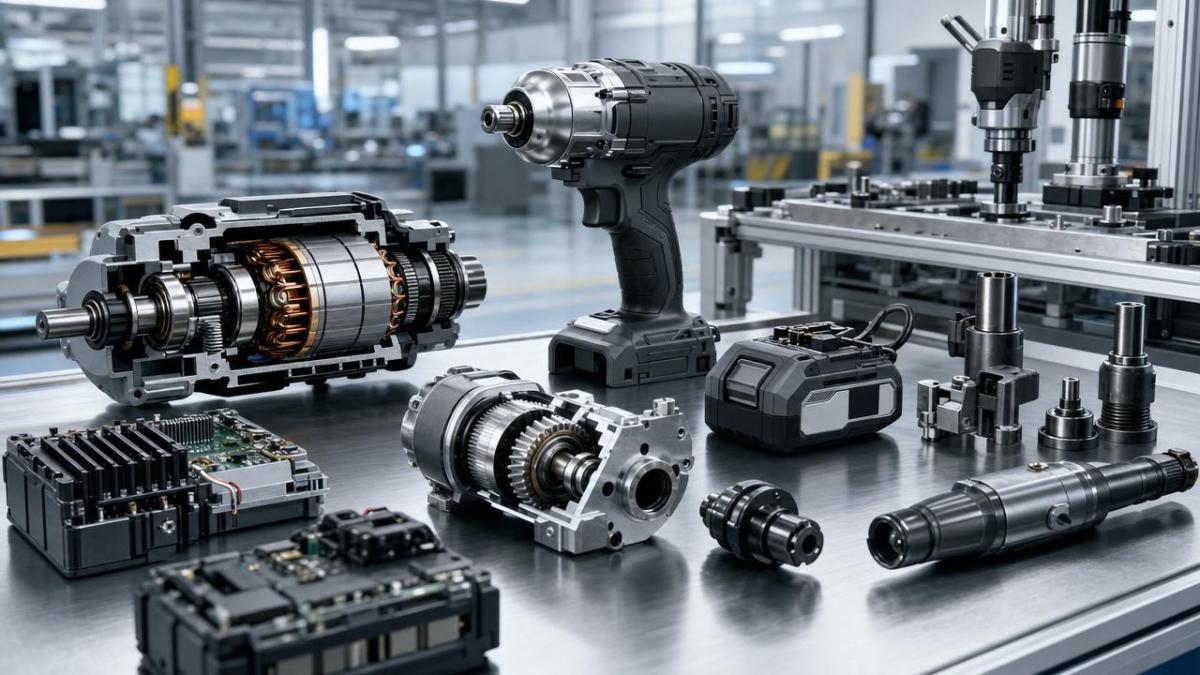
The image can illustrate how the motor, controller, gearbox, and battery act as one integrated architecture.
BLDC motor technology replaces carbon brushes with electronic commutation. On paper, that sounds like a motor upgrade. In practice, it changes how the entire tool is engineered.
A modern cordless impact wrench, drill, grinder, or fastening tool depends on coordinated control between magnets, windings, sensors, firmware, battery management, and gear reduction.
This is why two tools with similar voltage labels can perform very differently in the field. Voltage is only one variable. Motor control quality decides how efficiently stored energy becomes useful work.
In 2026, evaluation is moving beyond peak power claims. More attention is going to continuous output, stall recovery, temperature rise, vibration behavior, and consistency across repeated load cycles.
The engineering logic behind better field performance
The main advantage of BLDC motor technology is not simply higher efficiency. It is controllable efficiency under changing load, speed, and thermal conditions.
In demanding fastening or drilling work, load is rarely stable. Torque spikes, hard starts, sudden stalls, and repeated trigger changes are normal. Electronic commutation manages those transitions more precisely.
That precision supports several practical gains:
- Higher torque density in compact housings
- Lower friction losses than brushed designs
- Faster response to sudden resistance changes
- Reduced maintenance from brush wear elimination
- More tunable speed and torque curves through software
For technical review, the motor should be judged as part of a controlled electromechanical loop, not as a standalone component with an isolated efficiency number.
Thermal control is now a primary differentiator
Cordless tools are expected to deliver corded-like bursts from smaller packages. That raises the thermal burden on the motor, MOSFETs, current paths, and battery cells.
BLDC motor technology helps, but it does not remove heat. It only manages losses more intelligently. If the thermal path is poor, performance drops quickly during sustained work.
Useful evaluation points include housing conductivity, airflow design, controller protection logic, derating strategy, and recovery time after overload events.
Torque delivery matters more than rated torque
A headline torque number can hide unstable output. What matters in use is how repeatably the tool reaches target torque under battery depletion, varying bit condition, and fastener resistance.
For fastening applications, that consistency directly affects joint quality. In sectors tied to structural hardware, poor torque control can mean under-tightening, over-tightening, or premature wear.
What the market is watching in 2026
BLDC motor technology is now linked with broader industry shifts, especially AIoT-enabled manufacturing, lifecycle monitoring, and compact high-output equipment.
Three trends stand out.
- Higher power density without major weight growth
- Closer integration between motor control and battery intelligence
- More data-driven maintenance through usage logging and diagnostics
This matters in sectors where uptime is tracked carefully. A tool is no longer judged only by purchase price. It is judged by output per charge, downtime risk, and service interval stability.
That same logic appears across the SHSS ecosystem. Whether the product is a biometric entry device, a smart luminaire, or a cordless impact tool, the market rewards controlled performance over simple specification inflation.
Where BLDC motor technology creates business value
The practical value of BLDC motor technology appears in measurable operating outcomes. Better efficiency extends runtime, but the larger impact often comes from reduced interruptions and more stable process quality.
In assembly lines, consistent speed under load supports cycle-time predictability. In field maintenance, lower heat and stronger low-speed control reduce restart delays. In infrastructure work, compact power lowers operator fatigue.
For organizations managing fleets of tools, lifecycle cost becomes a decisive metric. Brushless systems typically reduce wear items, but that advantage depends on controller robustness and battery ecosystem quality.
Typical scenarios that expose real design quality
Not all applications stress BLDC motor technology in the same way. Evaluation improves when testing reflects realistic duty cycles.
High-torque fastening
This scenario reveals pulse behavior, reaction control, battery sag sensitivity, and repeated tightening consistency. It is highly relevant to structural hardware and industrial installation work.
Continuous drilling or cutting
Longer cycles highlight copper loss, housing heat accumulation, and controller derating strategy. A strong short-burst tool may underperform badly here.
Precision assembly
Fine speed control, startup smoothness, and low-end torque stability matter more than raw peak output. This is where firmware tuning becomes visible.
Harsh site conditions
Dust, vibration, temperature swings, and intermittent handling expose sealing quality and electronics durability. In these environments, brushless design alone is not enough.
How to judge BLDC motor technology beyond marketing claims
A useful review framework starts with evidence, not headline numbers. Peak wattage, no-load speed, and nominal torque are easy to publish, but they rarely tell the whole story.
A stronger assessment usually includes:
- Performance traces across low, medium, and heavy loads
- Temperature data during sustained operation
- Torque repeatability under different battery states
- Drop, dust, and vibration endurance results
- Controller protection behavior during abuse cases
- Battery pack compatibility and current delivery limits
It is also worth checking how serviceable the platform is. Some failures come from boards, connectors, or cooling paths rather than the motor core itself.
That is especially important in industrial fleets, where downtime cost often exceeds the price gap between mid-tier and premium brushless designs.
A practical next step for evaluation and selection
BLDC motor technology in 2026 should be reviewed as an operating system for the tool, not just as a motor choice. The most useful comparisons connect electrical efficiency with field endurance and process quality.
A sensible next step is to map real duty cycles, define acceptable heat rise, set torque consistency thresholds, and compare battery-platform behavior under those conditions.
When that framework is clear, cordless tool decisions become easier to justify. They also align better with the broader SHSS view of modern hardware: stronger performance, tighter control, and fewer weak points where failure can begin.
That approach creates a better basis for shortlisting platforms, validating claims, and identifying where BLDC motor technology will actually deliver long-term value.
Recommended News