
Search News
Industry Portal
Hot Articles
Brushless Drill vs Brushed Drill: Which Delivers Better Runtime?
Time
Click Count
Runtime often decides whether a drill feels practical or frustrating. In the debate around a brushless drill and a brushed model, battery life matters because it affects pace, comfort, and how often work is interrupted.
In today’s hardware market, that question also connects to a larger shift. Across construction, maintenance, home improvement, and light industrial tasks, tools are expected to deliver more output with less wasted energy.
That is why SHSS follows the rise of brushless systems so closely. Better runtime is not only a convenience issue. It reflects efficiency, heat control, battery management, and the broader move toward smarter physical hardware.
What runtime really means in drill performance
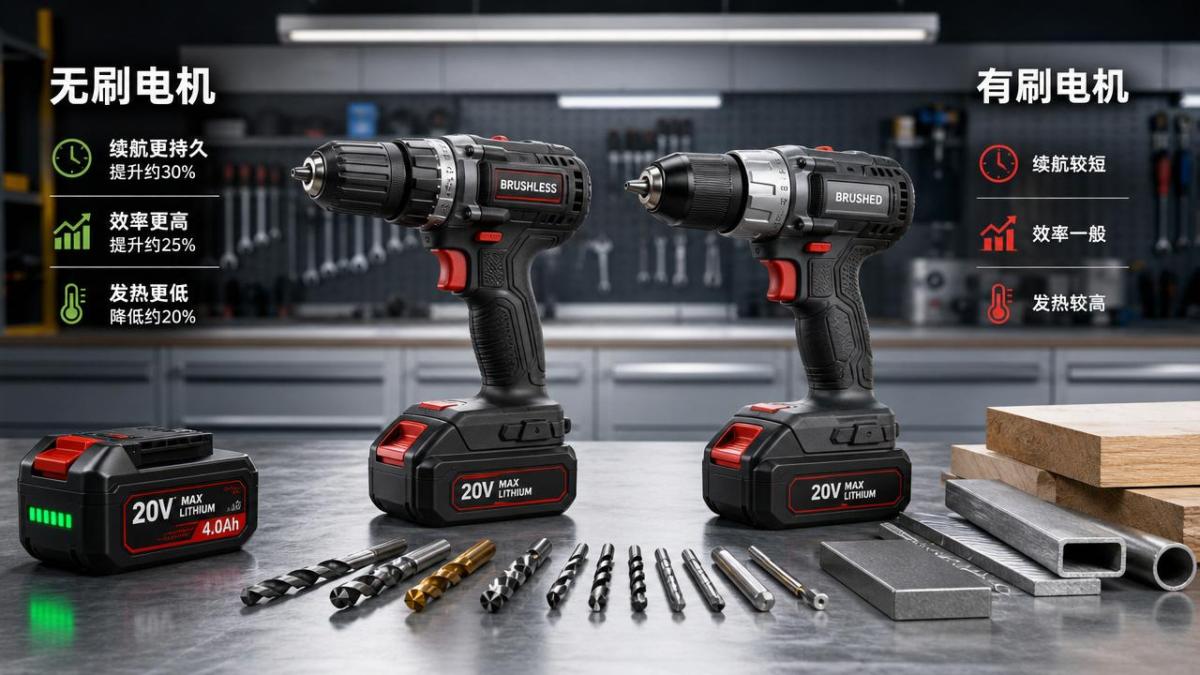
When people compare runtime, they usually mean how long a tool works on one battery charge. Yet that simple idea hides several variables that shape the real result.
A brushed drill uses carbon brushes to transfer electricity inside the motor. A brushless drill replaces that contact system with electronic control, which reduces friction and energy loss.
Because of that design, a brushless drill usually converts more battery power into usable torque. Less energy turns into heat, and more energy goes into drilling, driving, or fastening.
That does not mean every brushless drill automatically runs longer than every brushed drill. Battery size, motor tuning, gearbox quality, trigger behavior, and material resistance still matter.
Why the industry pays attention to brushless systems
The attention around brushless tools is part of a wider hardware transition. In sectors tracked by SHSS, from power tools to smart infrastructure, efficiency and controllability are becoming linked priorities.
Brushless motors fit that direction well. They support compact high-output tools, work effectively with modern lithium-ion batteries, and allow better electronic response under changing loads.
For everyday use, that translates into fewer battery swaps and steadier performance. For the broader market, it signals a shift toward hardware that wastes less energy while staying powerful enough for demanding tasks.
This matters beyond workshops. In jobsite environments, service fleets, and mobile repair work, longer runtime improves workflow in the same way smart lighting reduces wasted power or high-strength fasteners improve structural reliability.
Brushless drill vs brushed drill under real workloads
The biggest misunderstanding is assuming runtime should be judged with no context. Drilling softwood pilot holes and mixing dense material place very different demands on a motor.
A brushed drill often performs acceptably for occasional household use. If the load is light and the sessions are short, the runtime gap may feel modest.
Once the work becomes heavier, the advantage of a brushless drill becomes more visible. Repeated hole boring, long screw runs, masonry-compatible applications, and overhead work all expose inefficiencies faster.
Heat is a key reason. Brushed motors lose energy through friction and electrical contact. As heat rises, efficiency drops, and battery drain tends to increase.
A brushless drill stays cooler in many situations. That helps preserve runtime and often makes performance feel more consistent through the middle and later part of the battery cycle.
A practical comparison
What actually affects runtime besides the motor
Motor type matters, but it is not the whole story. A brushless drill can still disappoint if the battery pack is undersized or the task is mismatched to the tool.
Several factors deserve close attention when comparing models:
- Battery capacity in amp-hours, because a larger pack stores more usable energy.
- Voltage platform, since higher-voltage systems may handle demanding loads more efficiently.
- Bit sharpness and accessory quality, which affect resistance more than many buyers expect.
- Material density, especially hardwood, metal, masonry, or layered assemblies.
- Trigger control and speed setting, because aggressive full-speed use drains batteries faster.
This is where runtime becomes a system question rather than a single feature. SHSS often frames smart hardware this way: performance comes from the interaction between motor, battery, electronics, and workload.
Where a brushless drill makes the biggest difference
Not every task needs the same tool architecture. The value of a brushless drill becomes clearer in situations where interruption, heat, and repeat cycles affect the overall experience.
Typical high-value scenarios include installation work, furniture assembly at scale, decking projects, repeated anchor setting, metal drilling, and long sessions away from convenient charging points.
In compact urban jobsites, mobile service vans, and multi-room maintenance work, runtime is not just about minutes. It reduces stop-and-start friction across the entire task.
A brushed drill still has a place. For infrequent repairs, backup use, or budget-limited light duty, it can remain a sensible option if expectations are realistic.
When the runtime gap is easiest to notice
- Extended screw driving in dense wood.
- Repeated drilling with larger diameter bits.
- Work that involves many starts, stops, and speed changes.
- Warm environments where excess heat hurts battery efficiency faster.
How to judge the better choice before buying
A useful decision starts with workload, not marketing language. The right question is not whether a brushless drill is better in theory, but whether the runtime gain changes the result of the work.
If the tool will be used often, under moderate or heavy load, a brushless drill usually brings better long-term value. More runtime, lower heat, and reduced motor wear support that conclusion.
If use is occasional and light, the price gap may outweigh the runtime advantage. In that case, battery platform compatibility and overall tool balance may matter more than motor type alone.
It also helps to compare runtime claims carefully. Brand figures often come from controlled testing. Real drilling in tougher materials usually narrows advertised numbers, though brushless models still tend to lead.
A simple decision filter
- Choose brushless if runtime, heat control, and repeat performance matter regularly.
- Consider brushed if the tool will handle light, occasional tasks.
- Check battery ecosystem before comparing motor technology in isolation.
- Look at torque delivery under load, not just no-load speed claims.
A more useful way to think about runtime
The strongest case for a brushless drill is not simply that it runs longer. It usually uses stored power more intelligently, which improves the experience of real work rather than only test-bench numbers.
That perspective fits the broader SHSS view of advanced hardware. Whether the topic is brushless tools, biometric systems, or smart lighting, the best products tend to combine control, efficiency, and practical resilience.
For anyone comparing a brushless drill with a brushed alternative, the next step is straightforward. Match the drill to the material, the session length, the battery platform, and the frequency of use.
Once those factors are clear, runtime becomes easier to judge. In many cases, the brushless drill wins not by hype, but by delivering steadier output with less wasted energy over time.
Recommended News