
Search News
Industry Portal
Hot Articles
Smart LED Lighting ROI: What to Check Before a Retrofit
Time
Click Count
Why does smart LED lighting ROI deserve a closer look before any retrofit?
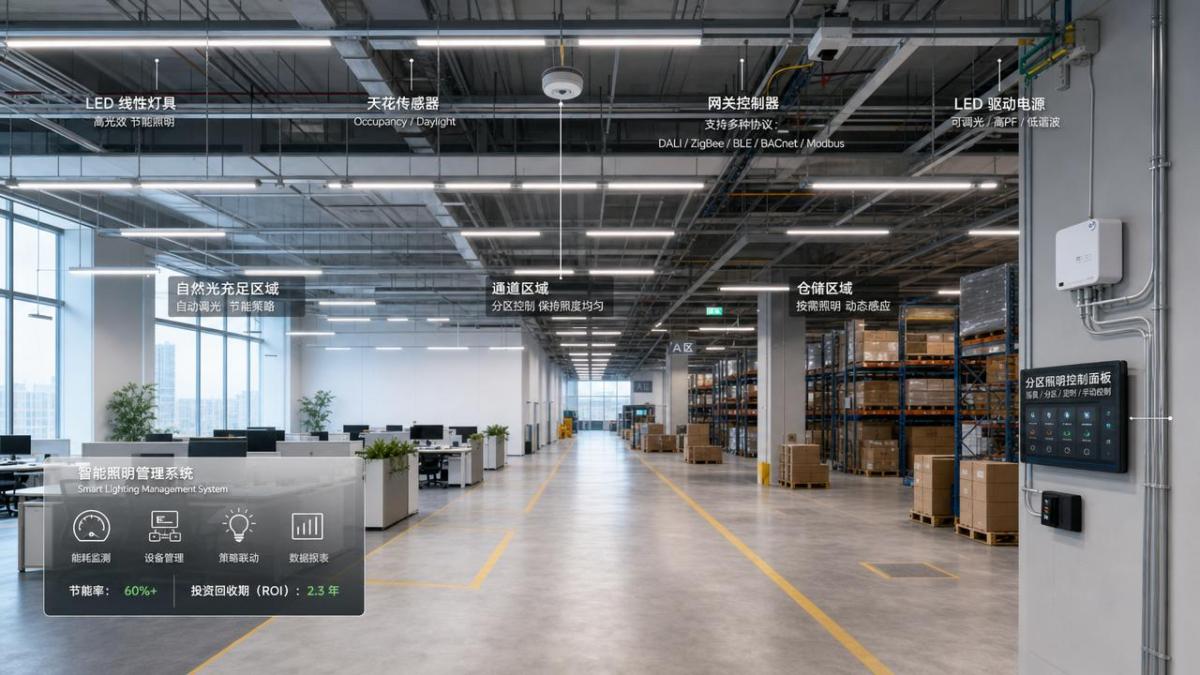
Smart LED lighting often enters discussions through energy savings. That is only part of the story.
A retrofit changes controls, maintenance routines, user comfort, and sometimes safety performance across an entire facility.
In commercial buildings, warehouses, campuses, and municipal spaces, ROI depends on what happens after installation, not just on fixture wattage.
That is why smart LED lighting should be reviewed as infrastructure, not as a simple product swap.
A strong assessment usually covers energy use, controls compatibility, sensor logic, labor savings, commissioning effort, and service life.
At SHSS, this wider view matters because lighting increasingly connects with security systems, industrial operations, and smart city reliability.
In other words, the best retrofit is not the cheapest fixture. It is the one that performs predictably for years.
Is smart LED lighting ROI mostly about energy savings, or is that too narrow?
It is too narrow.
Energy reduction usually provides the first measurable return. Yet many projects recover value from fewer lamp replacements, lower lift rental, and better scheduling.
Occupancy sensors can trim burn hours. Daylight harvesting can reduce overlighting near windows and skylights.
Networked controls can also reveal zones that run longer than needed, especially in logistics sites and mixed-use buildings.
A more practical ROI model should include these cost lines:
- Baseline electricity use by area, shift pattern, and seasonal load.
- Expected controls savings, not only fixture efficacy.
- Maintenance labor, access equipment, and downtime risk.
- Commissioning, software setup, and training time.
- Future replacement strategy for drivers, sensors, and nodes.
More common mistakes appear when spreadsheets assume every zone behaves the same. Real sites rarely do.
Loading bays, corridors, open offices, production cells, and parking areas each create different runtime profiles.
That is where smart LED lighting can outperform standard LED upgrades. It adapts to actual use instead of fixed assumptions.
What should be checked first when comparing a smart LED lighting retrofit?
Start with the existing environment before comparing brands or software dashboards.
A retrofit works well when the old system, the building layout, and the control goals are understood together.
The checklist below helps separate attractive proposals from workable ones.
This is often the turning point in evaluation. A high-efficiency luminaire can still deliver poor ROI inside a weak control design.
Needless to say, protocol choice matters more when a site may later connect lighting with access control, occupancy analytics, or building automation.
How do controls compatibility and integration affect long-term value?
Compatibility is where many smart LED lighting retrofits either gain flexibility or lose it.
If luminaires, sensors, gateways, and software do not communicate cleanly, efficiency gains become harder to scale.
In practical terms, open or widely adopted protocols reduce future friction. DALI supports precise fixture-level control. Zigbee can support wireless flexibility in complex layouts.
The right choice depends on site conditions, interference risk, and how much reconfiguration is expected later.
This matters beyond lighting alone. In smart campuses, transport hubs, and industrial estates, lighting may share data logic with security and occupancy layers.
SHSS frequently tracks this convergence because resilient infrastructure now relies on linked hardware, not isolated devices.
Before approving a retrofit, confirm whether the system can:
- Support zoning changes without major rewiring.
- Export usable performance and fault data.
- Integrate with broader building management workflows.
- Accept firmware updates and component replacement over time.
If the answer is unclear, the projected ROI may look better on paper than in operation.
Where do retrofit projects usually run into trouble?
The biggest problems rarely come from the LED chips themselves.
They usually come from assumptions around usage, commissioning, and maintenance conditions.
Overstated savings from unrealistic operating patterns
Some models assume full occupancy reduction across all hours. Real behavior is uneven, especially in multi-zone facilities.
Underrated commissioning effort
Smart LED lighting needs setup, testing, and adjustment. Poor commissioning leaves sensors too sensitive or not responsive enough.
Ignoring environmental stress
Heat, dust, vibration, and moisture affect drivers and controls. Industrial and outdoor sites need stronger specifications than clean offices.
Choosing by payback alone
A fast payback can hide higher failure rates or limited upgrade paths. Total lifecycle value matters more.
This is similar to other hardware decisions. In fasteners, tools, and biometric systems, durability and system fit often decide the real return.
Smart LED lighting follows the same logic. A lower entry cost does not guarantee a better operational result.
How long should smart LED lighting take to pay back, and what is a realistic way to judge it?
There is no single answer, because utility rates, runtime hours, incentives, and control depth vary widely.
Still, a realistic review does not stop at simple payback.
A useful decision frame combines three horizons.
- Short term: installation cost, disruption, and immediate energy reduction.
- Medium term: maintenance savings, tuning quality, and control stability.
- Long term: component longevity, protocol relevance, and upgrade flexibility.
In outdoor and municipal applications, longer service life can dramatically improve the business case because access and repair costs are high.
SHSS analysis often highlights this point in smart streetlighting and large commercial estates.
If a system reaches 50,000 hours with stable controls and low intervention, the ROI can outperform cheaper systems by a wide margin.
A practical way to judge proposals is to ask for scenario-based modeling instead of one headline number.
For example, compare normal occupancy, low occupancy, and extended-hour operations. That reveals whether the smart LED lighting plan is resilient.
What is the smartest next step before moving ahead?
Start by mapping the building or site into lighting zones with different behaviors.
Then document current energy use, maintenance pain points, and any planned system integrations.
After that, compare retrofit options using the same assumptions for hours, controls logic, and service expectations.
The goal is not only to find efficient luminaires. It is to confirm that smart LED lighting will remain useful, controllable, and supportable over time.
That is usually the difference between a retrofit that looks efficient and one that genuinely delivers ROI.
Where conditions are more complex, it helps to review controls architecture, protocol choices, and lifecycle assumptions together before final selection.
A careful evaluation now reduces rework later and gives smart LED lighting a stronger chance to produce reliable returns across commercial and industrial environments.
Recommended News