
Search News
Industry Portal
Hot Articles
Biometric Security vs PIN Access: Which Lowers Risk Better?
Time
Click Count
Choosing between biometric security and PIN access is no longer a simple technology preference. It is a risk decision that affects facility protection, workforce safety, compliance exposure, and business continuity across commercial buildings, industrial sites, and smart city infrastructure.
PIN systems still appear practical because they are familiar and inexpensive. Yet the real comparison starts when shared credentials, weak code habits, tailgating, and limited forensic value begin to influence daily operations.
Biometric security changes that equation by tying access to a physical trait rather than a memorized number. For environments where physical boundaries protect data, equipment, or critical operations, that distinction matters more than convenience.
Why access control risk is being reassessed
Across AIoT-enabled facilities, access points are no longer isolated doors. They connect to surveillance, alarms, visitor workflows, energy management, and incident reporting.
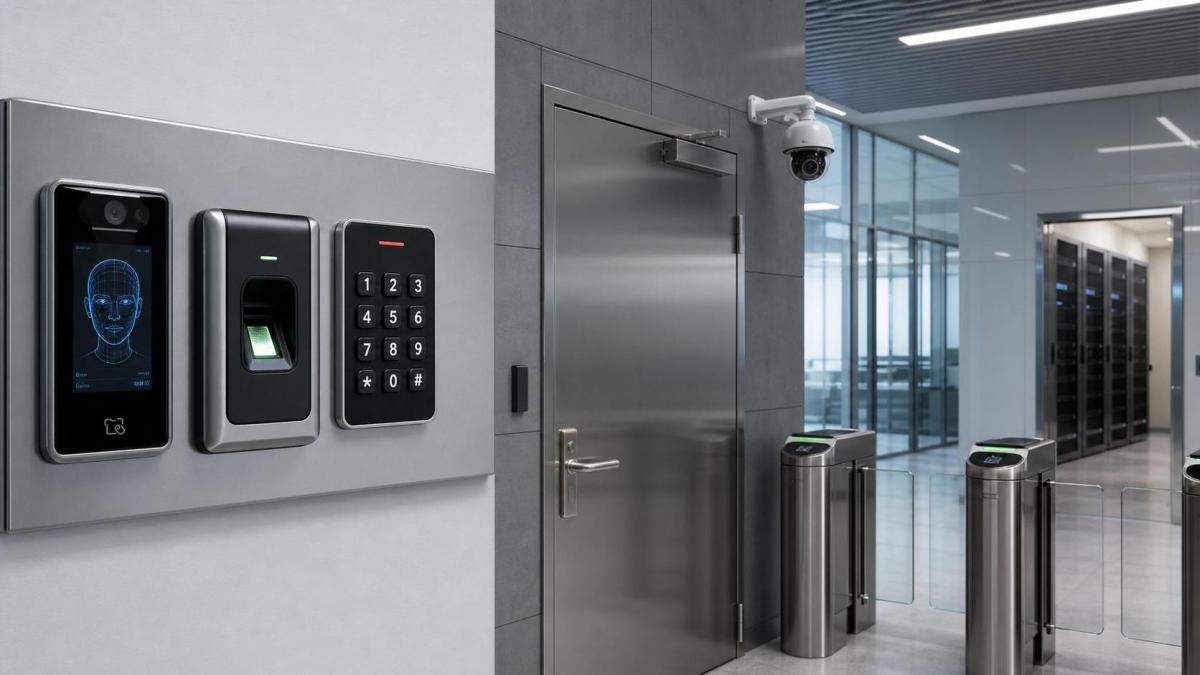
That wider integration increases the cost of a weak authentication method. A compromised entry event can now trigger operational downtime, compliance issues, or reputational damage far beyond one room or one shift.
This is where SHSS often frames the issue well. In modern security architecture, hardware reliability and identity verification work together like structural fasteners and protective gear: both must hold under pressure.
Facilities such as data centers, logistics hubs, municipal control rooms, research labs, and mixed-use buildings increasingly need proof of presence, not just proof of possession or memory.
The core difference between biometric security and PIN access
A PIN is knowledge-based authentication. Access depends on something a person knows, and that information can be guessed, observed, shared, reused, or written down.
Biometric security is identity-based authentication. Access depends on something a person is, such as a face, fingerprint, iris pattern, or palm characteristic.
That difference sounds basic, but it drives the whole risk profile. A PIN can move between people without any physical transfer. A biometric credential is far harder to lend casually or forget at home.
The strongest systems now use liveness detection, infrared imaging, or 3D structured light to resist spoof attempts. This makes advanced biometric security especially relevant in low-light or high-threat environments.
Where PIN access still works, and where it starts to fail
PIN access remains useful in low-risk areas, temporary installations, or locations with minimal privacy sensitivity. It is also easy to deploy where budget and retrofit speed are the main concerns.
Problems emerge when organizations expect a PIN to deliver strong accountability. In practice, several weak points appear quickly.
- Codes are often shared during shift changes or contractor visits.
- Common number patterns reduce real security strength.
- Shoulder surfing and keypad residue expose frequently used entries.
- Audit logs record a code event, not always a verifiable person.
- Frequent resets create administrative burden and user frustration.
For some sites, these weaknesses are manageable. For others, especially where physical access protects digital assets or hazardous operations, they become structural flaws rather than minor inconveniences.
How biometric security lowers risk in practical terms
Biometric security lowers risk best when the main threat is unauthorized entry by insiders, visitors, former staff, or borrowed credentials. It narrows the gap between the badge log and the actual person at the door.
In business terms, the benefit is not only stronger control. It is clearer accountability, faster investigations, and fewer hidden exceptions in daily access routines.
The table does not mean every biometric solution is automatically superior. Performance depends heavily on sensor design, template protection, environmental conditions, and system governance.
Risk reduction depends on context, not just technology
A warehouse side door, a pharmaceutical clean room, and a city traffic control center do not carry the same consequences. The best access method depends on what the door protects and what a failure would cost.
Higher-value environments
Biometric security usually has a stronger case where auditability and identity certainty matter. Examples include server rooms, R&D spaces, hazardous storage, executive zones, and multi-tenant properties with strict access segmentation.
Lower-friction environments
PIN access may remain acceptable for utility closets, temporary project cabins, or internal areas where unauthorized access would create inconvenience rather than serious loss.
A common mistake is standardizing one method across every opening. A better approach is tiered protection based on asset value, occupancy patterns, and incident history.
What decision quality really hinges on
When comparing biometric security with PIN access, the right question is not which sounds more advanced. It is which method reduces the most likely failures without creating new operational gaps.
A sound evaluation should include the following points.
- Match authentication strength to the consequence of a breach.
- Check false acceptance and false rejection performance, not just marketing claims.
- Review privacy compliance, data storage architecture, and template encryption.
- Assess throughput at busy entry points and shift-change periods.
- Confirm how the system handles gloves, dust, moisture, darkness, or outdoor glare.
- Plan fallback rules for outages, emergency egress, and visitor access.
This is where cross-disciplinary review becomes useful. Security performance, hardware durability, compliance, and lifecycle cost should be judged together, not in separate silos.
Privacy, compliance, and trust cannot be treated as side issues
Biometric security lowers physical risk, but it also raises data governance responsibilities. A face template or iris record is not managed like a simple keypad code.
Storage design matters. On-device matching, encrypted templates, limited retention, and clear consent logic can reduce legal and reputational exposure.
This point is especially important in global operations. Regulatory expectations differ across regions, and advanced systems must align with local privacy rules as carefully as they align with door hardware standards.
In other words, the strongest biometric security program is not only accurate at the sensor. It is also disciplined in governance.
A realistic path forward for access control upgrades
For many organizations, the answer is not a total replacement overnight. It is a phased design that places biometric security where identity certainty matters most, while retaining simpler methods in lower-risk zones.
That blended approach fits the broader SHSS view of modern infrastructure. Critical systems perform best when each protective layer is chosen for its real function, from smart lighting and entry systems to physical hardware and PPE.
If the goal is to lower risk rather than merely modernize appearances, start with a door-by-door review. Map who enters, what is protected, how incidents occur, and what level of identity proof each location truly requires.
From there, compare biometric security and PIN access against measurable criteria: credential abuse, audit clarity, environmental fit, privacy controls, and lifecycle cost. That process usually makes the right answer visible long before procurement begins.
Recommended News