
Search News
Industry Portal
Hot Articles
Flicker-Free LED Lighting: What Specs Matter Most in Commercial Spaces
Time
Click Count
In commercial projects, flicker-free LED lighting is no longer a minor comfort feature. It shapes visual accuracy, staff concentration, retail presentation, and the long-term value of building systems.
That is why the real conversation has moved beyond lumen output and fixture price. The better question is which specifications make LED lighting stable, controllable, compliant, and worth deploying at scale.
Across offices, logistics hubs, hospitals, campuses, and smart city assets, lighting now sits beside access control, hardware durability, and operational safety. In that wider SHSS perspective, reliable illumination becomes part of physical performance, not just interior finish.
Why flicker matters more than many specifications sheets suggest
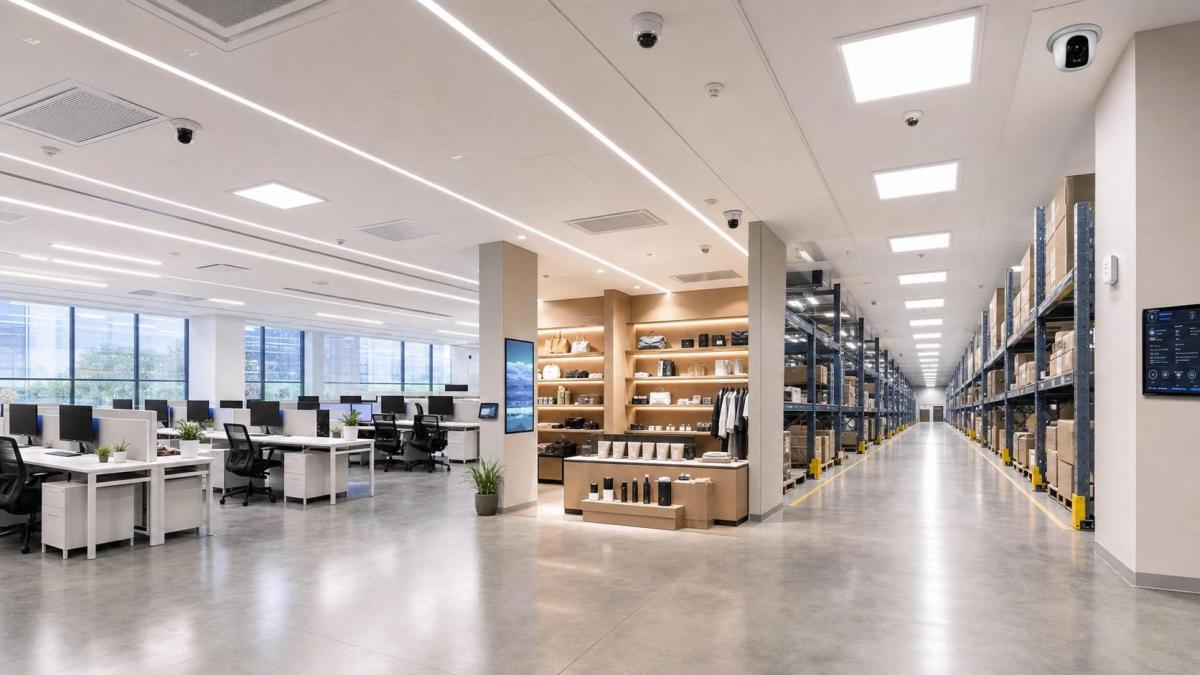
A light source can appear steady to the eye and still produce rapid intensity fluctuations. That is flicker, and in commercial LED lighting it usually comes from power conversion and poor driver design.
The impact is practical. Low-quality flicker can contribute to visual fatigue, headaches, camera banding, task errors, and discomfort in spaces where people spend long hours under artificial light.
It also affects machine vision, surveillance recording, and presentation quality in smart buildings. In environments that already rely on sensors, biometric readers, and digital monitoring, unstable light becomes a hidden systems problem.
For that reason, flicker-free LED lighting should be read as a performance requirement. It supports human factors, protects operational consistency, and reduces downstream complaints that are expensive to fix after commissioning.
The core specifications that deserve close review
Not every product sheet presents the same details. When evaluating LED lighting for commercial spaces, several parameters reveal far more than nominal wattage.
Flicker percentage and flicker index
Flicker percentage shows how much the light output varies during operation. Lower values are generally better, especially in offices, healthcare areas, classrooms, and inspection zones.
Flicker index adds waveform insight. Two fixtures may share similar percentages but behave differently in actual use. Asking for both figures helps separate marketing claims from measurable performance.
Driver quality
The driver is often the decisive component in flicker-free LED lighting. A poor driver can undermine an otherwise efficient luminaire.
High-quality constant-current drivers improve waveform stability, dimming response, thermal behavior, and lifetime consistency. In practice, they also reduce compatibility issues during system integration.
Dimming method and control compatibility
Commercial LED lighting increasingly operates inside connected control environments. DALI, 0-10V, PWM, and Zigbee-based systems are common, but not all fixtures behave equally under dimming.
Some luminaires remain stable at full output yet begin flickering at lower dim levels. That is why dim-to-low performance matters, especially in conference rooms, hospitality spaces, and mixed daylight zones.
Correlated color temperature and color rendering
Flicker is not the only comfort factor. Color temperature shapes mood and function, while CRI influences how accurately people see surfaces, products, signage, and faces.
For commercial LED lighting, 3000K to 4000K often fits hospitality and offices, while 5000K may suit task-heavy industrial settings. CRI 80 may be acceptable, but CRI 90 is better where detail matters.
UGR, beam control, and optical comfort
Even flicker-free LED lighting can fail if glare is excessive. Unified Glare Rating, diffuser quality, beam spread, and lens design influence whether a space feels calm or visually harsh.
This is especially relevant in open offices, control rooms, education spaces, and reception areas where direct view of luminaires is frequent.
Lifetime, thermal management, and lumen maintenance
A 50,000-hour claim means little without proper thermal design. Heat affects driver stability, LED degradation, color shift, and maintenance cycles.
Look for L70 or L80 data, ambient temperature ratings, and housing materials that support actual commercial duty rather than showroom conditions.
How specification priorities change by commercial setting
The right LED lighting decision depends on the type of work happening under it. A warehouse and a clinic may both need efficiency, but their lighting risks are not the same.
This is where the broader SHSS lens becomes useful. Lighting performance should be considered alongside access systems, safety hardware, and city-scale digital infrastructure, not in isolation.
What often gets missed during procurement and design review
Many lighting packages still focus too heavily on upfront cost. That approach can hide expensive weaknesses that surface during installation or after handover.
- Testing only at full output, while real use includes frequent dimming.
- Reviewing fixture data but ignoring driver brand and waveform behavior.
- Assuming all controls work smoothly across mixed vendors.
- Overlooking camera interaction in security, retail, or broadcast-heavy spaces.
- Accepting lifetime claims without thermal or lumen maintenance details.
- Treating compliance labels as enough, without checking actual application fit.
In actual projects, LED lighting succeeds when electrical, controls, and occupancy realities are reviewed together. A technically acceptable luminaire can still become the wrong choice in context.
Compliance, controllability, and long-term operating value
Commercial LED lighting is now tied to energy targets, wellness expectations, and smart building strategies. Compliance therefore extends beyond a single safety mark.
Relevant checks may include photobiological safety, EMC performance, local energy codes, emergency integration, and dimming protocol support. In connected environments, data-driven controls also raise interoperability questions.
More importantly, flicker-free LED lighting usually creates value that is not obvious in a basic tender comparison. Fewer complaints, smoother commissioning, stronger visual conditions, and lower rework risk often justify a better specification early.
This mirrors a wider pattern across smart hardware. Whether the component is a fastener, biometric reader, or luminaire, stable performance under real operating stress is what protects project quality.
A practical way to compare LED lighting options
A useful review process is simple, but it should be disciplined. The goal is not to collect every available metric. The goal is to identify the specifications that affect real conditions.
Start with the visual task
Map the space by activity, occupancy time, screen exposure, and daylight variation. That quickly clarifies where flicker sensitivity and glare control need stricter thresholds.
Request evidence, not broad claims
Ask for flicker data, dimming test results, driver details, lifetime curves, and control compatibility records. Serious LED lighting suppliers should be able to provide them.
Review the full system
Fixture, driver, controls, sensors, and installation environment should be considered together. In integrated buildings, one weak interface can compromise overall performance.
Use pilot zones when the project is complex
Mock-ups or limited-area trials reveal glare, dimming instability, and sensor interaction before large-scale procurement. That step is especially valuable in premium or mixed-use developments.
Where the next decision should focus
The strongest LED lighting specification is rarely the most complicated one. It is the one that matches visual needs, control strategy, compliance requirements, and maintenance expectations without leaving hidden risks behind.
For upcoming commercial work, it helps to build a short review matrix around flicker performance, driver quality, dimming behavior, optical comfort, and system compatibility. That creates a clearer basis for comparing products that may look similar on paper.
When LED lighting is evaluated as part of a wider smart hardware ecosystem, the result is usually better than an energy-only decision. The space works better, the controls behave more reliably, and the project carries less operational friction after handover.
That is a sensible next step: define the required performance first, then compare suppliers against the conditions the building will actually face.
Recommended News