
Search News
Industry Portal
Hot Articles
LED Lighting: How to Judge Flicker Risk in Commercial Spaces
Time
Click Count
In commercial spaces, LED lighting influences more than visibility. It shapes comfort, attention, safety, and the reliability of daily work.
Flicker risk is often underestimated because the most harmful effects may occur below conscious visual detection.
When LED lighting flickers, the result may be eye strain, headaches, fatigue, lower task accuracy, or discomfort during long exposure.
Judging this risk requires both practical observation and an understanding of the technical signals behind the light.
Why flicker risk matters in commercial LED lighting
A commercial building is not a simple lighting shell. It is a working environment with screens, movement, security systems, and human concentration.
This makes LED lighting quality part of operational safety, not just energy efficiency.
A visual overview of flicker sources can help connect symptoms, equipment, and installation conditions.
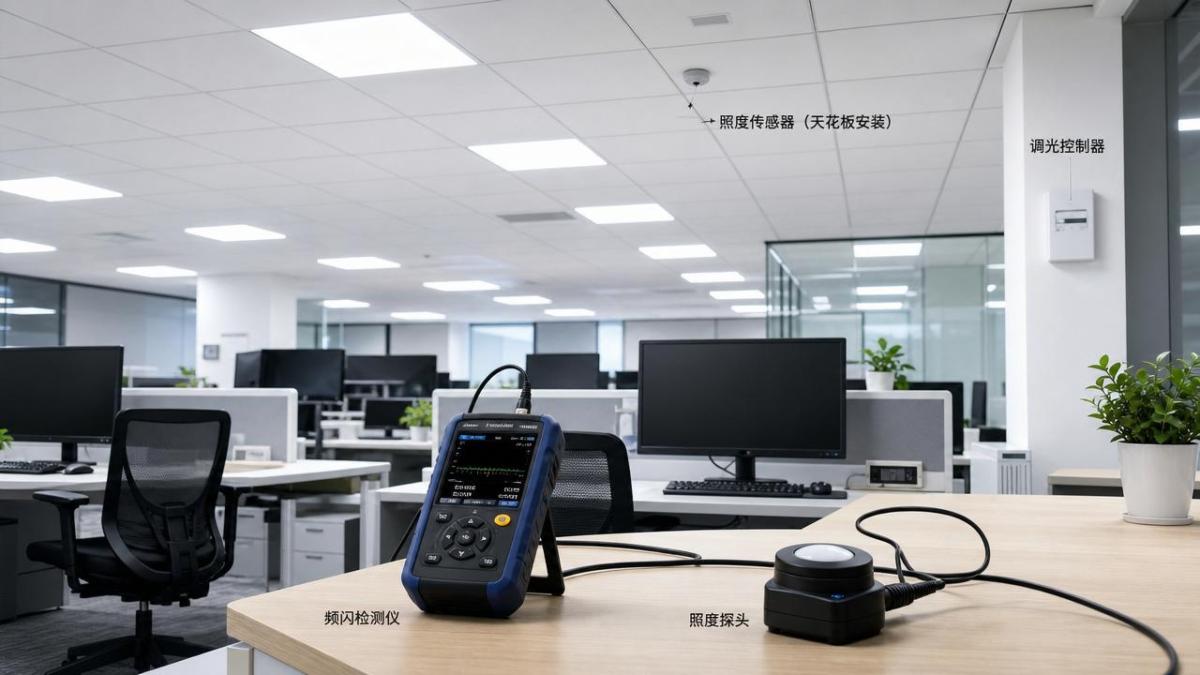
In offices, retail floors, hospitals, warehouses, schools, and transport hubs, lighting can affect performance throughout the day.
Poor LED lighting may not fail immediately. Instead, it can create a slow accumulation of discomfort.
That makes flicker a hidden risk, especially where long shifts, precision work, or screen-based tasks are common.
Smart buildings add another layer. DALI, Zigbee, occupancy sensors, dimming scenes, and daylight harvesting all change electrical behavior.
LED lighting that looks stable at full output may flicker when dimmed, grouped, automated, or connected to incompatible controls.
Understanding what flicker actually means
Flicker is a variation in light output over time. It can be visible, barely noticeable, or completely invisible.
The eye does not always detect high-frequency changes. The nervous system, however, may still respond to them.
For LED lighting, flicker often comes from the driver, dimming method, power quality, or control mismatch.
Unlike older lamps, LEDs react extremely quickly to changes in current. This speed is useful, but it exposes weak power design.
A fixture may have good brightness, color temperature, and efficiency while still carrying high flicker risk.
That is why LED lighting evaluation should include temporal light quality, not only lumens, watts, and CRI.
Visible flicker and invisible flicker
Visible flicker is easier to notice. It appears as pulsing, shimmering, or unstable brightness.
Invisible flicker is more difficult. It may only appear through symptoms, camera artifacts, or measurement data.
In commercial LED lighting, invisible flicker is often the more important issue because it can remain uncorrected for years.
Common places where flicker problems appear
Flicker risk is not evenly distributed across a building. It appears where lighting is stressed by controls, loads, or environment.
Some spaces deserve closer attention because people stay longer or perform more visually demanding tasks.
These examples show why LED lighting should be assessed in its actual setting, not only through a catalog sheet.
A fixture that performs well in a showroom may behave differently under building automation and real electrical loads.
Technical indicators worth checking
Flicker cannot be judged by brightness alone. Several metrics describe how light changes over time.
No single number explains every situation, but the following indicators give a clearer picture.
Percent flicker
Percent flicker shows the relative difference between maximum and minimum light output.
A lower value usually means steadier LED lighting, but frequency must also be considered.
Flicker index
Flicker index considers the shape of the light waveform, not only its high and low points.
It is useful when comparing fixtures that have similar percent flicker but different pulsing patterns.
SVM and PstLM
SVM relates to stroboscopic visibility, especially where motion is present.
PstLM reflects short-term flicker perception and is often referenced in lighting quality discussions.
For commercial LED lighting, these metrics are helpful because many spaces include moving people, tools, carts, and machinery.
Frequency
Frequency matters because low-frequency flicker is usually more likely to cause visible discomfort.
High-frequency flicker may be less visible, but it can still affect cameras and certain sensitive conditions.
Standards and guidance documents, including IEEE 1789 discussions, are often used to interpret risk levels.
On-site signs that should not be ignored
A basic inspection can reveal problems before formal measurement begins.
The goal is not to replace instruments, but to identify where deeper testing is justified.
- Brightness seems unstable after startup or during dimming.
- Phones or security cameras show banding under the fixtures.
- Discomfort increases in specific rooms or under certain scenes.
- Motion appears jerky near conveyors, fans, tools, or rotating parts.
- Fixtures from different batches behave differently in the same circuit.
- Flicker appears only after connecting dimmers or smart controls.
These signs are especially useful when reviewing existing LED lighting before a retrofit.
They also help separate lighting issues from glare, poor layout, insufficient illuminance, or unsuitable color temperature.
The role of drivers, dimming, and controls
Most flicker issues begin in the driver. The driver converts electrical input into current suitable for LEDs.
A high-quality driver stabilizes output across voltage changes, dimming levels, and operating temperatures.
In contrast, weak drivers may create ripple, pulsed output, or unstable performance over time.
Dimming method is another major factor. Phase-cut dimming, PWM dimming, and constant-current dimming behave differently.
PWM can be acceptable when frequency and waveform are well controlled. Poor PWM design can raise flicker risk.
Smart LED lighting systems add communication layers. DALI and Zigbee controls must match the fixture and driver specifications.
A well-designed automation scene can improve comfort. A mismatched scene can produce unstable output at low dim levels.
How to evaluate LED lighting before selection or upgrade
A practical evaluation combines documents, testing, and real-use observation.
The process should focus on how LED lighting behaves across the full operating range.
- Request flicker data, including percent flicker, frequency, SVM, or PstLM where available.
- Check whether reported data applies at full output and dimmed output.
- Confirm compatibility with dimmers, sensors, lighting control panels, and emergency circuits.
- Test samples in the real space before large-scale installation.
- Observe camera performance if video surveillance, scanning, or content recording is used.
- Compare performance after warm-up, not only immediately after switching on.
Sample testing is especially valuable for commercial LED lighting because building circuits are rarely identical.
Power quality, cable length, control grouping, and load sharing can all influence the final result.
Balancing flicker control with other lighting priorities
Flicker risk should not be evaluated in isolation. A comfortable space also needs proper illuminance, glare control, and color quality.
A fixture with low flicker but poor optics may still create fatigue.
Likewise, efficient LED lighting that saves energy but causes discomfort can weaken the value of a retrofit.
The stronger approach is to view lighting as part of a wider smart hardware environment.
In secure buildings, light quality supports cameras, biometric access points, and safe movement.
In industrial and logistics spaces, stable LED lighting supports visibility around tools, fasteners, PPE zones, and moving equipment.
This connection reflects a broader shift toward physical systems that are efficient, reliable, and protective.
Building a practical flicker-risk checklist
A clear checklist makes flicker assessment easier to repeat across sites, suppliers, and upgrade phases.
It should cover the fixture, control system, installation environment, and daily-use conditions.
This type of checklist also improves supplier comparison.
Instead of relying only on price and wattage, LED lighting decisions can include comfort, reliability, and control compatibility.
Moving from suspicion to reliable decisions
Flicker risk is manageable when it is treated early.
The most effective path is to combine technical data with real operating conditions.
Before replacing or expanding LED lighting, review fixture data, control compatibility, dimming behavior, and complaint patterns.
Where comfort or safety is critical, add measurement instead of relying on visual judgment alone.
A safer lighting decision starts with asking how the system behaves over time, not only how bright it looks.
From there, comparing drivers, controls, standards guidance, and application demands becomes more practical.
Well-judged LED lighting supports healthier spaces, steadier operations, and smarter buildings that protect both performance and people.
Recommended News