
Search News
Industry Portal
Hot Articles
Smart LED Lighting ROI: Energy Savings vs Upgrade Costs
Time
Click Count
Smart LED Lighting ROI: Energy Savings vs Upgrade Costs
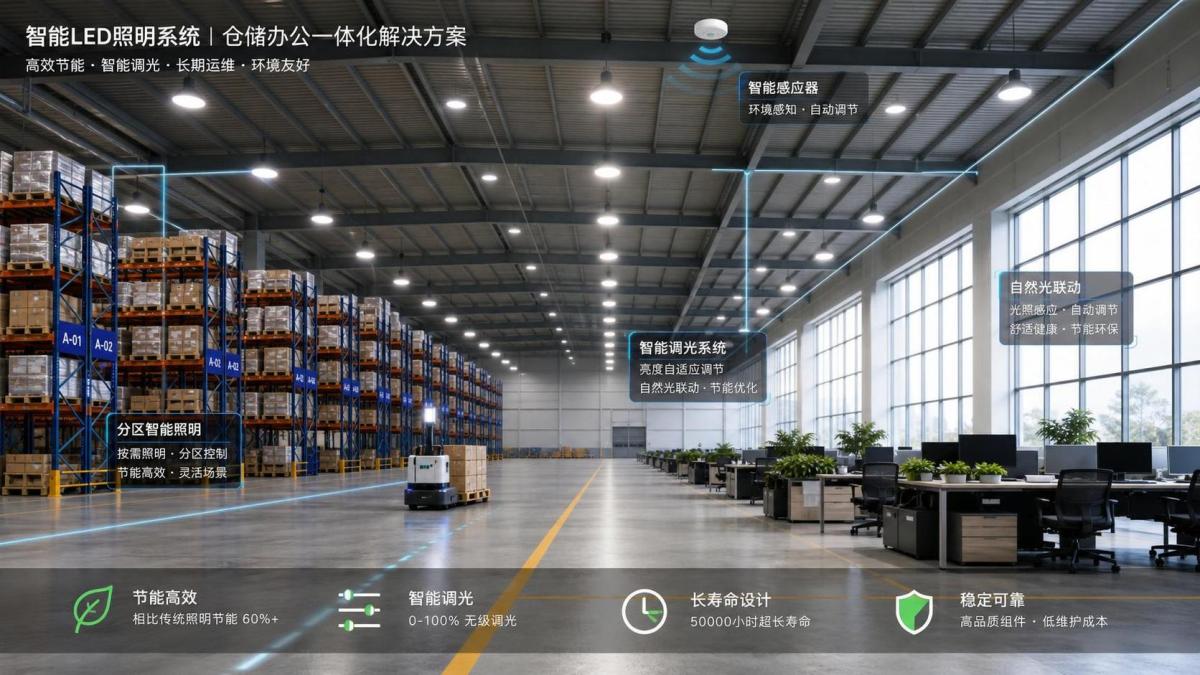
For finance approvers, the real question behind smart LED lighting is not whether it works, but how fast it pays back.
That is the right starting point.
In most facilities, lighting is still treated as a utility cost.
Yet smart LED lighting can behave more like a controllable asset.
It reduces energy use, lowers maintenance demand, and adds operating data that supports better budgeting.
The key is to compare hard savings against full upgrade costs, not just fixture prices.
In practical terms, a strong business case depends on usage hours, tariff levels, controls strategy, and installation scope.
This also means the best smart LED lighting project is rarely the cheapest bid.
It is the one with the clearest path to measurable returns.
Why Smart LED Lighting ROI Looks Better Than Basic LED Replacement
A standard LED retrofit cuts wattage.
Smart LED lighting goes further by adjusting output to real conditions.
That difference matters most in warehouses, offices, parking areas, schools, hospitals, and mixed-use commercial sites.
In these settings, lighting demand is rarely constant.
Occupancy shifts, daylight changes, and zone usage vary throughout the day.
A connected system captures those changes and responds automatically.
From a capital review angle, this creates three distinct value layers.
- Direct energy savings from lower fixture wattage.
- Additional savings from dimming, daylight harvesting, and occupancy control.
- Operational savings from fewer failures, less labor, and better visibility into asset performance.
The first layer is easy to estimate.
The second and third layers often determine whether the payback period is acceptable.
More clearly, smart LED lighting earns attention when a site has long operating hours or inconsistent occupancy.
The Main Savings Drivers That Shape Payback
Smart LED lighting ROI is built on a few numbers.
If those numbers are weak, the project struggles.
If they are strong, payback can be surprisingly fast.
1. Operating Hours
Facilities running 12 to 24 hours daily see the fastest returns.
Every watt saved compounds across long schedules.
A warehouse on two shifts will usually outperform a small office in ROI terms.
2. Electricity Tariffs
Higher energy prices make smart LED lighting more attractive.
This is especially true in regions with rising utility volatility.
The higher the cost per kilowatt-hour, the shorter the payback window.
3. Control Depth
Not all controls deliver the same return.
Scheduled dimming is simple and useful.
Occupancy sensors often create larger savings in irregularly used zones.
Daylight harvesting can be highly effective near windows, atriums, and skylit production areas.
4. Maintenance Reduction
Maintenance savings are often underestimated.
Long-life fixtures reduce replacement frequency.
Networked monitoring also helps teams locate failures faster and plan group replacements.
That matters in high-bay facilities or campuses with expensive access equipment.
Where Upgrade Costs Really Come From
Many approvals slow down because budgets focus too narrowly on fixture cost.
A reliable smart LED lighting cost model should include every layer of deployment.
That is where hidden overruns usually begin.
- Fixtures and drivers with smart controls capability.
- Sensors, gateways, switches, or control nodes.
- Software licensing, dashboards, or cloud subscriptions.
- Commissioning, zoning, and control programming.
- Labor for installation, lift access, and disposal.
- Possible wiring upgrades or network integration work.
In actual projects, commissioning quality has a large influence on financial outcomes.
Poor setup can erase expected savings, even with premium hardware.
That is why low-price proposals deserve close scrutiny.
If controls are oversimplified, the smart LED lighting system may never reach modeled performance.
A Simple ROI Framework for Capital Approval
A practical review does not need a complex model at first.
It needs a disciplined one.
Start with this structure:
- Measure current annual lighting energy consumption.
- Estimate post-upgrade consumption with controls included.
- Apply local tariffs to convert energy savings into cash savings.
- Add annual maintenance savings and avoided replacement costs.
- Subtract annual software or service fees.
- Divide total project cost by annual net savings.
That gives a simple payback figure.
Then check internal rate of return, net present value, and sensitivity under different energy price scenarios.
A quick example makes this easier.
That range is often enough to move a project into serious review.
More importantly, it shows why smart LED lighting should be analyzed as a business system, not a commodity purchase.
Common Financial Risks and How to Avoid Them
Not every smart LED lighting proposal delivers the promised return.
The risk usually comes from assumptions, not technology.
Overstated Savings
Some proposals apply aggressive occupancy reductions across every zone.
That rarely reflects real use patterns.
Ask for zone-by-zone assumptions and a baseline audit.
Ignored Recurring Costs
Software subscriptions, support plans, and network management fees can change total economics.
These costs should appear in the financial model from day one.
Weak Interoperability
Closed systems may limit future expansion.
Protocols such as DALI or Zigbee can improve flexibility when the site may scale later.
Poor Installation Planning
If installation disrupts production or trading hours, the hidden cost can be substantial.
Phased rollout planning reduces this risk.
How to Compare Vendors Without Getting Lost in Specs
A procurement decision becomes clearer when vendor comparison follows financial outcomes.
Start with five questions.
- What verified energy reduction can this smart LED lighting design achieve by zone?
- What is included in commissioning and post-install support?
- Which costs are one-time, and which recur annually?
- How open is the system for future control integration?
- What warranty terms cover drivers, sensors, and communication components?
This approach shifts the discussion away from isolated lumens or device counts.
Instead, it centers on lifecycle cost, operational stability, and payback confidence.
That is usually where better procurement decisions are made.
A Practical Decision Path
If a facility has high operating hours, rising power costs, and frequent lamp maintenance, smart LED lighting deserves immediate analysis.
If occupancy is stable and energy costs are low, a simpler LED retrofit may be enough.
That is why project screening matters.
A sensible next step is to request a site audit, a control-by-zone proposal, and a five-year cost model.
From there, compare best-case, expected, and conservative scenarios.
That makes the smart LED lighting decision easier to defend internally.
In the end, the strongest proposals do not just promise efficiency.
They show exactly how energy savings, maintenance reduction, and upgrade costs connect to real financial return.
That is the point where smart LED lighting moves from technical upgrade to capital-worthy investment.
Recommended News