
Search News
Industry Portal
Hot Articles
Industrial Bolts and Nuts: How to Choose Grades for Heavy-Load Projects
Time
Click Count
In heavy-load construction, transport systems, energy facilities, and advanced manufacturing lines, the choice of industrial bolts and nuts sits at the center of structural reliability. What looks like a small hardware decision often determines whether a connection can survive vibration, cyclic loading, corrosion, installation error, and years of service without costly failure.
That is why grade selection matters. When industrial bolts and nuts are matched correctly to load paths, materials, and standards, they support not only strength, but also predictable maintenance, safer commissioning, and clearer project risk control.
Within the SHSS view of modern infrastructure, fasteners are the steel sutures of industrial civilization. They connect the same safety logic that shapes power tools, smart buildings, protective equipment, and secure urban systems: small components must perform flawlessly under real-world pressure.
Why grade selection has become a project-level issue
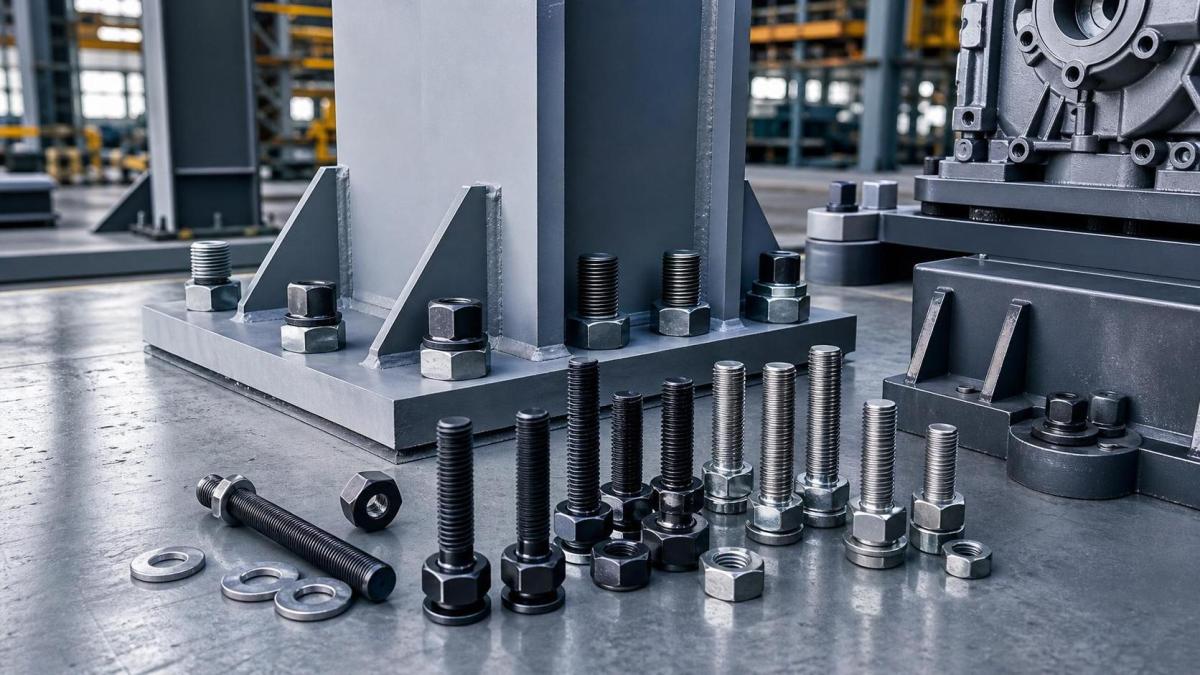
Heavy-load projects rarely fail because of one dramatic overload alone. More often, joints weaken through accumulated stress, poor preload, thermal movement, moisture exposure, or incompatible materials. A bolt grade that looks acceptable on paper may still underperform in service.
This is especially relevant today. Equipment is more compact, torque output is higher, operating cycles are faster, and uptime expectations are stricter. Brushless fastening tools can apply installation force rapidly, but that speed also raises the importance of selecting industrial bolts and nuts that can hold preload consistently.
At the same time, many projects now combine mechanical loads with smart infrastructure demands. Data centers, automated plants, transit hubs, and urban systems require every connection to support safety, inspection, and long service life with minimal disruption.
What a bolt or nut grade actually tells you
A grade is not just a ranking label. It indicates defined mechanical properties, typically including tensile strength, yield behavior, hardness, and compatibility with matching nuts. In practice, it helps determine whether a fastener can sustain clamp load without permanent deformation.
For metric fasteners, common property classes include 8.8, 10.9, and 12.9. In inch-based systems, references often include ASTM or SAE grades. These systems are not interchangeable by assumption. Each must be read within its own standard framework.
The nut matters just as much. A high-strength bolt paired with an underspecified nut can shift the failure point to thread stripping or loss of preload. Industrial bolts and nuts should always be evaluated as a working assembly, not as separate catalog items.
A practical reading of common grades
The table offers direction, not a substitute for engineering verification. Load case, joint geometry, washer selection, and tightening method still decide whether the chosen grade is appropriate.
Strength alone does not guarantee a safe joint
One common mistake is moving to the highest available grade without checking the surrounding system. Higher-grade industrial bolts and nuts can increase clamp force, but they can also introduce new risks if the joint material, hole quality, surface finish, or torque control is poor.
For example, in a steel connection exposed to vibration, preload retention may matter more than headline tensile strength. In a corrosive site, a slightly lower mechanical class with better environmental resistance may deliver longer real service life.
The better question is not, “What is the strongest fastener?” It is, “What fastener system performs most reliably in this joint over time?” That shift usually leads to better decisions.
Key variables behind real performance
- Static and dynamic load levels, including shock and fatigue exposure
- Required preload and the accuracy of the tightening method
- Temperature range and thermal expansion differences
- Corrosion environment, coatings, and galvanic compatibility
- Access for inspection, retightening, and replacement during service
How industrial bolts and nuts are judged in demanding applications
Across infrastructure and industrial sectors, fastener selection usually follows a chain of practical questions. The first is whether the joint is structural, mechanical, pressure-related, or safety-critical. That classification shapes the acceptable standards and documentation level.
The second is the load pattern. Bridges, lifting systems, conveyors, wind assemblies, heavy enclosures, and equipment skids all stress industrial bolts and nuts differently. A joint under constant tension behaves differently from one under repeated transverse vibration.
The third is environment. Offshore platforms, chemical plants, tunnels, and food-grade facilities each impose different material constraints. Strength grade must be considered together with corrosion resistance, coating integrity, and maintenance frequency.
SHSS often frames this as a broader reliability issue. Whether the subject is a biometric gate housing, a smart lighting mast, or a high-torque tool assembly, the physical joint must remain trustworthy long after installation crews leave the site.
A practical selection path for heavy-load projects
A useful selection process begins with the joint, not the catalog. Start by identifying the design load, safety factor, and code requirement. Then confirm whether the fastener is expected to carry direct tension, shear, combined loading, or preload-dependent friction.
Next, check the material family. Carbon steel, alloy steel, and stainless grades each offer different trade-offs. Heat treatment improves strength, but environmental resistance may require coatings or a different base material.
After that, verify the installation method. If the project relies on impact tools, torque control tools, or calibrated tensioning, the selected grade must match the achievable installation consistency. This is where many field problems begin.
Finally, confirm paperwork. Heavy-load projects increasingly require mill certificates, standard compliance, batch traceability, and sometimes third-party testing. Industrial bolts and nuts without clear documentation can create approval delays even when the hardware appears suitable.
Checklist before final approval
- Match bolt class and nut class within the same standards system
- Confirm tensile, yield, and proof load against actual joint demand
- Review coating effects on friction and torque-tension behavior
- Check installation tool capability and calibration records
- Require traceability for safety-critical or regulated assemblies
Where grade mistakes usually happen
Many failures come from assumptions made during substitution. A fastener with the same dimensions is often treated as equivalent, even when the grade, heat treatment, coating, or thread tolerance differs. That shortcut can change the whole joint response.
Another issue is mixing sourcing channels. Industrial bolts and nuts used in one package assembly should come with consistent quality records. Mixed lots can introduce variation in preload behavior, corrosion resistance, and long-term durability.
There is also a planning error that appears late in projects: specifying high-grade fasteners, but not budgeting for proper tightening control, inspection access, or replacement stock. In that case, the written specification looks strong, while field reliability remains weak.
What to watch next
The fastener market is moving toward tighter traceability, smarter installation workflows, and better lifecycle accountability. As digital construction records expand, industrial bolts and nuts are no longer invisible commodities. They are becoming documented reliability assets.
For current and upcoming heavy-load work, the most useful next step is to build a selection matrix around load type, environment, standards, tightening method, and inspection needs. That approach makes grade decisions easier to defend during procurement, review, and operation.
When those criteria are clear, comparing industrial bolts and nuts becomes less about price alone and more about verified performance. That is usually where stronger projects begin: not with bigger hardware, but with better judgment.
Recommended News