
Search News
Industry Portal
Hot Articles
Thread Rolling vs Cutting: Cost and Fatigue Trade-offs
Time
Click Count
Thread rolling decisions start with real service conditions
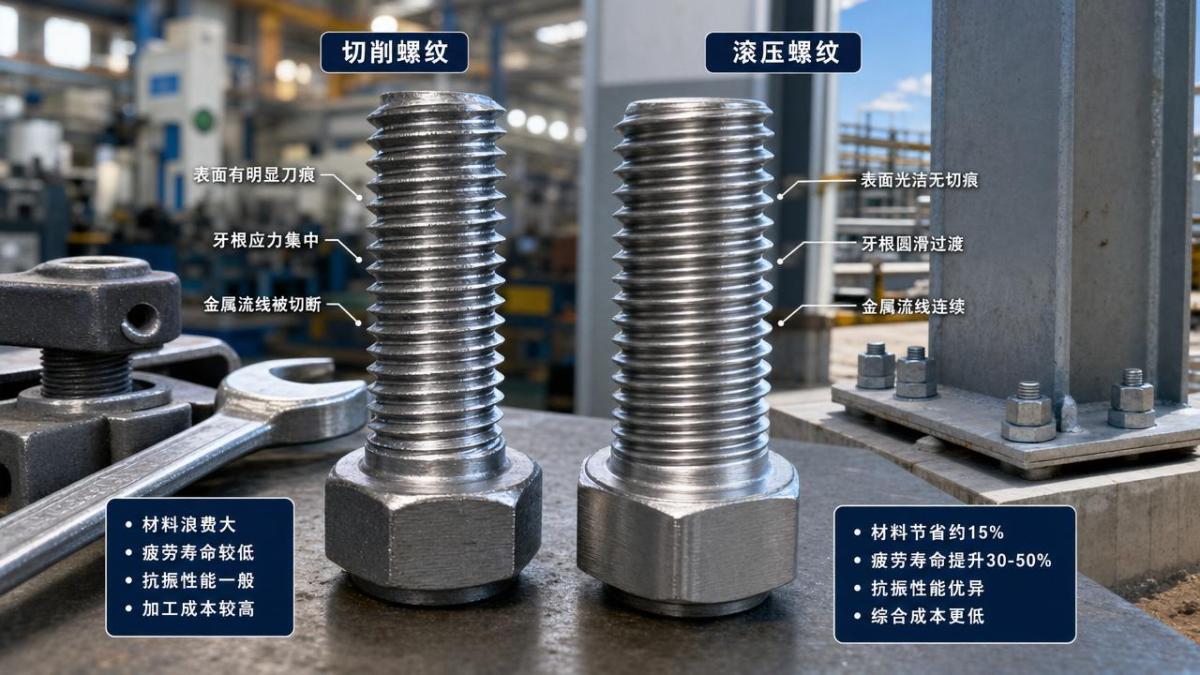
Thread rolling is rarely a simple manufacturing preference. In many assemblies, it changes failure behavior long after the part leaves the factory.
That matters across construction hardware, industrial tools, security enclosures, smart lighting poles, and other load-bearing systems tracked closely by SHSS.
Cut threads remove material. Rolled threads form the profile through plastic deformation. The geometry may look similar, but the surface condition and grain flow are different.
In practice, those differences affect three things most: piece cost, fatigue resistance, and confidence under vibration or repeated tightening cycles.
The useful question is not which method is universally better. It is where thread rolling creates measurable value, and where cutting remains the practical choice.
Why similar-looking fasteners behave differently in the field
Different applications load threads in very different ways. A static mounting bolt is not judged like a motor housing fastener or a roadside lighting anchor.
Thread rolling usually improves surface finish and introduces beneficial compressive stresses. That often helps delay crack initiation under cyclic loading.
Cut threads can still perform well, especially in lower-volume parts, larger diameters, or custom geometries where tooling flexibility matters more than fatigue life.
This is why cost comparison should not stop at machining minutes. The real comparison includes scrap risk, tool wear, field replacement, and shutdown consequences.
A quick comparison before diving into scenarios
The table is only a starting point. Field conditions often decide more than process theory.
Where thread rolling earns its keep: vibration-heavy assemblies
Portable brushless tools are a good example. Housings, gear seats, and fastening points see repeated torque pulses, impact events, and maintenance disassembly.
In that environment, thread rolling can reduce the risk of early crack formation at the thread root. That translates into fewer fatigue failures over long duty cycles.
The same logic appears in smart lighting poles, traffic hardware, and outdoor mounting systems. Wind, vibration, and thermal expansion do not look dramatic, but they accumulate damage.
Here, a slightly higher forming setup cost may be easier to justify than repeated field access, lift equipment, lane control, or unplanned nighttime maintenance.
In security infrastructure, enclosure fasteners may not carry huge tensile loads. Still, access panels, gate equipment, and support brackets often face repeated service cycles.
When tamper resistance and uptime both matter, thread rolling supports consistency. Fewer damaged roots during manufacture usually means more stable assembly performance later.
When cutting still makes sense despite the fatigue advantage
Not every fastening job deserves rolled threads. Custom fixtures, repair components, oversized shafts, and low-quantity parts often favor cutting for practical reasons.
If geometry changes frequently, thread rolling tooling can become a burden. Changeover time and die cost may outweigh any gain in cycle speed.
This is common in maintenance-heavy industries. Retrofit brackets, one-off industrial security mounts, and special hardware for older equipment may never reach volume efficiency.
Cut threads can also be reasonable in static, lightly stressed assemblies. If the joint sees minimal cyclic load, the fatigue benefit of thread rolling may not repay itself.
That does not mean ignoring quality. It means matching process choice to service reality, not assuming every thread belongs in the same performance class.
Different environments shift the cost equation more than expected
A dry indoor assembly line and a corrosive outdoor installation can produce very different conclusions from the same drawing.
In exposed lighting systems or industrial hardware near moisture, coatings, plating response, and root condition become part of the thread rolling decision.
For access control hardware near public entrances, frequent operation adds micro-vibration. For construction anchors, shock loading and weather are more important than cycle count alone.
That is why SHSS often frames fastening choices as infrastructure reliability questions, not only production questions. The thread is small; the consequence chain is not.
What changes from one scene to another
- Battery tools: watch torque pulses, repeated teardown, and compact joint design.
- Smart lighting: prioritize wind vibration, corrosion exposure, and service access cost.
- Security hardware: consider tamper events, maintenance frequency, and enclosure integrity.
- General industrial equipment: compare custom geometry needs against fatigue duty.
Common misreads when comparing thread rolling and cutting
One frequent mistake is comparing only purchase price per piece. That hides warranty exposure, inspection effort, and replacement labor.
Another is assuming all vibration is severe vibration. Some joints fail from moderate but relentless cyclic loading, especially outdoors.
A third mistake is treating thread rolling as automatically superior even when the design is low-volume and geometry keeps changing.
There is also a specification problem. Drawings may define thread dimensions clearly, yet say little about fatigue expectations or assembly cycle history.
When those service details are missing, the selected process often reflects habit rather than engineering intent.
A practical way to choose the right process
A useful selection path starts with load pattern, not supplier tradition. Ask whether the thread will mainly hold, cycle, loosen, or be repeatedly serviced.
Then compare lifecycle costs. For thread rolling, include die investment, volume scale, and process stability. For cutting, include machining time and field risk.
Where uncertainty remains, validate with a limited test plan. Torque retention, fatigue cycling, and salt-spray exposure often reveal more than catalog claims.
If the component supports urban infrastructure, industrial tools, or safety-linked hardware, document why thread rolling or cutting was chosen.
That record becomes valuable when a design is scaled globally or moved between suppliers.
Useful checkpoints before freezing the specification
The better choice is the one that matches risk, volume, and duty
Thread rolling tends to win where vibration, cyclic stress, and long service life shape the economics.
Cut threads remain useful where flexibility, low volume, or special geometry matter more than maximum fatigue performance.
The most reliable decisions come from reading the application honestly. A lighting pole, a BLDC tool, and a secure access enclosure may share threads, not duty.
Before finalizing the specification, sort the actual service conditions, compare lifecycle cost drivers, and confirm which failure mode is least acceptable.
That is usually where the thread rolling decision becomes clear.
Recommended News