
Search News
Industry Portal
Hot Articles
High Strength Bolts: Key Failure Risks in Heavy Structures
Time
Click Count
In heavy structures, high strength bolts are often the smallest components carrying the largest safety consequences. For quality control teams and safety managers, bolt failure is rarely random—it usually traces back to preload loss, improper installation, hydrogen embrittlement, fatigue, corrosion, or mismatched materials. Understanding these risks early helps prevent joint slip, structural loosening, and catastrophic load-transfer breakdowns. This article examines the key failure mechanisms behind high strength bolts and highlights practical inspection and control points for safer, more reliable heavy-duty assemblies.
For bridges, cranes, pressure equipment, wind towers, mining machinery, and heavy steel frames, bolted joints are not secondary details. They are engineered load paths.
A single joint may contain 8, 24, or more than 100 bolts, yet one uncontrolled failure mode can redistribute stress across the entire connection.
Why High Strength Bolts Fail in Heavy Structures
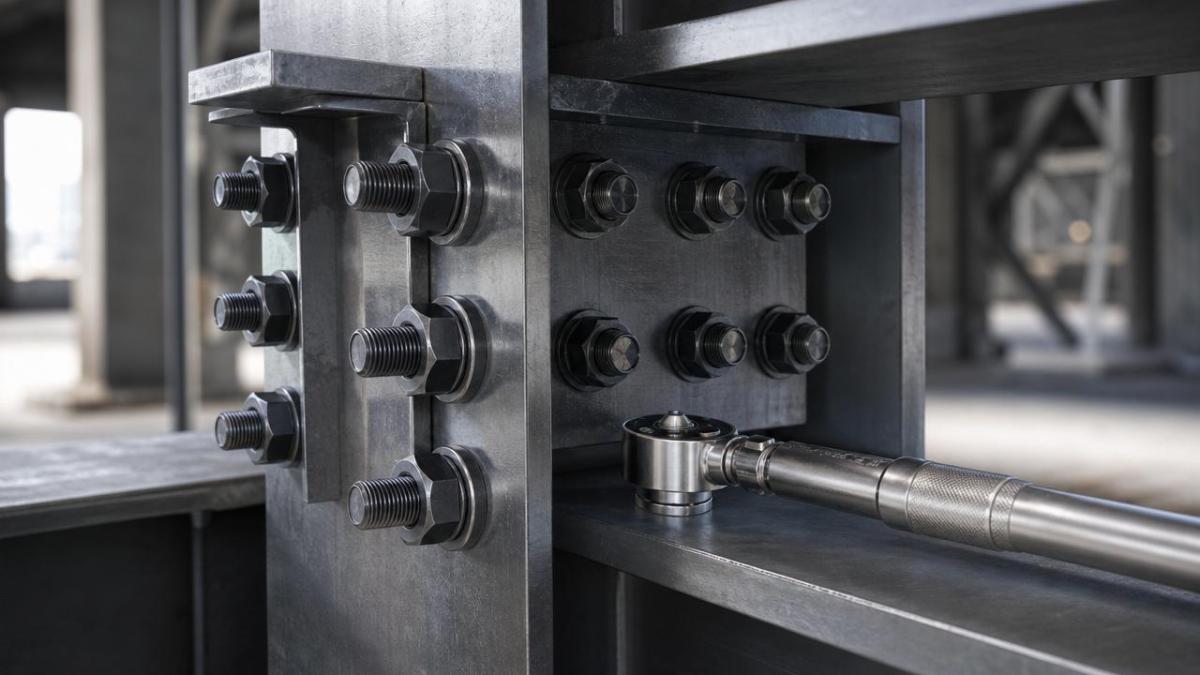
High strength bolts are designed to generate controlled clamping force, resist slip, and maintain joint integrity under static and dynamic loads.
In safety-critical assemblies, the issue is rarely ultimate tensile strength alone. Failure often begins when preload, friction, material condition, or environment changes.
Preload Loss and Joint Relaxation
Preload is the intentional tension introduced during tightening. In many structural applications, it is the difference between a stable friction joint and a slipping joint.
Loss of preload may occur within the first 24–72 hours because of embedment, coating compression, gasket creep, or uneven bearing surfaces.
If the joint was designed as slip-critical, even a 10%–20% preload reduction can increase movement, fretting, noise, and secondary bending.
Improper Installation and Torque Scatter
Torque is an indirect method of estimating bolt tension. Friction under the head and in threads may consume 85%–90% of applied torque.
Two bolts tightened to the same torque can still show very different clamp loads if lubrication, washer hardness, or surface condition differs.
Installation warning signs for inspectors
- Mixed lubricant use across the same connection group.
- Uncalibrated impact tools used for final tightening.
- Washers omitted, reversed, or substituted without engineering approval.
- Final tightening performed before member fit-up is stable.
- No traceable record of tightening sequence, tool setting, or operator.
For quality teams, the practical target is not simply “tight.” It is consistent, verified, and documented bolt tension across the joint group.
The table below links common failure modes of high strength bolts with field indicators and control actions suitable for inspection planning.
The key conclusion is that each risk has a different origin. A visual check alone cannot replace process control, material verification, and installation records.
Material, Process, and Environmental Risks
The performance of high strength bolts depends on steel chemistry, heat treatment, thread forming, coating, storage, and service exposure.
Safety managers should treat bolts as engineered components, not commodity hardware, especially when tensile grades reach 8.8, 10.9, or 12.9 equivalents.
Hydrogen Embrittlement: Delayed and Dangerous
Hydrogen embrittlement is one of the most concerning failure mechanisms because fracture can occur hours or days after installation.
High hardness bolts, acid cleaning, electroplating, corrosion reactions, and inadequate baking can all increase hydrogen-related cracking risk.
For very high strength fasteners, QC plans often include hardness limits, plating process review, bake time verification, and sample testing by batch.
Fatigue Under Vibration and Repeated Load
Fatigue failures develop under repeated stress cycles below the static breaking load. Heavy machinery and transport structures may see thousands of cycles daily.
A crack frequently starts at a stress concentration, such as the first loaded thread, thread root, underhead transition, or corrosion pit.
Good preload control reduces alternating stress in the bolt. Poor preload allows joint separation and sharply increases fatigue demand.
Corrosion, Coating, and Galvanic Compatibility
Outdoor structures face humidity, salt spray, industrial pollutants, temperature swings, and trapped moisture. Corrosion reduces cross-section and damages thread geometry.
Hot-dip galvanizing, zinc flake coatings, mechanical plating, and stainless solutions each affect friction, dimensions, and compatibility differently.
Environmental checks before approval
- Identify exposure category: indoor dry, outdoor mild, marine, chemical, or submerged.
- Confirm coating thickness does not impair thread engagement.
- Check galvanic pairing between bolt, nut, washer, and connected materials.
- Define inspection frequency, commonly every 3, 6, or 12 months.
A strong bolt used in the wrong atmosphere can lose reliability faster than a moderate-grade bolt selected with correct corrosion protection.
Inspection Controls for Quality and Safety Teams
An effective inspection plan for high strength bolts covers receiving, storage, installation, verification, and maintenance, not only final appearance.
The most reliable programs use 5 linked controls: specification review, batch traceability, calibrated tooling, installation supervision, and periodic reassessment.
Receiving Inspection and Traceability
Before bolts reach the worksite, QC staff should verify grade markings, certificates, dimensions, coating condition, and packaging integrity.
For critical projects, a receiving sample plan may check 3–5 pieces per batch for thread fit, markings, and visible coating defects.
Traceability matters when a defect appears later. Heat number, lot number, supplier documents, and installation location should be connected.
Tightening Method Selection
Different tightening methods suit different structures. The choice affects repeatability, inspection workload, operator skill requirements, and documentation quality.
The following table compares common tightening and verification approaches used with high strength bolts in heavy-duty connections.
No method is universally superior. The right method is the one that matches joint design, workforce capability, site access, and verification needs.
Calibration, Tooling, and Operator Discipline
Industrial brushless and pneumatic tools can deliver very high torque, but power without control can damage threads or create uneven preload.
Tool calibration intervals are commonly set at 3–12 months, or sooner when tools are dropped, repaired, overloaded, or used heavily.
A practical site checklist should capture tool serial number, calibration date, target setting, operator name, joint location, and final inspection status.
Procurement Criteria for Reliable High Strength Bolts
Procurement decisions directly influence field safety. Low-cost fasteners with unclear origin can increase inspection burden and lifecycle risk.
For B2B buyers, high strength bolts should be evaluated through 6 dimensions: standard, grade, coating, traceability, testing, and technical support.
Standards and Grade Alignment
Common references include ASTM, ISO, EN, and project-specific structural codes. The standard must match both design assumptions and inspection procedures.
A bolt specified by strength class alone may be incomplete. Nut grade, washer hardness, coating system, and thread tolerance must also align.
Supplier Documentation to Request
For safety-critical orders, documentation should arrive before installation, not after a nonconformance is discovered in the field.
- Material certificate or inspection certificate linked to heat and lot number.
- Mechanical test results, including tensile strength and proof load where applicable.
- Hardness readings with acceptable range for the selected grade.
- Coating declaration, thickness range, and friction condition guidance.
- Packaging, storage, shelf-life, and corrosion prevention instructions.
These records help safety managers connect procurement decisions with installation controls and long-term maintenance planning.
When to escalate to engineering review
Escalation is recommended when bolt grade changes, coating changes, hole conditions are abnormal, or the joint has experienced overload.
Engineering review is also prudent when replacement bolts come from a different standard family, even if nominal diameter appears identical.
Maintenance Strategy and Failure Prevention Workflow
Preventing bolt failure requires a lifecycle workflow. The work begins at specification and continues through inspection, service monitoring, and replacement.
For large facilities, a risk-based schedule can separate critical joints inspected every 3 months from lower-risk joints inspected annually.
A Practical 7-Step Control Workflow
- Classify the joint by consequence: structural, rotating equipment, lifting, pressure boundary, or secondary support.
- Confirm correct high strength bolts, nuts, washers, coating, and lubrication condition.
- Inspect holes, bearing surfaces, member alignment, and contact condition before tightening.
- Apply the specified tightening sequence to avoid uneven clamp distribution.
- Verify preload method using torque audit, angle check, DTI check, or documented tension control.
- Record batch, tool, operator, date, location, and inspection result.
- Schedule follow-up inspection based on vibration, corrosion exposure, and consequence level.
This workflow reduces dependency on individual judgment. It also creates evidence for audits, incident reviews, and preventive maintenance decisions.
Common Misjudgments That Increase Risk
One frequent mistake is assuming higher grade always means safer. Excessive hardness can increase brittleness and hydrogen sensitivity.
Another mistake is replacing a coated bolt with an uncoated bolt, or changing coating without adjusting tightening procedure and friction assumptions.
Safety managers should also be cautious with reused bolts. Threads, coatings, and previous plastic deformation may no longer meet original assumptions.
Building a Safer Fastening Program
High strength bolts protect the hidden load paths of modern structures. Their reliability depends on specification discipline, controlled installation, and measurable inspection.
For quality control personnel, the priority is traceable evidence. For safety managers, the priority is reducing the probability and consequence of joint failure.
SHSS focuses on the steel sutures of industrial civilization, connecting fastening intelligence with practical safety management in construction, industry, and smart infrastructure.
If your project involves heavy structures, vibration exposure, harsh environments, or critical load transfer, review your bolt program before problems appear.
Contact us to discuss high strength bolts, inspection priorities, procurement requirements, or a customized fastening risk-control plan for your application.
Recommended News