
Search News
Industry Portal
Hot Articles
AI-Energy Rules Add Green Entry Test for Fastener Exports
Time
Click Count
On May 8, 2026, four Chinese authorities released an action plan on two-way empowerment between artificial intelligence and energy, and one practical implication is already drawing industry attention: by 2027, industrial hardware used in new power system projects, including high-strength bolts for wind power and aerospace fasteners, is set to face dual certification covering green energy traceability and carbon-efficiency labeling. For exporters, processors, and project suppliers, the issue is no longer only product performance, but whether heat-treatment energy use and related verification documents can meet updated tender requirements in overseas markets.
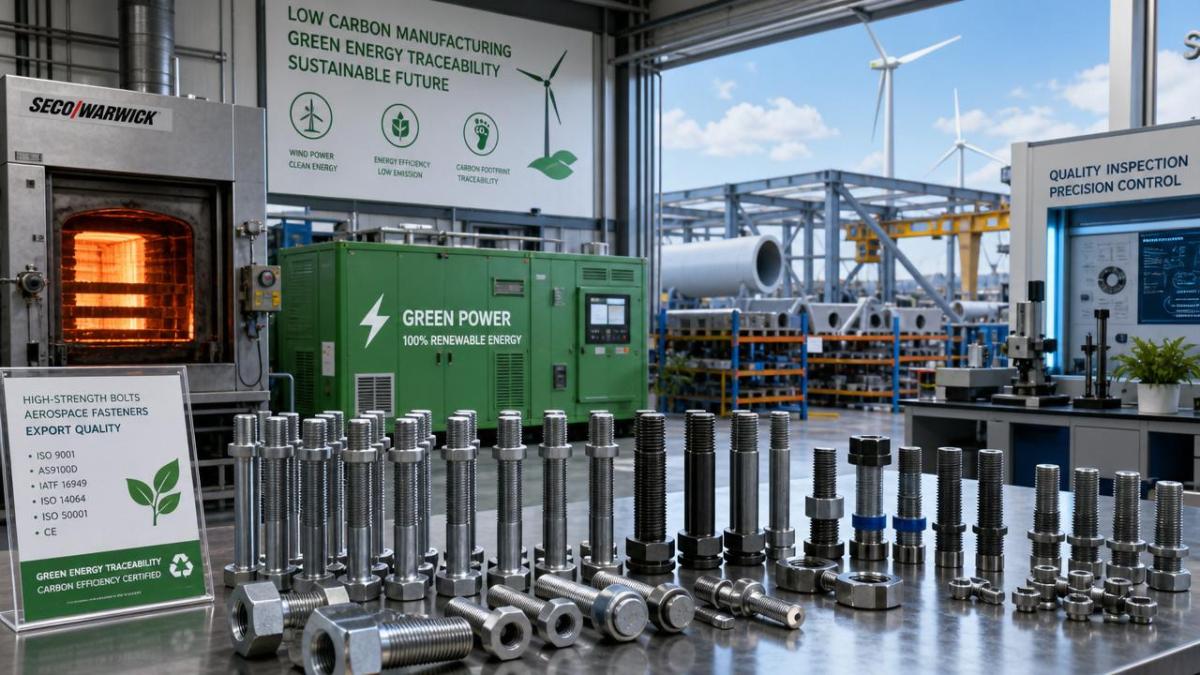
What the new requirement clearly says
According to the information provided, the National Development and Reform Commission, the National Energy Administration, the Ministry of Industry and Information Technology, and the National Data Administration jointly issued the Action Plan on Promoting the Two-Way Empowerment of Artificial Intelligence and Energy on May 8, 2026.
The plan requires that, before 2027, industrial hardware participating in the construction of new power systems implement a dual-track certification mechanism combining green energy traceability and carbon-efficiency labeling. The scope mentioned in the provided information includes high-strength bolts used in wind power and aerospace fasteners.
The same information also states that several large EPC contractors in the European Union have already updated tender technical appendices accordingly. Suppliers are now required to provide third-party verification showing that the share of green electricity used in the heat-treatment process is no less than 65%; otherwise, they lose bidding eligibility.
Where the pressure may appear first in the supply chain
Export suppliers may face a documentation threshold, not only a product threshold
From an industry perspective, companies directly serving overseas EPC projects may be affected first because the updated requirement is tied to tender access. The immediate business impact is likely to center on bid qualification, customer audit preparation, and the ability to present third-party proof for the heat-treatment stage.
Manufacturers with heat-treatment processes may see compliance move into production control
Analysis shows that the requirement touches a specific manufacturing link rather than a general sustainability statement. For fastener and related hardware producers, heat treatment becomes a key compliance point because the green electricity share in that process is explicitly referenced in the provided information. What deserves closer attention is whether production records, electricity sourcing evidence, and certification readiness can support external review.
Procurement and project delivery teams may need earlier supplier screening
For buyers, sourcing teams, and project contractors, the issue is likely to shift upstream into supplier qualification. If a supplier cannot provide the required verification materials in time, the risk may surface during tender submission or delivery planning rather than after the order is placed. This makes supplier file completeness and timeline coordination more important in export-facing business.
What companies should watch now
Track how the policy language is translated into operating rules
The confirmed fact is the release of the action plan and the stated dual-certification direction. Observably, companies still need to watch how this wording is converted into practical certification rules, review procedures, and accepted proof formats in actual business scenarios.
Identify which product lines are exposed first
The provided information specifically mentions industrial hardware used in new power system construction, including wind power high-strength bolts and aerospace fasteners. Companies handling multiple fastener categories may need to distinguish which export products, customers, and project applications are most likely to be checked first under this standard.
Prepare third-party verification materials around heat treatment
Analysis shows that customer requirements are already focusing on a measurable threshold in the heat-treatment link. That means supplier qualification files may need to include not only product and process records, but also evidence tied to electricity sourcing and third-party verification for that specific step.
Separate policy signal from immediate transaction risk
It is more appropriate to understand this as both a medium-term policy direction and an immediate commercial screening issue in some tenders. The policy target points to implementation before 2027, while the tender updates mentioned in the provided information suggest that some market participants are moving faster than the policy deadline itself.
Why this reads as more than a routine compliance update
Analysis shows that the notable point in this development is the connection between industrial policy, energy-use traceability, and export tender access. This is not only about whether a product meets mechanical specifications; it also suggests that process-level energy attributes may increasingly become part of market entry conditions for selected hardware categories.
Observably, the current information does not confirm how broadly the requirement will spread across all markets or all industrial hardware segments. However, it does indicate that for suppliers linked to new power system projects and EU EPC procurement, compliance expectations may begin to move from general environmental claims toward verifiable process data.
How the market may best read this stage
At this stage, the development is best understood as a concrete policy-and-procurement signal rather than a fully settled industry outcome. The confirmed facts already show a clear direction: dual certification tied to green traceability and carbon-efficiency is entering the conversation for industrial hardware, and some overseas buyers have started converting that direction into bid-access conditions.
A neutral reading is that affected companies do not need to assume universal application across every market today, but they do need to treat documentation, third-party verification, and heat-treatment energy structure as practical issues that could influence export eligibility.
Basis of this article
This article is generated based on the user-provided news title, event date, and event summary. The specific official source link was not provided in the input, so it still requires continued verification against original materials.
For this type of development, commonly relevant source categories include official policy releases, tender documents, company disclosures, industry association updates, authoritative media reporting, and standards-related documents. Based on the information provided here, the follow-up points worth monitoring are whether more detailed certification rules are published, how third-party verification is defined in practice, and whether similar tender clauses appear in additional export markets or project categories.
Recommended News