
Search News
Industry Portal
Hot Articles
High-Strength Fasteners: How to Avoid Early Failure in Critical Joints
Time
Click Count
In critical joints, early failure rarely starts with a dramatic overload. More often, it begins with a small gap between design intent and field reality. Even premium high-strength fasteners can lose reliability when preload is uneven, mating materials react badly, coatings change friction, or installation tools drift out of control. In sectors shaped by advanced manufacturing, infrastructure upgrades, and smart-city assets, that gap matters because a single weak joint can trigger vibration damage, leaks, safety incidents, and unplanned shutdowns.
For platforms such as SHSS, where fastening performance sits alongside industrial tools, security systems, lighting hardware, and protective equipment, the topic is not isolated. Fasteners are part of a larger safety chain. They hold together the physical systems that keep factories running, buildings secure, and public infrastructure dependable.
Why early failure remains a major concern
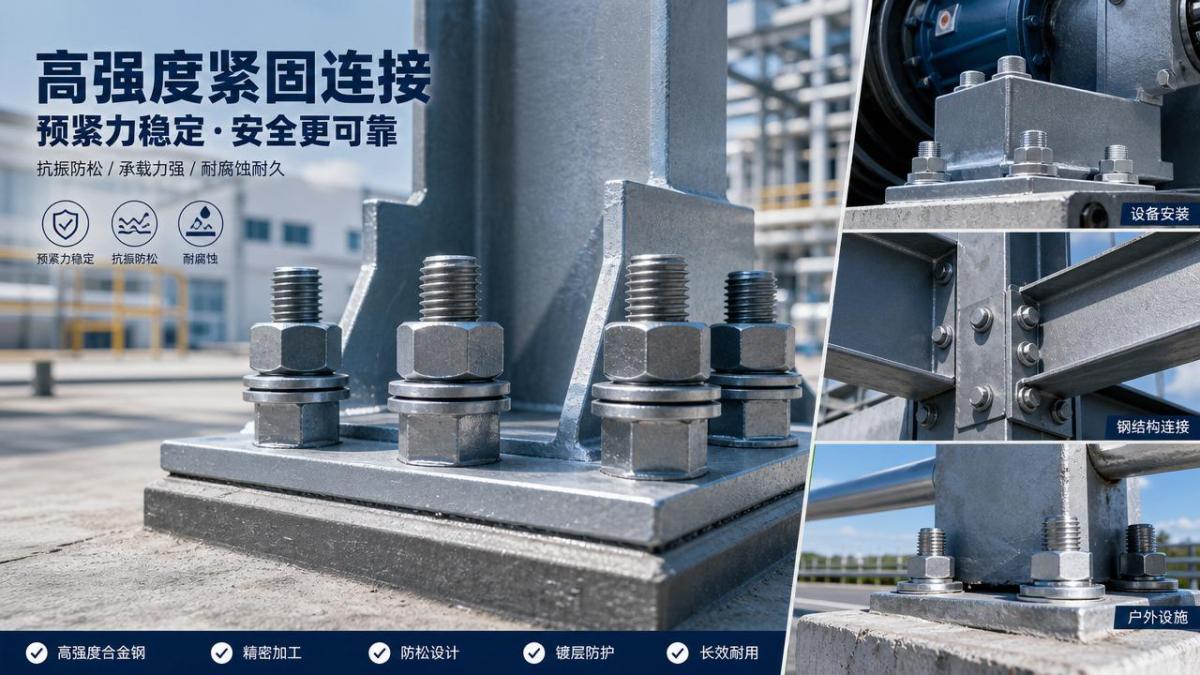
The strongest bolt on paper may still underperform in service. That is why high-strength fasteners deserve closer scrutiny than simple strength grades alone.
A critical joint is expected to transfer load, resist slip, survive vibration, and remain stable over time. In bridges, heavy equipment, access-control enclosures, industrial lighting mounts, and automated production cells, failure is rarely acceptable.
The challenge is that many failures look similar from the outside. A loose nut, a cracked shank, fretting marks, corrosion staining, and stripped threads may all appear late in the chain. The real trigger often sits earlier, during specification, storage, installation, or maintenance.
This is also why the conversation has shifted. The market no longer views high-strength fasteners as simple commodity hardware. In demanding assemblies, they are load-management components, process-sensitive components, and inspection-sensitive components.
What “high-strength” really means in practice
The term usually points to fasteners engineered for high tensile and yield performance through alloy selection, heat treatment, thread rolling, and controlled manufacturing. Common examples include structural bolts, socket cap screws, alloy steel studs, and specialized stainless or titanium fasteners.
But strength is only one part of joint reliability. A critical joint depends on several linked conditions:
- correct clamp load for the applied service load
- stable friction behavior during tightening
- compatible joint materials and surface finishes
- resistance to vibration, heat, moisture, and chemicals
- traceable installation and inspection records
In other words, a high-strength fastener works as part of a system. The bolt, nut, washer, coating, hole geometry, joint stiffness, and tightening method all influence the final result.
The hidden triggers behind premature failure
Some failure causes are obvious, such as using the wrong grade. Others are easy to miss because they develop quietly under routine production conditions.
Preload that is too low or too inconsistent
Insufficient preload allows micro-movement between clamped parts. Once slip begins, vibration can accelerate loosening, enlarge holes, and create fatigue loading in the fastener.
Inconsistent preload across the same joint group is also risky. One bolt may carry far more load than intended, while neighboring bolts contribute less than expected.
Coatings and lubrication that change friction
Zinc flake, hot-dip galvanizing, phosphate finishes, and added lubricants can all change the torque-tension relationship. If tightening values are copied from another finish, the actual clamp load may be far off target.
Material mismatch and galvanic risk
Joining dissimilar metals in humid or conductive environments can accelerate corrosion. Stainless fasteners in carbon steel assemblies, or coated steel bolts in aluminum structures, need careful review of the full corrosion path.
Hydrogen embrittlement and heat effects
Very hard high-strength fasteners can become vulnerable after electroplating or acid cleaning. Delayed brittle fracture may appear after installation, even when the joint initially passes inspection.
Temperature cycling adds another complication. Expansion differences and relaxation can reduce clamp force over time.
Installation drift on the shop floor
Brushless torque tools have improved speed and control, but tool capability still depends on calibration, socket condition, operator sequence, and access angle. A capable tool does not guarantee a capable process.
Where failure risk shows up across industries
The same mechanical principles appear in very different applications. That makes high-strength fasteners a cross-industry issue rather than a narrow hardware topic.
That broad relevance is one reason SHSS treats fastening intelligence as part of operational safety. A failed joint can interrupt not only mechanics, but also access control, lighting continuity, and maintenance safety.
How to evaluate high-strength fasteners before problems develop
Good prevention starts earlier than failure analysis. The most effective reviews happen before the first production batch or before a maintenance shutdown closes.
Check the joint, not only the fastener
Look at load path, hole tolerance, clamped thickness, washer use, hardness differences, and expected vibration. A correct bolt grade cannot rescue a weak joint design.
Confirm finish, lubrication, and tightening method together
Torque values should match the actual coating and lubrication condition. If tension-critical joints are involved, direct tension measurement or angle control may be more reliable than torque alone.
Review certificates, but do not stop there
Material certificates, hardness data, and plating reports matter. So do lot segregation, storage conditions, and evidence that mixed components were not introduced during assembly.
Watch for field signals that appear early
- paint cracking around the joint
- rust staining at the washer edge
- fretting debris between parts
- torque scatter between identical assemblies
- repeated loosening in the same location
These are not minor housekeeping issues. They often point to unstable clamp load or environmental mismatch.
Practical controls that improve joint reliability
Avoiding early failure does not always require a redesign. Many gains come from tighter control of routine decisions.
- Standardize approved fastener assemblies, including nut, washer, finish, and lubricant condition.
- Use calibrated installation tools and verify capability under real access conditions.
- Separate structural, vibration-prone, and corrosion-exposed joints into different control plans.
- Require traceability for critical lots, especially for plated or heat-treated high-strength fasteners.
- Define inspection triggers after maintenance, transport shock, overload, or environmental exposure.
In advanced facilities, these controls are increasingly linked to digital records. Installation data from smart tools, inspection photos, and lot history make failure trends easier to detect before they become incidents.
What deserves attention next
For any operation that depends on critical joints, the next step is not simply buying stronger hardware. It is mapping where joint failure would carry the highest safety, downtime, or compliance cost.
From there, compare actual installation practice against design assumptions. Review preload strategy, coating compatibility, corrosion exposure, maintenance intervals, and traceability depth. That comparison often reveals the first weak link.
High-strength fasteners perform best when they are treated as engineered safety components rather than interchangeable parts. In a world of connected infrastructure, compact power tools, secure physical systems, and resilient industrial assets, that mindset is becoming less optional and more essential.
A useful starting point is a focused audit of the joints that carry vibration, weather exposure, sealing demands, or high consequence of failure. Once those joints are identified, specifications and inspection rules become much easier to sharpen.
Recommended News