
Search News
Industry Portal
Hot Articles
How to verify CE certification for keyless entry systems before purchase
Time
Click Count
A claim that a keyless entry system is CE certified should not be accepted on the basis of a product-page badge, packaging artwork, or a supplier’s email. Before placing an order, the practical test is whether the exact product configuration is supported by a complete compliance file: an EU Declaration of Conformity, relevant technical evidence, correct product identification, and records that match the system you will import, install, and maintain.
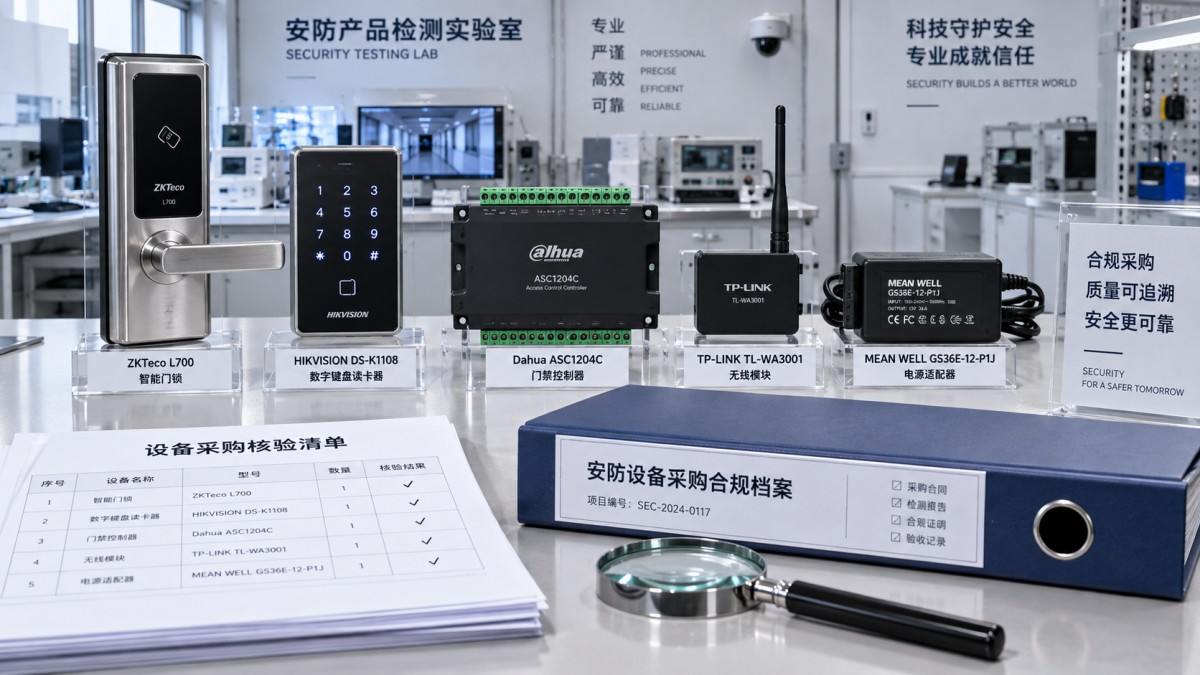
For access hardware, this matters because a “keyless entry system” is rarely one simple device. A typical purchase may include a door controller, reader, keypad, electric lock, power supply, gateway, wireless module, mobile-app connection, and sometimes biometric hardware. CE obligations can differ across those elements. A supplier may have documentation for a standalone reader while the quoted package contains a different radio module, power adapter, or firmware version.
Procurement should therefore treat CE verification as a configuration-control exercise, not a logo check.
Start with the exact system you are buying
Ask the supplier for a quotation or product schedule that identifies each item clearly. Model number, version, power input, wireless interface, included accessories, firmware or software version where relevant, and brand name should all be traceable. This list becomes the reference point for every document that follows.
A wired keypad with a low-voltage controller presents a different compliance profile from a cloud-connected smart lock using Bluetooth, Wi-Fi, RFID, or cellular communications. A biometric terminal may add privacy, data-security, and deployment considerations, even where its CE assessment is focused on the electrical and radio aspects of the equipment. Do not assume that a certificate covering one family member automatically covers every option, enclosure, power supply, or communication module.
Ask one direct question early: Does the CE documentation cover the complete quoted configuration, including the supplied power unit and all built-in radio functions? A clear, document-backed response is more useful than a general statement that the manufacturer is “CE compliant.”
The EU Declaration of Conformity is the central document
For most procurement reviews, the EU Declaration of Conformity (DoC) is the first document to inspect. It is the manufacturer’s formal declaration that the product meets the applicable EU requirements. It is not merely a laboratory certificate, and it should be specific enough to connect the legal declaration to the physical item being purchased.
A usable DoC normally identifies the manufacturer or its authorised representative, the product identity, the relevant EU legislation, the standards or other conformity methods used, the responsible signatory, and the date and signature or equivalent approval. The wording and format may vary, but the document must allow a buyer to answer basic questions: who takes responsibility, for which product, and on what basis?
Compare the DoC against the quotation line by line. Differences in model suffixes deserve attention. A suffix can indicate a change from wired to wireless operation, a different mains adapter, a battery variation, an outdoor enclosure, a camera, or another material change. A declaration titled for a broad product range is not automatically inadequate, but it must define the covered variants in a way that unambiguously includes the product ordered.
A useful procurement rule is simple: if the supplier cannot map the declared model to the ordered model, do not treat the CE claim as verified.
Match the legal scope to the hardware functions
CE marking is not one universal test. It is the visible result of an assessment against EU rules that apply to the product’s functions and risks. The relevant scope depends on the system design.
This is why a generic “CE certificate” is often a weak procurement document. It may not identify the applicable legislation, explain the tested configuration, or show whether the wireless and power functions in the quoted product were included. For smart access equipment, the relationship between hardware version and communication capability is especially important.
Read test reports as evidence, not as a substitute for responsibility
Test reports can be valuable, particularly when they identify the tested model, product photographs, software or hardware versions, test conditions, and standards applied. They help a buyer judge whether the manufacturer’s declaration has a credible technical basis. They do not replace the manufacturer’s DoC, and they should not be reviewed in isolation.
Begin with the report’s product identification. Does it name the same device, module, or platform? Does it show product photos that resemble the proposed unit? Does the report state a different brand, applicant, or factory? Private-label manufacturing can be legitimate, but the documentation must explain the relationship between the testing applicant, the manufacturer, and the brand under which the equipment will be supplied.
Then check the scope. A report for an RFID reader does not necessarily support a reader with added Wi-Fi. A report for a controller does not prove that an included plug-in power supply is covered. A report for a sample using one radio module may not extend to a later production version using another. Procurement teams do not need to reproduce an engineering assessment, but they should be able to identify these mismatches before the purchase order is released.
Pay attention to report dates without treating age alone as decisive. Older evidence can remain relevant where the design is unchanged and the declaration remains valid. The concern is whether the product, its components, and the compliance basis have changed. A supplier that cannot explain version control creates a greater risk than one presenting an older but well-documented file.
Do not confuse CE marking with third-party certification
In many product categories, CE marking is based on the manufacturer’s conformity assessment rather than a universal approval certificate issued by a government or notified body. That does not make it informal. It means the buyer should focus on the manufacturer’s identity, technical file discipline, and evidence supporting the declaration.
Some suppliers use phrases such as “CE approved,” “CE certificate available,” or “CE test passed” as sales shorthand. These phrases may describe part of the evidence, but they are not enough to establish that the finished product placed on the EU market is correctly documented. The stronger question is: Can the supplier provide a signed DoC and technical evidence for this exact product and configuration?
A notified-body number beside the CE mark should also be approached carefully. Its presence can be appropriate in certain conformity-assessment situations, but it is not a general indicator that a product is safer or more compliant. Conversely, its absence does not automatically invalidate a CE-marked access device. The document trail and applicability to the product remain the deciding factors.
Common red flags in smart-access sourcing
- One document for unrelated models: The declaration lists a broad collection of readers, locks, alarms, and controllers without identifying covered variants.
- Brand or factory mismatch: The report belongs to another company and no manufacturing or authorisation relationship is documented.
- Missing wireless scope: A connected lock is supported only by general electrical documentation, with no evidence addressing its radio function.
- Unidentified power supply: The system is offered with a mains adaptor, but the adaptor model and rated input are absent from the compliance package.
- Documentation that looks promotional: A one-page certificate contains logos and product names but no declaration, signatory, legislation, standards, or traceable product identity.
- Late substitutions: A supplier changes the battery, gateway, wireless board, charger, or enclosure after samples are approved without updating the document set.
These issues do not always prove non-compliance. They do show that the buyer lacks a defensible link between the product ordered and the evidence presented. For a project with installation deadlines, acceptance requirements, or resale obligations, that gap can turn into a delivery dispute or a costly replacement exercise.
Build CE verification into the purchasing workflow
The most reliable time to verify documents is before technical approval and before a deposit is committed. Leaving the review until goods arrive makes correction difficult, particularly if products have already been labelled, shipped, or installed.
- Create the configuration register. Record every device, accessory, power unit, radio interface, and option included in the proposed system.
- Request the DoC for each relevant product. Ensure product names and model numbers match the register.
- Request supporting test evidence where the function raises additional risk. Wireless equipment, mains-powered devices, battery products, and complex integrated systems deserve closer scrutiny.
- Check consistency across documents. Compare model, manufacturer, brand, address, photos, electrical ratings, radio functions, and revision information.
- Place document-control requirements in the purchase order. Require the delivered configuration to match the approved file and require notice before substitutions.
- Retain the approved package with receiving records. This helps maintenance, project handover, importer obligations, and future replacement purchases.
For larger deployments, request a production sample or pre-shipment confirmation that shows the final marking, labels, adaptor, and accessories. This is particularly useful when the system is branded for the buyer or assembled from several components. A compliant sample does not protect a project if the delivered batch is materially different.
CE marking is only one part of a purchase decision
A properly documented product can still be a poor fit for the installation. CE verification should sit beside practical checks: door compatibility, fail-safe or fail-secure locking requirements, emergency egress design, ingress protection for outdoor use, power-loss behavior, credential administration, audit-log retention, mobile-app support, local versus cloud operation, cybersecurity maintenance, and spare-part availability.
Biometric access equipment requires an additional decision path. Hardware conformity and personal-data governance are different questions. A reader may be correctly CE marked while a proposed face, fingerprint, or iris workflow remains unsuitable for the organisation’s legal basis, retention policy, user notice, or security architecture. The same separation applies to cloud platforms: device conformity does not assess whether the chosen service arrangement meets the organisation’s data-protection and operational requirements.
SHSS coverage of smart access and biometric security is useful in this broader context because a purchase review should connect compliance documents with the actual boundary being protected. The right system is not simply the one with the most functions; it is the one whose declared configuration, installation conditions, access method, and operational controls all match the site’s requirements.
When the document set is sufficient to proceed
A procurement file is in good shape when the supplier can identify the responsible manufacturer, provide a signed DoC that covers the quoted models, show supporting evidence consistent with the product’s electrical and wireless functions, and maintain traceability when components or firmware change. It should also be clear who will handle documentation, labelling, and product information after import or distribution.
Where those links are missing, the right response is not to accept a generic certificate as a substitute. Pause technical approval until the supplier can provide a coherent file for the exact system. This protects the buyer from a narrow but common failure: purchasing hardware that appears ready for the EU market yet cannot be connected, on paper, to the CE claim used to justify the purchase.
Recommended News