
Search News
Industry Portal
Hot Articles
How to evaluate data center access security systems for critical sites
Time
Click Count
How to Evaluate Data Center Access Security Systems for Critical Sites
A data center does not need a dramatic break-in to suffer a serious physical-security failure. An engineer tailgates through a mantrap during a busy maintenance window. A contractor badge remains active after a project ends. A biometric terminal becomes unavailable after a network change, and the site falls back to a poorly controlled manual process. These are the events that should shape an evaluation of data center access security systems—not a vendor brochure showing a sleek reader beside a glass door.
For critical sites, access control is a chain: identity proofing, credential issuance, door hardware, controller logic, video evidence, alarm response, visitor governance, and recovery during failure. A strong reader cannot compensate for a weak onboarding process. Likewise, an advanced biometric device may add friction and privacy obligations without improving the real threat model. Technical evaluators should therefore assess the full operating system around the door, not simply compare authentication methods.
The right design also depends on what the site is protecting. A small edge facility with infrequent visits has different risks from a colocation hall with continuous vendor access, delivery activity, and tenant segregation. The practical question is not “Which technology is most advanced?” It is: “Can this system reliably prevent, detect, document, and recover from the access events that matter at this location?”
Start with the physical access model, not the reader
Before reviewing products, map how people and materials actually move through the facility. Include the site perimeter, reception, loading bay, telecom rooms, generator and fuel areas, electrical rooms, equipment halls, cages, roof access, and emergency exits. The path taken by a network technician at 2 a.m. may be more revealing than the main visitor route shown during a daytime site tour.
Each zone should have a defined access purpose, approved population, expected traffic volume, required authentication strength, and response expectation when access is denied. A general staff entrance may support a managed card or mobile credential. A restricted room containing core network equipment may justify card-plus-PIN or card-plus-biometric verification. A cage inside a multitenant site may need tenant-specific permissions and a reliable audit trail that can be separated from the operator’s broader access records.
Avoid treating every door identically. Applying the highest-friction method everywhere often causes users to find workarounds: propped doors, shared credentials, informal escorting, or requests to disable alarms. Security controls work best when the level of proof is proportional to the consequence of unauthorized entry.
A useful early exercise is to write down the access events the system must handle without improvisation: a lost credential, an emergency evacuation, a contractor arriving outside approved hours, a failed biometric match, a terminated employee, a controller outage, and a forced-door alarm while the security desk is managing another incident. If the proposed platform cannot make these workflows clear, it is not ready for a critical environment.
Measure identity assurance and resistance to misuse
Credentials answer different questions. A card confirms possession. A PIN confirms knowledge. A biometric factor attempts to confirm a physical characteristic. Combining factors can raise assurance, but only if the enrollment process, device configuration, and exception handling are equally sound.
For conventional badge systems, assess credential technology rather than accepting “proximity card” as a sufficient description. Older, easily copied credential formats may be inappropriate for high-value areas. Ask how keys are managed, how credentials are issued and revoked, whether the reader-controller communications are protected, and how the design resists cloning or replay. A secure credential carried over an insecure connection still leaves an avoidable weakness.
Biometric access can be useful at doors where shared cards, borrowed PINs, or unattended entry are realistic concerns. But a biometric reader should be assessed as a security sensor, not a magic identity guarantee. Vendors should be able to explain their presentation-attack detection approach, the conditions under which it works, environmental limitations, enrollment requirements, and how the device handles false rejects. A face-recognition terminal that performs well in a controlled demonstration may behave differently when users wear glasses, masks, helmets, or protective equipment, or when direct sunlight reaches the entry point.
For iris, facial, fingerprint, or palm-based systems, test real operating conditions. Include low light, bright backlight, shift changes, a range of user heights, wet or gloved hands where relevant, and degraded network connectivity. If a supplier claims rapid recognition or anti-spoofing performance, require a structured acceptance test using the configuration proposed for the site. The useful result is not a headline speed figure; it is a documented decision on whether the device remains accurate and usable in the actual doorway.
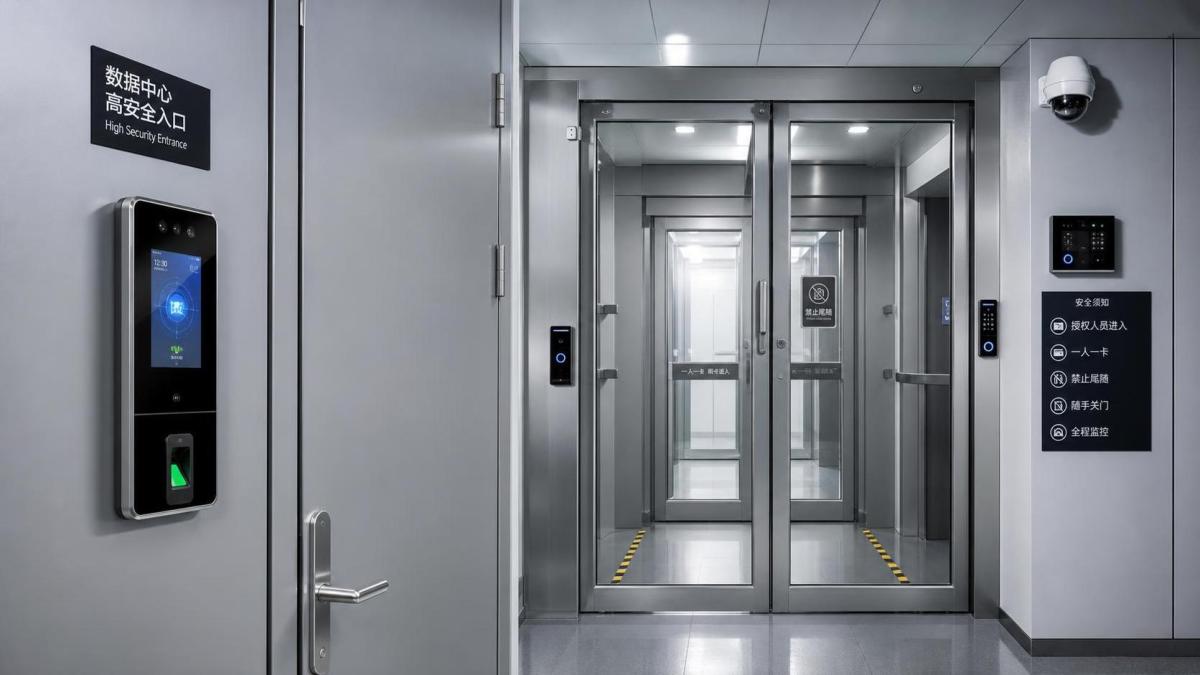
Anti-tailgating deserves separate attention. No reader can determine whether two people entered on one valid credential unless the doorway design adds detection or containment. Depending on traffic patterns and risk, this may involve door-position monitoring, video analytics, turnstiles, interlocking doors, or mantraps. These measures require careful tuning. Excessive nuisance alarms train operators to ignore alerts; insufficient detection creates a false sense of control.
Look beneath the software interface: controllers, locks, and power
Access-control software is highly visible during procurement, but the physical layer determines whether a door behaves safely during disruption. Evaluators should inspect controller architecture, lock selection, power supplies, battery backup, enclosure protection, cabling paths, and the logic used when communications are lost.
The first question is often uncomfortable but essential: what happens when the controller, local network, application server, or power source fails? Doors cannot simply “fail secure” or “fail safe” in the abstract. Life-safety requirements, fire alarm integration, egress rules, local code, door type, and the criticality of the protected room all influence the correct behavior. This decision needs security, facilities, fire/life-safety, and operations stakeholders in the same discussion.
A resilient design commonly keeps enough local authorization data at the edge to allow approved users to enter during a temporary upstream outage, while preserving tamper alarms and event buffering for later synchronization. The exact capacity and behavior should be verified in writing. Ask whether event logs can be altered locally, what happens if controller storage fills, how time remains synchronized, and whether a firmware update can accidentally interrupt access at multiple doors.
Door hardware must also match the opening. A reader and controller cannot overcome a poorly fitted strike, weak hinge arrangement, inadequate frame reinforcement, or a door that staff routinely force closed. In critical infrastructure, the mechanical boundary deserves the same scrutiny as the software. Lock holding force alone is not a complete measure of security; installation quality, latch engagement, monitoring contacts, and maintenance access matter just as much.
Evaluate integration as an operational requirement
Most serious deployments connect access control with video surveillance, visitor management, identity systems, incident management, and sometimes building management platforms. Integration can reduce response time, but it also expands the attack surface and creates dependencies that are easy to underestimate.
The useful test is scenario-based. When a door is forced, can the security operator see the relevant camera view, verify whether someone entered, and create an incident record without switching among several disconnected screens? When a contractor’s work order expires, does access end automatically, or does someone need to remember to remove it? When a user is disabled in the authoritative identity source, how quickly does that change reach the access platform?
Do not accept the word “open” as proof of interoperability. Ask which interfaces are supported, which functions are available through them, whether the integrations are maintained across software versions, and who owns troubleshooting when a connection fails. An API may expose basic unlock commands while omitting detailed alarm states, audit events, or credential lifecycle controls. Those gaps become obvious only after commissioning.
Cybersecurity review should include the access platform itself. Clarify network segmentation, administrative access controls, encryption in transit, certificate management, vulnerability notification practices, remote support procedures, audit logging, backup restoration, and patching responsibilities. A physical-security system increasingly behaves like an operational technology platform with endpoints at every door. It should not be treated as an isolated facilities application.
Biometric data requires governance before deployment
Biometric data changes the evaluation beyond hardware performance. In many jurisdictions, its collection and processing can trigger stricter privacy obligations than ordinary badge identifiers. Requirements may vary by location, employment relationship, purpose of processing, retention practice, cross-border transfer, and whether templates are stored centrally, on the device, or within a credential.
The key technical question is not merely whether the vendor says it stores a “template rather than an image.” Evaluators should establish what data is captured, how it is transformed, where it resides, whether it can be exported, how deletion is verified, who can access it, and what happens when a person leaves the organization. Legal and privacy teams should review the proposed workflow before enrollment begins, particularly for facilities operating across regions.
There should also be a workable alternative path for users who cannot use a particular biometric method or decline where an alternative is required or appropriate. A fallback process should not quietly become a lower-security loophole. It needs its own approval rules, event logging, periodic review, and clearly assigned ownership.
Use a weighted evaluation, but keep site risks visible
A scoring matrix helps procurement teams compare proposals, especially when different stakeholders prioritize different outcomes. It should not replace engineering judgment. The matrix works best when it is built from site-specific scenarios and supported by demonstration evidence, configuration documents, integration details, and maintenance commitments.
Insist on a pilot or acceptance plan that reflects the intended deployment rather than a showroom demonstration. Test permissions during network disruption, emergency release behavior, denied-entry workflows, tailgating alarms, visitor expiry, controller replacement, and restoration from backup. Include facilities technicians and security operators, because they are the people who will manage alarms, replace hardware, and make decisions during an outage.
The best system is maintainable after the project team leaves
A technically impressive platform can become a liability if only the installer knows how it works. During evaluation, examine administrator training, documentation quality, spare-part availability, firmware management, licensing dependencies, support escalation, and the ability to export records if the organization changes vendors. Clarify whether future door additions, tenant changes, or biometric enrollment growth require new infrastructure or unexpected licensing steps.
This is where a broader smart-hardware view is valuable. Secure access is not merely an IT purchase: it depends on reliable electronics, durable enclosures, correctly selected fasteners, stable power, appropriate lighting around recognition points, and safe working practices during installation and maintenance. A system designed only around software features can overlook the physical details that determine whether it remains dependable in service.
When evaluating data center access security systems, prioritize evidence over promises. Ask vendors to demonstrate the difficult conditions, document the failure states, and show exactly how identity, access, alarms, and records remain controlled over the system’s life. The final decision should leave the site with fewer unverified assumptions—not simply more devices mounted beside the doors.
Recommended News