
Search News
Industry Portal
Hot Articles
Fastener Specification Standards in Europe: Key Rules That Affect Compliance
Time
Click Count
Why do fastener specification standards in Europe matter so much in daily compliance work?
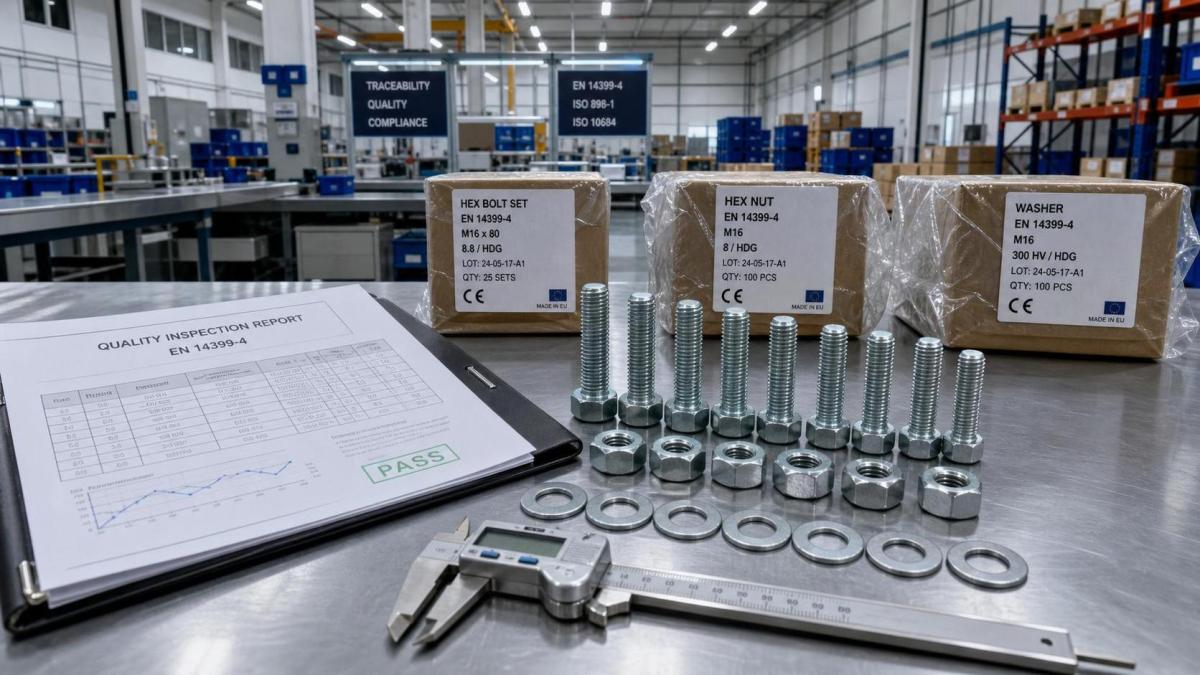
A single bolt rarely looks risky on its own.
Yet in European projects, one mismatch in grade, coating, or documentation can stop installation, fail inspection, or expose a safety system.
That is why fastener specification standards Europe remain central in construction, industrial assembly, energy equipment, rail, and smart infrastructure.
The issue is not only mechanical strength.
It also involves traceability, harmonized standards, CE-related obligations in certain assemblies, corrosion performance, and proof that the supplied part matches the approved design.
In practice, European compliance depends on a chain.
Material selection affects strength.
Heat treatment affects toughness.
Surface finish affects corrosion behavior.
Marking and test certificates affect acceptance.
This is exactly the kind of cross-discipline issue SHSS often tracks across hardware, safety systems, and urban infrastructure.
Fasteners may be small, but they act like load-transfer points for larger systems that cannot tolerate ambiguity.
When people search fastener specification standards Europe, what standards are they usually trying to identify?
Most searches are not asking for one master rule.
They are usually trying to sort out which standard governs which property.
A common starting point is the DIN, EN, and ISO relationship.
DIN is the German standards body.
EN refers to European standards.
ISO covers international standards.
Many fasteners now appear as DIN EN ISO documents, which signals alignment across systems.
Then the question becomes more specific.
Is the concern dimensions, mechanical properties, coating, structural use, or inspection evidence?
The table below helps separate these issues.
A useful habit is to stop asking for “European standard fasteners” in general.
Ask instead which exact performance claim must be proven.
Which rules affect compliance before the fastener even reaches site?
Many failures start upstream, long before installation.
A purchase order may call for an M12 bolt, but omit property class, coating type, or certificate level.
That gap is enough to create nonconforming supply.
In fastener specification standards Europe, pre-delivery control usually depends on five checks.
- Exact designation: thread, diameter, pitch, length, head style, and product standard.
- Mechanical class: for example 8.8, 10.9, or stainless categories with different performance expectations.
- Base material and finish: carbon steel, alloy steel, A2, A4, zinc flake, hot-dip galvanizing, or special coatings.
- Inspection evidence: commonly EN 10204 2.2, 3.1, or project-specific reporting.
- Batch traceability: heat number, production lot, manufacturer marking, and packing identity.
It also helps to confirm whether the fastener is a component or part of a certified assembly.
For structural bolting sets, bolts, nuts, and washers are often treated as a system.
Mixing approved and unapproved parts can break compliance, even when each piece looks correct in isolation.
That detail gets missed often in industrial projects with multiple suppliers.
How do structural and non-structural fasteners differ under European rules?
This is one of the most important distinctions.
Not every bolt in Europe faces the same compliance burden.
For ordinary machinery covers, cable trays, lighting enclosures, or service brackets, dimensional and material conformity may be the main issue.
For steel structures, bridges, towers, or critical supports, the rules become stricter.
EN 14399 usually applies to high-strength structural bolting assemblies designed for preloading.
EN 15048 generally covers non-preloaded structural bolting assemblies.
The difference is not academic.
Preloaded systems depend on defined tightening behavior, assembly testing, and compatible components.
Using a standard commercial bolt where a preloaded assembly is required can create legal and technical exposure.
A quick field check can help.
If the connection is expected to resist fatigue, slip, vibration, or dynamic load, ordinary catalog substitution is rarely acceptable.
That principle also matters in smart-city equipment.
Lighting poles, security housings, access-control gates, and roadside cabinets may appear secondary, yet they still face wind, vibration, and public safety demands.
SHSS often treats these as system-risk questions, not just hardware questions.
Where do teams usually make mistakes with fastener specification standards Europe?
Most compliance problems are not caused by rare metallurgy issues.
They come from ordinary assumptions.
One common mistake is treating DIN numbers as always current.
Some older DIN references remain popular in trade language, but the valid purchasing reference may now be an EN or ISO version.
Another mistake is reading strength class without checking coating risk.
High-strength fasteners can face hydrogen embrittlement concerns after certain electroplated finishes.
That matters in safety-related or vibration-loaded assemblies.
A third problem is certificate overconfidence.
A document alone does not prove the delivered lot matches the tested lot.
Marking, packaging identity, and receiving inspection still matter.
There is also a subtle documentation issue.
Some project files specify torque values but never link them to lubrication state, washer type, or assembly standard.
That makes repeatable tightening almost impossible.
When reviewing fastener specification standards Europe, it helps to flag any requirement that cannot be verified at receiving, during installation, and during audit.
What is the most practical way to judge compliance during sourcing and inspection?
A workable method is to treat compliance as a three-layer test.
First, confirm the product standard.
Second, confirm the performance standard.
Third, confirm the evidence trail.
That sounds simple, but it creates discipline.
This approach works well across mixed sectors.
It fits heavy steelwork, machine fastening, outdoor lighting structures, and security installations where hardware integrity supports broader operational safety.
So what should be reviewed next if compliance still feels uncertain?
Start with the actual connection, not the catalog page.
Identify load type, environment, service life, inspection route, and whether the fastener belongs to a regulated assembly.
Then compare that need against the exact standard reference, class, coating, and document package.
For many teams, the best improvement is not a new supplier.
It is a clearer internal specification template.
That template should capture standard number, revision, property class, finish, certificate requirement, marking rule, and installation notes.
Fastener specification standards Europe are manageable once they are broken into verifiable checkpoints.
The deeper lesson is that compliance is rarely about the bolt alone.
It is about how hardware, documentation, and application risk connect inside one system.
Reviewing drawings, purchase language, and incoming inspection criteria together is usually the fastest next step toward fewer surprises and stronger European compliance.
Recommended News