
Search News
Industry Portal
Hot Articles
Zigbee vs Wi-Fi for Smart Door Locks: What Matters Most
Time
Click Count
Zigbee vs Wi-Fi for Smart Door Locks: What Matters Most
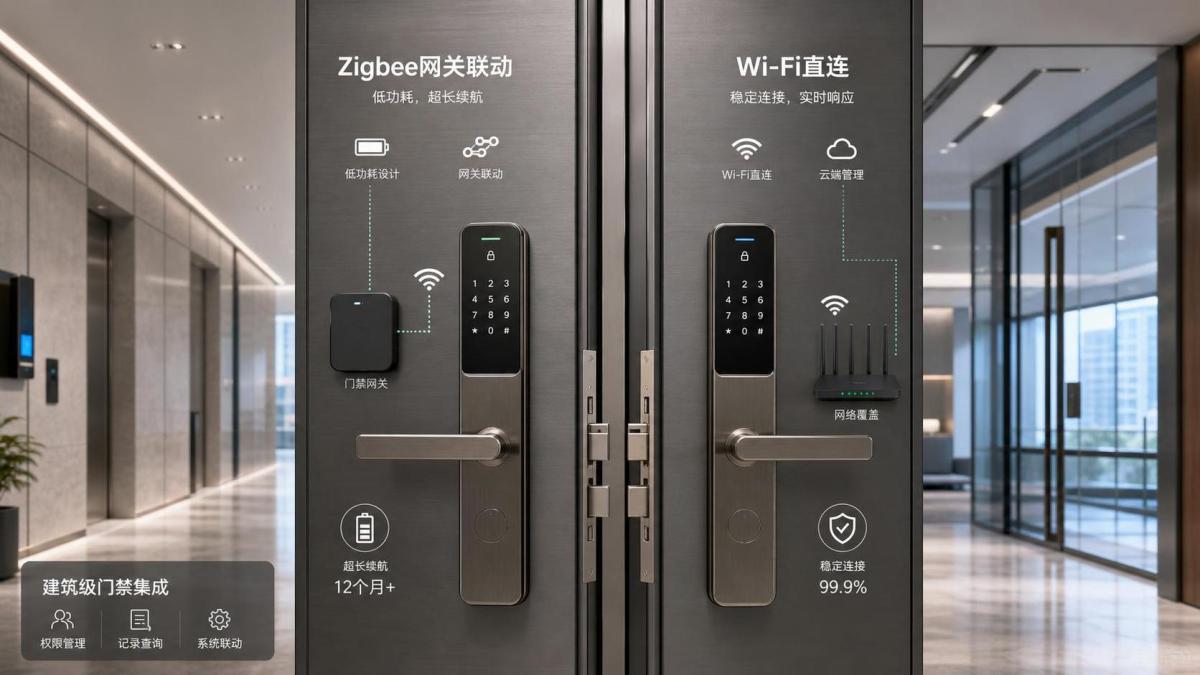
When choosing connectivity for smart door locks, the real question is not range alone.
For most projects, Zigbee or Wi-Fi shapes battery life, uptime, security design, and maintenance effort.
That matters even more in offices, apartments, schools, and mixed-use buildings.
A smart lock is not an isolated gadget.
It is part of a wider access control, safety, and operations system.
In that context, Zigbee often enters the discussion because it was built for low-power device networks.
Wi-Fi, by contrast, benefits from familiar infrastructure and direct internet connectivity.
The best choice depends on deployment scale, credential policy, retrofit limits, and acceptable operational risk.
From a technical evaluation angle, five issues usually decide the outcome.
They are power consumption, network reliability, cybersecurity architecture, response speed, and ecosystem fit.
Why Zigbee Stands Out in Battery-Powered Locks
Battery life is often the first hard filter.
A door lock cannot fail gracefully when power drains too quickly.
That is where Zigbee usually gains an early advantage.
Zigbee was designed for low-data, low-power communication.
A smart door lock mainly sends status updates, credential events, and command acknowledgments.
It does not need the bandwidth profile that Wi-Fi typically supports.
Because of that, Zigbee locks often deliver much longer battery service intervals.
In practical terms, fewer battery replacements reduce labor cost and service disruptions.
This becomes significant across hundreds or thousands of doors.
- Choose Zigbee when lock traffic is light but uptime must remain high.
- Prefer Zigbee in residential portfolios and distributed commercial sites.
- Factor in truck rolls, battery inventory, and staffing availability.
Wi-Fi locks can still perform well.
But they usually demand more careful power management and more frequent battery attention.
If the lock supports wake scheduling and efficient firmware, the gap narrows.
Even so, Zigbee remains the safer default for long-life battery performance.
Network Stability: Direct Wi-Fi vs Zigbee Mesh
Stability is the next issue, and it is more nuanced than people expect.
Wi-Fi offers direct communication with the local network.
That can simplify architecture in small deployments.
However, Wi-Fi congestion is common in dense buildings.
Locks then compete with phones, cameras, laptops, and guest traffic.
That may introduce retries, latency spikes, or intermittent availability.
Zigbee works differently.
It builds a mesh network, where compatible devices relay messages.
That can improve resilience when physical layout blocks a direct path.
In larger properties, Zigbee often scales more gracefully than standalone Wi-Fi locks.
Still, mesh quality depends on network design.
Poor device placement can weaken Zigbee performance.
- Map door locations and wall materials before protocol selection.
- Check interference from 2.4 GHz devices in crowded environments.
- Validate signal behavior during peak occupancy, not quiet hours.
In small homes, Wi-Fi may be perfectly adequate.
In multi-door or multi-floor projects, Zigbee often provides more predictable coverage behavior.
Security Architecture Changes the Decision
Smart lock security is never just about encryption labels.
The bigger question is exposure surface.
Wi-Fi locks frequently connect more directly to IP networks and cloud services.
That can improve remote management.
It can also increase the number of paths that require hardening.
Zigbee usually works through a hub, gateway, or building controller.
This creates a more segmented model.
For many security teams, that central control point is useful.
It supports policy enforcement, logging, credential updates, and network isolation.
That said, Zigbee is not automatically safer.
Security depends on key management, firmware integrity, commissioning practice, and vendor patch discipline.
The stronger signal is this.
Zigbee fits better when segmented access control is part of the design philosophy.
For regulated or security-sensitive sites, Zigbee often aligns better with defense-in-depth planning.
Latency, User Experience, and Failure Behavior
Users judge locks by one moment.
Does the door open quickly and consistently?
Both Zigbee and Wi-Fi can deliver acceptable response times.
But reliability under weak signal, roaming, or network outages matters more than raw speed.
A fractionally faster unlock means little if retries occur during busy entry periods.
Zigbee performs well when the mesh is healthy and the gateway is stable.
Wi-Fi performs well when signal strength and channel planning are clean.
The practical distinction appears during failure conditions.
Ask how the lock behaves if internet service drops.
Ask how cached credentials work during gateway loss.
Ask what local fallback exists if the wireless path becomes unstable.
- Test offline entry scenarios with temporary credentials.
- Measure unlock time during high traffic and interference.
- Review event logs for missed or delayed status updates.
In many buildings, Zigbee earns points because it supports a more controlled local device layer.
That often improves operational continuity when cloud dependence must be minimized.
Integration with Smart Building Systems
A lock decision should not ignore the broader building stack.
This is where Zigbee becomes especially relevant in smart environments.
Many buildings already use Zigbee for lighting, sensors, occupancy logic, or automation workflows.
Adding Zigbee door locks can simplify orchestration across those systems.
For example, an authorized unlock can trigger hallway lighting, audit logging, and HVAC zone activation.
That creates operational value beyond access alone.
Wi-Fi has its own advantage here.
It may fit better when the building strategy is strongly IP-centric and cloud-managed.
Still, integration is not just about protocol labels.
It is about API quality, gateway compatibility, event structure, and lifecycle support.
From a long-term operations view, Zigbee often supports cleaner convergence in mixed smart building deployments.
How to Choose Between Zigbee and Wi-Fi
A simple rule helps.
Choose based on operational priorities, not consumer familiarity.
Zigbee is usually the stronger fit when battery life, mesh resilience, and smart building integration matter most.
It is particularly effective for multi-unit housing, commercial retrofits, and managed access estates.
Wi-Fi makes more sense when direct connectivity, lighter hardware ecosystems, or simpler small-site deployment take priority.
Before final selection, compare these checkpoints.
- Estimate annual battery service hours per 100 doors.
- Review wireless congestion at each installation zone.
- Define local operation requirements during WAN outages.
- Check lock integration with existing gateways or controllers.
- Audit vendor support for firmware, logs, and credential policy.
If the decision still feels close, pilot both options in a real environment.
Track battery drain, unlock consistency, packet loss, and service tickets for at least several weeks.
That evidence usually makes the better choice obvious.
For most scaled smart lock deployments, Zigbee delivers the better balance of endurance, control, and system-level efficiency.
And in access systems, that balance is often what matters most.
Recommended News